Mock Call Script Examples: 7 Full Call Center Samples
By Dave Wilson · 11 min read · Updated 2 October 2026
A mock call script is the skeleton of a mock call: five moments every call passes through, opening, verifying, probing, resolving, closing, with example lines you adapt to whatever the caller actually says. It is not a word-for-word transcript to memorize. The seven customer service script samples below cover the situations mock calls test most often: a billing question, an account balance check, a no-internet call, an angry customer, a cancellation, a missing order, and a demand for a manager.
What is a mock call script?
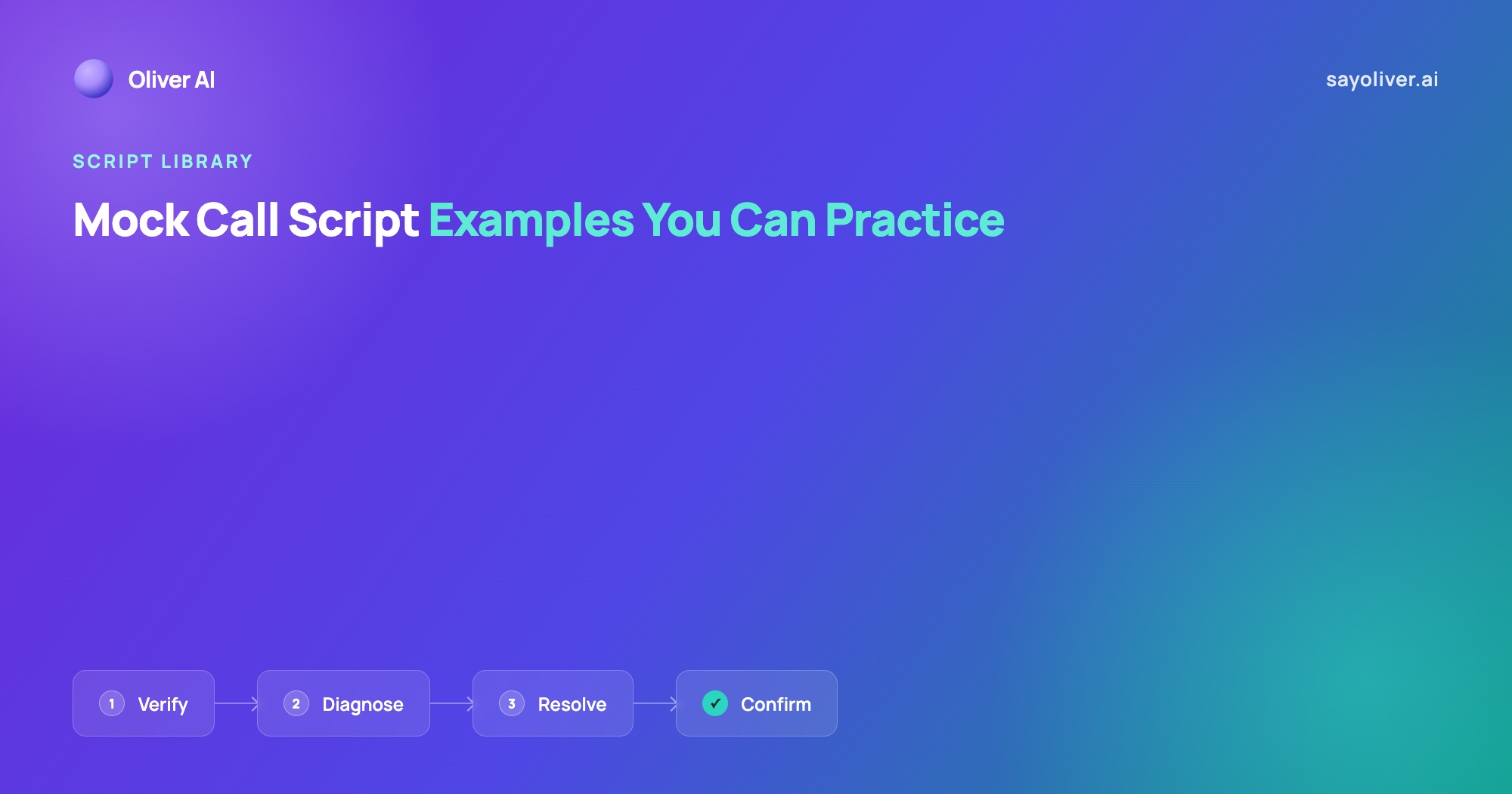
A mock call script is a written skeleton of a customer service call: opening, verification, probing, resolution, and closing, with example phrases for each stage. Trainers and interviewers use it to see how someone handles a simulated call before they take real ones. It is not a word-for-word transcript to memorize. The person playing the customer will not answer exactly as written, so the script is a guide, not a recitation.
The seven samples below are full mock call sample scripts: both sides, start to finish, covering the situations mock calls test most often.
The call flow every mock call script follows
Strip away the specific product or issue and almost every customer service call, and every mock call built to train for one, follows the same five-part shape. Learn the shape and you can adapt to any scenario a trainer or interviewer throws at you, instead of memorizing scripts for situations that never come up exactly as written.
- Opening: greet, give your name, ask how you can help ("Thank you for calling, this is [Name], how can I help you today?")
- Verification: confirm who you are speaking with before discussing account details
- Probing: ask questions until you understand the actual problem, not just the first thing the caller mentions
- Resolution: state the fix and, critically, a specific next step and timeframe
- Closing: confirm the customer understood the next step before ending the call
Practise this script live against an AI customer, free, with no account or card needed.
Practise this script live against an AI customerScript, sample, spiel: what the words actually mean
These three get used interchangeably on a training floor and they are not the same thing, which matters when a trainer asks you for one specifically.
- A spiel is the fixed wording you are expected to say more or less verbatim: the opening greeting, the verification request, the hold, the closing. Accounts often mandate these, and they are the only part you should memorize. There are opening spiels by account type, and hold, transfer and dead-air spiels for the moments in the middle of a call.
- A script is the five-part flow plus example phrasing for each stage. It is a structure to internalise, not lines to recite.
- A mock call sample is a worked example of a whole call, both sides, start to finish. That is what the seven below are, and it is what people usually mean when they ask for a "mock call sample script".
7 mock call script examples
Each sample below follows the same five-part flow with lines adapted to the scenario. Every agent line is tagged with its stage, using the same names as the grading table further down, and each script ends with the line where candidates most often lose the mark. Read them for the shape and the specific phrases, not to memorize word for word. If the account you are interviewing for is telco, there are six telco-specific scripts with the jargon and the upsell phase that account type expects.
Billing question
Agent [Opening]: "Thank you for calling, this is Jordan, how can I help you today?" Customer: "Hi, I was charged twice this month and I am not sure why." Agent [Verification]: "I am sorry for the confusion, let me pull up your account. Can I confirm your name and the last four digits of the card on file?" Customer: "Maria Santos, and the card ends 4417." Agent [Probing]: "Thank you, Maria. I can see two charges, on the 4th and the 6th. Did you get an email on the 4th saying a payment had failed?" Customer: "I think so, yes." Agent [Resolution]: "That explains it. The first payment was flagged as failed and retried automatically, but both went through. I am refunding the duplicate now, you will see it back in three to five business days, and I am flagging your account so it does not happen again. Does that work?" Customer: "Yes, that is fine." Agent [Closing]: "So that is the duplicate refunded, back on your card in three to five business days. Is there anything else I can help you with today?" Where candidates lose the mark: promising the refund with no timeframe. "I will refund it" scores lower than "three to five business days".
Account balance inquiry
Agent [Opening]: "Thank you for calling, this is Carla, how can I help you today?" Customer: "Hi, I just need my current balance. Quick one." Agent [Verification]: "I can get that for you. Before I open the account, may I have the full name on it?" Customer: "Mark Reyes. Can you not just look it up from my number?" Agent [Verification]: "Your number gets me to the account, Mark, but I still need to confirm it is you before I read out anything on it. That protects your account too. Can I have your date of birth and the last four digits of your account number?" Customer: "March 14, 1994. Account ends 2208." Agent [Verification]: "Thank you, that all matches." Agent [Resolution]: "Your current balance is $184.20, due on the 20th. Your last payment, $96.50, posted on the 5th." Customer: "Okay, that is what I needed." Agent [Closing]: "To recap, $184.20 due on the 20th. Is there anything else I can help you with today?" Where candidates lose the mark: confirming the balance, or even that the account exists, before verification is complete. "Let me check, yes, I can see your account" already gives something away.
No internet connection
Agent [Opening]: "Thank you for calling, this is Liza, how can I help you today?" Customer: "My internet has been down for two hours and I have a work meeting at three." Agent [Verification]: "I am sorry, that is bad timing. Can I confirm the account holder's name and the service address so I can check your line?" Customer: "Joel Garcia, 22 Sampaguita Street, Quezon City." Agent [Probing]: "Thank you, Joel. Are the lights on your modem normal, or is one of them red?" Customer: "They all look normal. My laptop says connected, no internet." Agent [Probing]: "That helps. I am running a line test on your modem now. It takes about twenty seconds, so if it goes quiet, I am still here with you." Agent [Hold]: "The test shows your modem is fine but no signal is reaching it, so this is not your WiFi. I need to check for network work in your area, which takes about two minutes. May I place you on a brief hold?" Customer: "Go ahead." Agent [Resolution]: "Thank you for holding, Joel. There is an outage in your area since 12:40, and the repair team expects service back by 4pm. I have linked your account to the outage ticket, reference 6610385, so you get a text the moment it is restored. For your three o'clock meeting, joining from your phone on mobile data is the quickest option today." Customer: "Okay. Not great, but okay." Agent [Closing]: "I understand. To recap: area outage, fix expected by 4pm, a text when it is back, reference 6610385. Is there anything else I can help you with?" Where candidates lose the mark: going silent while the line test runs, or putting the caller on hold without asking and without saying how long. Both count as dead air. For a longer version with modem troubleshooting and a technician visit, see the full no-internet telco script.
Angry customer / complaint
Agent [Opening]: "Thank you for calling, this is Sam, how can I help?" Customer: "This is the third time I have called about the same issue and nobody has fixed it!" Agent [Probing]: "I hear you, and I am sorry you have had to call about this three times. That should not have happened. Can you walk me through what has happened so far so I have the full picture?" Customer: "I reported it on the 2nd, someone promised a callback, nothing. Then again last week." Agent [Verification]: "Thank you for laying that out. So I can see those earlier contacts, can I confirm your name and account number?" Customer: "Lena Cruz, 30018842." Agent [Resolution]: "Thank you, Lena. I can see both contacts, and the callback was never logged. Here is what I am doing differently this time: I am escalating this directly to our specialist team today, and I am personally calling you back tomorrow by 2pm with an update, whether or not it is fully resolved by then." Customer: "Fine, but I have heard that before." Agent [Closing]: "That is fair. My reference for this is 4417092, so if you do not hear from me by 2pm you can quote it to anyone here. Does that timeline work for you?" Where candidates lose the mark: starting verification before acknowledging the repeat contact. The first line after the complaint has to own the three calls, or the rest of the call starts from behind.
Cancellation request
Agent [Opening]: "Thank you for calling, this is Alex, how can I help you today?" Customer: "I want to cancel my subscription." Agent [Verification]: "I can help you with that. First, can I confirm the name and mobile number on the account?" Customer: "Tom Villanueva, 0917 555 0142." Agent [Probing]: "Thank you, Tom. Before I process it, can I ask what prompted the decision? If it is something I can fix I would rather do that, and if not I will get it cancelled straight away." Customer: "I am just not using it enough to justify the price." Agent [Resolution]: "That is a fair reason. Two quick options and then I will action whichever you prefer: I can move you to the lower tier at half the price, or I can pause the account for three months so you keep your history without paying. If neither fits, I will cancel now and there is no fee either way." Customer: "Pause it, actually. Three months." Agent [Closing]: "Done, paused from the end of this billing period, restarting automatically in three months, and I will email you a reminder a week before. Reference 5520118. Anything else?" Where candidates lose the mark: pushing a second retention offer after the caller says no. Make one offer, then cancel if they still want to; a hard sell reads as not listening.
Missing order or delivery
Agent [Opening]: "Thank you for calling, this is Dani, how can I help?" Customer: "The tracking says my order was delivered yesterday. It is not here." Agent [Verification]: "I am sorry, that is a bad one. Let me check the delivery record. Can I confirm your name and the order number or the delivery postcode?" Customer: "Ben Okafor, order 88214." Agent [Probing]: "Thank you. I can see it was marked delivered at 2:40pm with no photo and no signature, which is not what should happen. Before I raise it, have you been able to check with anyone else at the address or a neighbour?" Customer: "Yes, I asked both. Nothing." Agent [Resolution]: "Then I am treating this as a non-delivery rather than sending you chasing it. I am sending a replacement on next-day delivery at no cost, and raising an investigation with the courier separately so you are not waiting on their answer." Customer: "Okay, thank you." Agent [Closing]: "You are welcome, Ben. Replacement tomorrow, tracking by email tonight, and your reference is 7719043. Is there anything else I can help with today?" Where candidates lose the mark: telling the caller to wait 48 hours or chase the courier themselves. Assessors want to hear you own the fix.
"Let me speak to your manager"
Agent [Opening]: "Thank you for calling, this is Rico, how can I help?" Customer: "I do not want to explain this again. Put me through to a manager." Agent [Verification]: "I can arrange that. Before I do, so my manager is not asking you to start from the beginning, can I confirm your name and account number and take thirty seconds to read what is on the account?" Customer: "Fine. Aira Mendoza, 7730215. Thirty seconds." Agent [Probing]: "Thank you, Aira. I can see two previous contacts about the same charge and a promised credit that was never applied. Is that the issue?" Customer: "Yes. Exactly that." Agent [Resolution]: "Then I can apply that credit myself right now, which is faster than a transfer. If you would still like to speak to a manager afterwards I will put you through, and I will brief them first so you do not repeat any of this. Shall I apply the credit while we are on the call?" Customer: "Yes, do it." Agent [Closing]: "Done, the credit is on your account now and will show on your next bill. Would you still like me to put you through to my manager?" Where candidates lose the mark: transferring straight away without reading the account, or refusing the transfer outright. Offer the transfer and the faster fix, then let the caller choose.
Practise this script live against an AI customer, free, with no account or card needed.
Practise this script live against an AI customerPositive scripting: what to say instead
Positive scripting means telling the caller what you can do rather than what you cannot. Assessors listen for it at every stage, and a flat "I can't" at the resolution stage is one of the easiest marks to lose. Each line on the left is something candidates really say under pressure; the line on the right does the same job without the refusal.
| Stage | Instead of | Say |
|---|---|---|
| Opening | "What is the problem?" | "How can I help you today?" |
| Verification | "I can't tell you anything until you verify." | "So I can open your account, may I have your full name and date of birth?" |
| Probing | "You must have entered it wrong." | "Let us check what was entered together." |
| Hold | "Hold on." | "May I place you on a brief hold for about two minutes while I check that?" |
| Resolution | "I can't waive that fee." | "What I can do is split that fee across your next two bills." |
| Closing | "Is that all?" | "Is there anything else I can help you with today?" |
What a mock call script is graded on
Whether it is an interview or a nesting assessment, the marking is more predictable than most candidates expect. The right-hand column is the version that actually loses points.
| Stage | What earns the mark | What loses it |
|---|---|---|
| Opening | Brand, your name, an offer of help, unhurried | Rushing it, or sounding read rather than said |
| Verification | Identity confirmed before any account detail | Quoting a balance or charge before verifying |
| Empathy | One line acknowledging the problem, then progress | Three apologies stacked, or none at all |
| Probing | Questions that find the real problem | Fixing the first thing the caller mentioned |
| Hold | Asks permission, says why and for how long, thanks the caller on return | Silence while the system loads, or a hold with no reason given |
| Resolution | A specific action, a timeframe, a reference number | "I have escalated it" with no timeframe |
| Closing | Recap, confirm understanding, branded sign-off | Hanging up the moment the issue is solved |
Practise this script live against an AI customer, free, with no account or card needed.
Practise this script live against an AI customerWhy a script does not survive contact with a real caller
Every script above assumes the customer answers roughly the way the example shows. Real callers do not. They interrupt mid-sentence, answer a different question than the one you asked, or stay angry past the point where the script expects them to calm down. The script is not wrong for that, its job is to give you the flow and the phrases, not to predict the conversation.
Most interviewers will not hand you a script at all. You get a one-line scenario, such as "a customer is calling about a late fee", and you run the same stages from memory: opening, verification, probing, resolution, closing. For that late fee, one line can acknowledge, empathise and reassure at once: "I can see why a fee you were not expecting is frustrating, and I will go through it with you now." There is more on what to say in a mock call when you have no script.
The skill that actually gets tested in a mock call is what you do when the caller goes off-script, not whether you can recite the opening line. Practise these exact scripts against an unpredictable AI customer, get a transcript and score back, and you will find out where you actually go blank before it happens on a real call, or a real interview.
Frequently asked questions
What is an example of a positive scripting spiel?
Positive scripting tells the caller what you can do instead of what you cannot. Instead of "I can't waive that late fee," say "What I can do is split that fee across your next two bills so it does not land all at once." The policy is the same, but the caller hears an option instead of a refusal.
Does a mock call have a script?
Usually, yes, in the sense of a five-part flow, opening, verification, probing, resolution, closing, with example lines. It is rarely a strict word-for-word transcript, because the trainer or interviewer playing the customer will not answer exactly as written, so the script is a guide, not a recitation.
Is there a mock call script specifically for customer service?
Yes, the seven scripts on this page are written for general customer service, billing, an account balance check, a no-internet call, an angry customer, a cancellation, a missing order, and a manager escalation, which covers most training and interview scenarios. If your account is a specific industry, retail, financial, telco, or health care, the account-specific scripts linked below add the vocabulary and compliance rules those accounts grade differently.
What questions are asked in a mock call?
The person playing the customer usually gives you a name, a problem, and enough detail to make the scenario realistic, then answers your questions the way a real caller would, sometimes cooperatively, sometimes with pushback or frustration built in on purpose to see how you handle it.
What is a mock call script?
A mock call script is a written skeleton of a customer service call, opening, verification, probing, resolution, and closing, with example phrases for each stage, used to train or evaluate how someone handles a simulated call before they take real ones.
How do I practise mock calls?
Say the script out loud rather than reading it silently, practise against someone (or something) that pushes back instead of a fully cooperative customer, and pay attention to the specific moment you lose your composure or forget the flow, since that is the part worth repeating.
What is a mock call sample script?
A sample script is a worked example of an entire call, both the agent and the customer, from the greeting to the close, rather than just the phrases you are meant to say. The seven above are samples in that sense. They are more useful than a list of lines because you can read both parts aloud and hear where the call would realistically stall.
What is the AER method for a mock call?
AER stands for Acknowledge, Empathize, Resolve: acknowledge what the customer said, empathize with how they feel about it before defending or explaining, then move to resolving the actual issue. It is a simple structure for the probing and resolution stages of almost any customer service script.
Can I see a full mock call example, not just lines?
Yes, the seven samples on this page are full examples, both the agent and the customer side, from the opening greeting to the close, not just a list of phrases. Read them for the shape and the pacing, then say each one out loud, since a mock call example only teaches you something once you hear yourself say it under a bit of pressure.
A script is worth exactly as much as your ability to depart from it and still land the call. Memorizing the seven samples above word for word will not get you through a real mock call, saying them out loud enough times that adapting mid-sentence feels normal will. Practise the flow, not the transcript.
See it in Oliver
Ready when you are
Practise before the next real conversation.
No sign-up required. Pick the scenario, add your name, and speak with a realistic AI partner. Get a scorecard and transcript after every call.