Mock Call Script for a Health Care Account: 6 Full Examples
By Dave Wilson · 14 min read · Updated 11 September 2026
A mock call script for a health care account is a practice dialogue for a caller who is a patient or plan member, not a customer. Three things separate it from a generic customer service mock call: verification is a compliance step rather than a courtesy, you are expected to use payer vocabulary correctly, and you are never allowed to give medical advice. The six scripts below cover the calls health care accounts actually test.
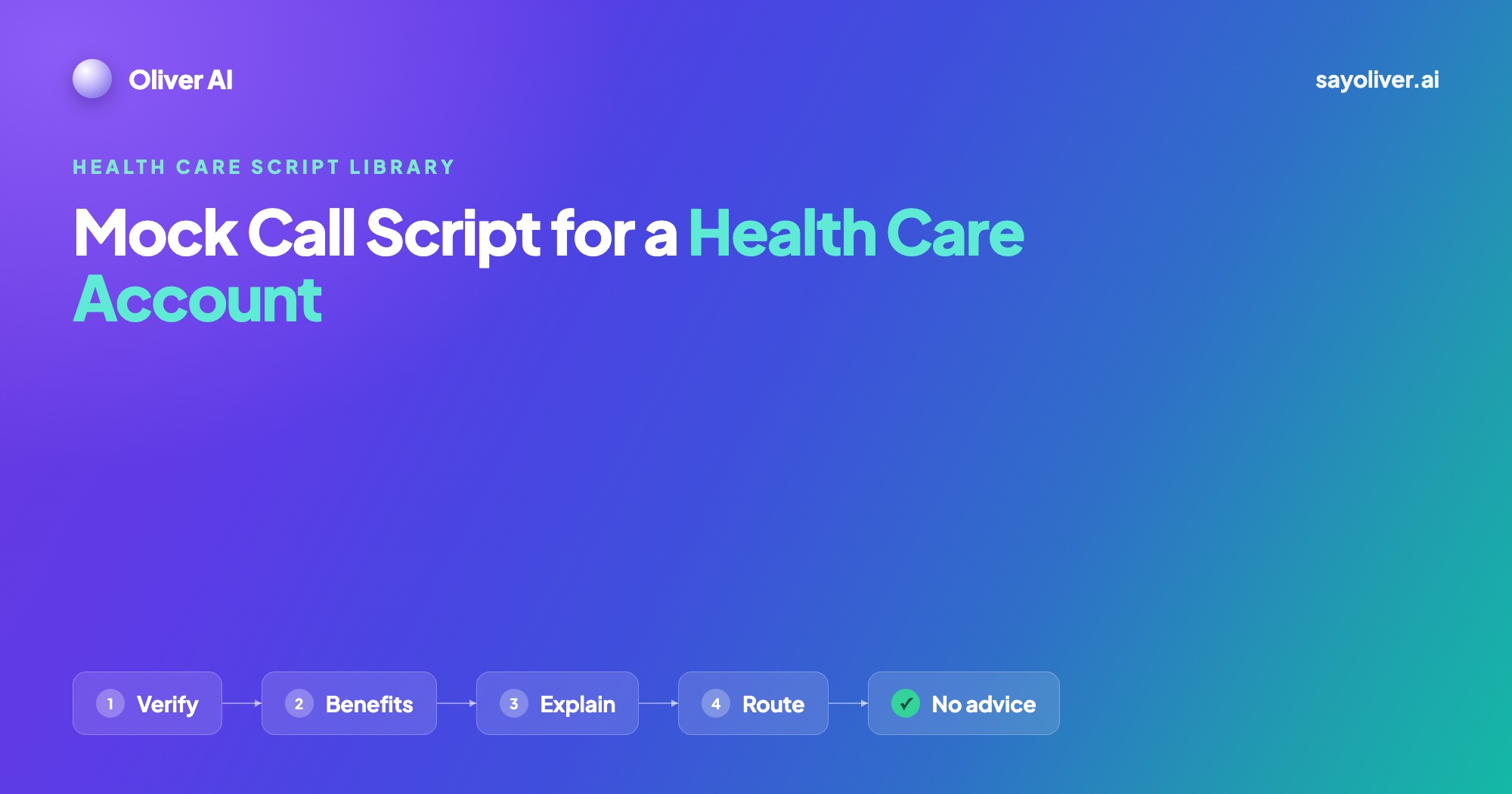
How a health care mock call differs from a generic one
If you want the account-agnostic version first, the five-part flow every mock call follows has six worked scripts on its own page. This one assumes you have been told your account is health care, which in a BPO usually means a US health plan, a provider group, or a pharmacy benefit manager.
The call shape is the same. What changes is what a mistake costs. On a retail account, saying the wrong thing annoys a customer. On a health care account, saying the wrong thing can be a privacy breach or a caller acting on advice you were not qualified to give, which is why assessors mark this account type harder and why two of the failures below are instant, not deducted.
| Generic customer service | Health care account | |
|---|---|---|
| Why you verify | To protect the account | Compliance. Discussing anything before verifying is a breach |
| What you verify with | Name, email, last four of the card | Member ID, full name, date of birth, sometimes address or group number |
| How much you disclose | Whatever helps | Only what the caller needs for this request |
| Vocabulary expected | Order, refund, ticket | Copay, deductible, coinsurance, prior authorization, EOB, formulary, in-network |
| Advice you can give | Product advice freely | Nothing clinical. Ever. Route to a nurse line or the provider |
| Emotional register | Annoyed, occasionally angry | Frightened, grieving, or in pain, on top of angry |
Three things that fail a health care mock call instantly
Most scorecard items lose you points. These three end the assessment, and the third is the one almost nobody prepares for because no script sample online mentions it.
1. Discussing anything before verification
On a health care account this is not a process shortcut, it is a disclosure to someone you have not confirmed is entitled to the information. Saying "I can see your claim was denied" before you have the member ID and date of birth is a fail even if the caller turns out to be the right person. Verify first, every time, including when the caller is upset and pushing you to skip it.
2. Sharing more than the caller needs
The principle is minimum necessary: disclose only the information required for the request in front of you. If someone calls about a pharmacy copay, they do not need to hear the other claims on the account, and reading them out unprompted is a breach. Assessors watch for candidates who over-share to sound helpful, which is a very easy habit to bring across from a retail account.
3. Giving medical advice
You are not clinically qualified and the account will not let you act as if you are. That includes the softer versions that feel harmless: telling someone a dose sounds fine, that a symptom is probably nothing, that they should stop a medication, or that a generic is "the same thing". The correct move is always to acknowledge, decline the clinical question explicitly, and route to a nurse line, pharmacist, or the prescribing provider. There is a worked example below.
Practise a health care call against an AI caller, try it now, no sign-up needed.
Practise a health care call against an AI callerPayer vocabulary you are expected to use correctly
This is the layer that separates a candidate who has worked a health care account from one who has not, and it is what most script samples skip entirely. You do not need to be an expert. You do need to say these without hesitating and without mixing up the three cost-sharing terms, which is the most common slip.
| Term | What it means | What you say on the call |
|---|---|---|
| Member ID | The number identifying the person on the plan | "May I have the member ID from the front of your card?" |
| Group number | Identifies the employer or plan group | "And the group number, just below the member ID." |
| Copay | A fixed amount per visit or prescription | "Your copay for a specialist visit is $40." |
| Deductible | What you pay before the plan starts covering | "You have $420 left on your deductible this year." |
| Coinsurance | A percentage you pay after the deductible | "After the deductible it is 20% coinsurance." |
| Out-of-pocket max | The annual ceiling on what you pay | "Once you reach your out-of-pocket maximum, covered care is at no cost." |
| In / out-of-network | Whether the provider has a contract with the plan | "That clinic is out-of-network, which is why the cost is higher." |
| Prior authorization | Plan approval needed before certain care | "That procedure needs prior authorization from your doctor." |
| EOB | Explanation of Benefits, not a bill | "That is an EOB, a summary. It is not a bill." |
| Formulary | The list of drugs the plan covers | "That medication is not on your plan formulary." |
| Claim denial | A submitted claim the plan will not pay | "The claim was denied for a missing authorization." |
| HMO vs PPO | Plan types differing on referrals and network | "On an HMO you need a referral from your primary care doctor." |
6 mock call scripts for a health care account
Each script runs end to end so you can read it aloud without editing. Names, dollar amounts and [Health Plan Name] are placeholders. Read them for the shape and the phrasing, not to memorize.
Script 1: Benefits and copay verification
Agent: "Thank you for calling [Health Plan Name], my name is Cara, how can I help you today?" Customer: "I need to know what I will pay to see a dermatologist." Agent: "I can check that for you. For your privacy, may I have the member ID on your card, your full name and your date of birth?" Customer: "It is W44207118, Elena Ramos, June 3rd 1986." Agent: "Thank you, Ms. Ramos. Give me a moment to pull up your benefits. Is a short hold okay?" Customer: "Sure." Agent: "Thank you for waiting. You are on the PPO plan, so you do not need a referral for a specialist. Your specialist copay is $40 in-network, and you have $420 remaining on your $1,000 deductible." Customer: "So do I pay $40 or the deductible?" Agent: "Good question, and this catches a lot of people. Office visits on your plan are copay only, so you pay the $40 at the desk and it does not go through the deductible. The deductible applies to things like procedures or imaging, so if the dermatologist removes something that day, that part would apply." Customer: "And how do I know if they are in-network?" Agent: "I can check the specific clinic now if you have the name, or I can text you the provider search link so you can check any clinic yourself." Customer: "Text me the link." Agent: "Sent. To recap: PPO, no referral needed, $40 specialist copay, $420 left on the deductible, and the provider search link is on its way. Reference number 3308142. Anything else I can help with?"
Script 2: Prior authorization denial
Agent: "Thank you for calling [Health Plan Name], this is Cara, how may I help?" Customer: "My MRI was denied. My doctor said I need it." Agent: "I am sorry, that is a stressful thing to get in the post. Let me look into it. May I have your member ID, full name and date of birth?" Customer: "W44207118, Elena Ramos, 6 3 1986." Agent: "Thank you. I can see the request for the MRI, and it was denied for missing prior authorization, which means the request came in before your doctor submitted the clinical documentation, not that the plan decided you do not need it." Customer: "So it is not a no?" Agent: "Not a final one. Denials for missing authorization are the most commonly overturned kind, because it is a paperwork gap rather than a coverage decision. There are two routes and your doctor drives both. The faster one is that their office resubmits with the clinical notes attached. The other is a formal appeal, which you can file and which takes longer." Customer: "What do I have to do?" Agent: "Realistically, call your doctor's office and tell them the authorization was not on file. If it helps, I will send you the denial reference and the exact fax and portal details their staff need, so nobody has to hunt for them." Customer: "Yes please. How long does it take?" Agent: "Once they resubmit with notes, standard review is up to 14 days, and if your doctor marks it urgent it is 72 hours. I cannot promise the outcome, but I can tell you the clock only starts when the documentation arrives." Agent: "To recap: denied for missing authorization, not a coverage decision, your doctor's office resubmits with clinical notes, urgent review is 72 hours. Reference 3308177, and the details are going to your email now."
Script 3: Prescription refill and a formulary change
Agent: "Thank you for calling [Health Plan Name], my name is Cara, how can I help you today?" Customer: "The pharmacy says my prescription is not covered anymore. I have taken it for two years." Agent: "I understand, that is an unwelcome surprise at the counter. May I take your member ID, full name and date of birth?" Customer: "W44207118, Elena Ramos, June 3rd 1986." Agent: "Thank you. I can see it. Your medication moved off the plan formulary on January 1st, which is the list of drugs the plan covers, and formularies are updated each plan year. That is why it worked in December and not now." Customer: "Nobody told me." Agent: "A notice goes out before the change, but it is easy to miss in a plan pack, and that is not much comfort standing at the pharmacy. Here is what I can do. There are two covered alternatives in the same drug class on your formulary. I cannot tell you which is right for you, that is your prescriber's call, but I can send both names to you and fax the list to your doctor so they can choose and send a new prescription." Customer: "Can I just pay for it myself in the meantime?" Agent: "You can, and I can also tell you about a formulary exception: if your doctor documents that the alternatives are not suitable for you, the plan can review covering the original. That form goes from their office, not from you." Customer: "Okay, do the fax." Agent: "Faxing the alternatives and the exception form to your prescriber now, and texting you the same list. Reference 3308193. If you need the medication today, ask the pharmacy for a short emergency supply while this is sorted."
Script 4: Appointment scheduling and a reschedule
Agent: "Thank you for calling [Provider Group Name], this is Cara, how may I help?" Customer: "I need to move my appointment on the 14th." Agent: "Of course. May I have your full name, date of birth and the phone number on file?" Customer: "Elena Ramos, June 3rd 1986, 555 0142." Agent: "Thank you, Ms. Ramos. I can see a follow-up with Dr. Okonjo on the 14th at 10:20am. Would you like me to move it or cancel it?" Customer: "Move it. Anything after 4pm?" Agent: "Dr. Okonjo has 4:40pm on the 19th, or 5:10pm on the 21st. There is also a 4pm on the 16th with Dr. Lin in the same practice if sooner matters more than seeing the same doctor." Customer: "Is it a problem to see a different doctor?" Agent: "For continuity most people prefer the same clinician for a follow-up, and both have access to your chart. It is your choice, and there is no cost difference." Customer: "The 19th then." Agent: "Booked, Dr. Okonjo, the 19th at 4:40pm, and the 14th is released. You will get a confirmation text and a reminder the day before. One thing worth knowing: cancellations inside 24 hours can carry a fee, so if plans change, calling earlier saves you that. Anything else today?"
Script 5: Medical bill dispute and a payment plan
Agent: "Thank you for calling [Health Plan Name], my name is Cara, how can I help?" Customer: "I got a bill for $1,240 for an ER visit and my insurance was supposed to cover it." Agent: "I am sorry, that is a big number to open unexpectedly. May I have your member ID, full name and date of birth?" Customer: "W44207118, Elena Ramos, 6 3 1986." Agent: "Thank you. Before I go further, can I check whether the document you have says Explanation of Benefits at the top?" Customer: "It says Explanation of Benefits." Agent: "Then some good news: that is not a bill. An EOB is a summary of how the claim was processed. The $1,240 is what the hospital charged, not what you owe. Looking at your claim, the plan paid $940, and your share is $300, which is your ER copay plus coinsurance." Customer: "So I owe $300, not $1,240?" Agent: "Based on this claim, yes, $300, and the hospital will bill you separately for that. If a bill arrives for more than $300, call us and we will look at whether it was billed correctly." Customer: "I still cannot pay $300 in one go." Agent: "That is worth saying to the hospital billing department directly, because payment plans are set by the provider rather than the plan. Most will split a balance like this over several months interest free, and asking before the due date usually gets a better arrangement than asking after." Agent: "To recap: what you have is an EOB and not a bill, your share is $300, the hospital bills that separately, and their billing team can set up a payment plan. Reference 3308211, and I am emailing you a plain-language breakdown of the claim."
Script 6: Distressed caller after a denied claim
Agent: "Thank you for calling [Health Plan Name], this is Cara, how can I help you today?" Customer, upset and crying: "They denied my husband's treatment. He starts chemotherapy next week and now they are saying it is not covered." Agent: "I am so sorry. That is a frightening thing to be told, especially with a date that close. I am going to help you with this. Take your time." Customer: "Sorry. I just do not know what to do." Agent: "There is nothing to apologise for. When you are ready, I will need the member ID, the full name on the plan and the date of birth, then I can see exactly what happened." Customer: "It is W44207118, Marco Ramos, February 11th 1979." Agent: "Thank you. Give me a moment to read the notes properly rather than guess. Are you okay to hold briefly?" Customer: "Yes." Agent: "Thank you for waiting. I want to be accurate with you. The claim was denied because the facility submitted it as out-of-network. The treatment itself is covered under your plan. So this is about where it was billed from, not whether your husband can have it." Customer: "So he can still have the treatment?" Agent: "Nothing I can see stops the treatment going ahead as scheduled. What has to be fixed is the billing side, and there are two routes. The oncology centre may have an in-network agreement that was not applied, which their billing office can correct. If it genuinely is out-of-network, we can request a network gap exception, which is used exactly for this situation when the care is not available in-network in time." Customer: "How long does that take? He starts Tuesday." Agent: "Given the date, I am flagging this as urgent, which means a 72-hour review rather than the standard timeline. I am also noting the treatment start date on the file so whoever picks it up sees the deadline." Customer: "Thank you. I did not know who else to call." Agent: "You called the right place. So you are not holding all of this: reference number 3308248, I have raised the urgent gap exception, and I am emailing you a summary of exactly what I have done and the direct number for the oncology centre's billing office. Would it help if I called you back on Monday with an update either way?" Customer: "Please." Agent: "I will. Monday morning, this number. Take care of yourself as well."
Practise a health care call against an AI caller, try it now, no sign-up needed.
Practise a health care call against an AI callerHandling a distressed caller, without dropping the process
Script 6 is the one health care accounts test that no other account type does, and it is the reason interviewers pick this scenario. The assessor is watching whether you can hold two things at once: the human response, and the compliance and structure that do not get suspended because someone is crying. Candidates usually drop one or the other. They either go cold and process-driven, or they go warm and start skipping verification and making promises.
Slow down instead of speeding up
Nerves make people talk faster, which reads as impatience to a distressed caller. Drop your pace slightly below normal.
Name the feeling once, then act
"That is a frightening thing to be told" is enough. Repeating sympathy in place of progress reads as stalling to both the caller and the assessor.
Do not skip verification, but explain why it exists
"I will need a few details before I can look, because it is your husband's medical information" turns an obstacle into protection.
Read before you speak
Ask for a brief hold and actually check the notes. Guessing to fill silence is where wrong reassurance gets given.
Separate what is settled from what is not
"The treatment is covered, the billing route is the problem" is the sentence that lowers the temperature, because it answers the fear rather than the question.
Never promise an outcome
Promise an action, a timeframe, and a callback you will actually make. "I will call you Monday morning either way" is worth more than optimism.
End by taking the weight off them
A reference number, a written summary, and the next step in their inbox means they do not have to hold it all in their head.
The medical advice boundary, with a worked example
This comes up in health care mock calls precisely because it is easy to fail without noticing. The caller asks something clinical, you know the answer, or think you do, and answering feels like good service. It is an instant fail. The pattern that works is acknowledge, decline explicitly, route.
What failing sounds like
Customer: "The pharmacist gave me the generic. Is it the same as what I was on?" Agent: "Yes, generics are the same thing, just cheaper. You will be fine." That is a clinical assurance from someone not qualified to give it, and it is a fail even though the general statement is broadly true, because the agent has no idea what this caller was prescribed or why.
What passing sounds like
Customer: "The pharmacist gave me the generic. Is it the same as what I was on?" Agent: "That is a question I am genuinely not able to answer, because I am not clinically trained and I would not want you acting on a guess from me about your medication. What I can tell you is the plan side: the generic is the covered option on your formulary, which is why the pharmacy switched it. For whether it is right for you, your pharmacist can answer that at the counter, or I can connect you to the nurse line now. Which would you prefer?" Same refusal, but the caller gets a reason, a fact you are allowed to give, and two concrete routes to an answer. Assessors mark the routing, not just the refusal.
Practise a health care call against an AI caller, try it now, no sign-up needed.
Practise a health care call against an AI callerHow to save these health care mock call scripts as a PDF
Most searches for a health care mock call script PDF end on a document host that wants a signup, an upload of your own, or a payment before it shows the full script. This page is the ungated version, and turning it into a PDF takes about ten seconds.
- On a computer: press Ctrl+P, or Cmd+P on a Mac, to open the print dialog.
- Change the destination or printer to "Save as PDF", then save it with your interview notes.
- On a phone: use the browser share button, then "Print" on Android or "Options, Print" in Safari, and save to Files.
How to practise a health care mock call out loud
Reading these will teach you the vocabulary, which is the easy half. The half that decides the assessment is whether you can hold verification when someone is crying and pushing you to skip it, and whether you can decline a clinical question without sounding unhelpful. Neither of those happens on a page.
A friend running the customer side will cooperate by the second attempt, which is exactly what you do not need. Running the scenario against free mock call practice gives you a caller who pushes back, plus a transcript afterwards so you can find the sentence where you over-shared or over-promised.
Practise a health care call against an AI caller, try it now, no sign-up needed.
Practise a health care call against an AI callerFrequently asked questions
What is a health care account in BPO?
It is a contact centre account serving a health care client, most often a US health insurance plan, a provider group such as a hospital or clinic network, or a pharmacy benefit manager. Agents handle benefits and eligibility questions, claims and billing, prior authorizations, and appointment or prescription matters. The work is more regulated than a retail account, which is why training is longer and assessments are stricter.
What is a call center script for a healthcare account?
It follows the same five-part flow as any customer service script, opening, verification, probing, resolution, close, with three additions specific to health care: verification is a compliance requirement rather than a courtesy, you are expected to use payer vocabulary such as copay, deductible and prior authorization correctly, and you must route any clinical question rather than answering it.
What is the best opening spiel for a health care account?
Brand, your name, and an offer of help, exactly as on any account: "Thank you for calling [Health Plan Name], my name is Cara, how can I help you today?" There is no health-care-specific opening that scores better. What is specific to the account is what comes next, which is a full verification request before you discuss anything on the record.
How do you verify a caller on a health care account?
The usual combination is the member ID plus the full name and date of birth on the plan, and some accounts add the address or group number. Ask for them together rather than one at a time, and say why you need them. Nothing about the account, including whether a claim exists, should be discussed before verification is complete.
Can a call center agent give medical advice?
No. Agents on health care accounts are not clinically qualified and answering a clinical question is treated as an instant fail in assessments and a serious issue on a live floor. That includes softer versions such as saying a dose sounds fine or that a generic is the same thing. Acknowledge the question, decline it explicitly with a reason, and route the caller to a nurse line, pharmacist, or their prescriber.
What is the difference between an EOB and a bill?
An Explanation of Benefits is a summary showing how a claim was processed: what the provider charged, what the plan paid, and what the member owes. It is not a request for payment, and it usually says so at the top. The provider sends the actual bill separately. Callers confusing the two is one of the most common reasons for a billing call, so expect it in a mock call.
Is there a free health care mock call script PDF?
The versions circulating as PDFs are mostly uploads on document-sharing sites that ask you to sign up or pay before showing the whole script. The six scripts on this page are complete and ungated, and you can save them as a PDF yourself with Ctrl+P or Cmd+P and choosing "Save as PDF" as the destination.
What interview questions are asked for a health care account?
The behavioural questions are the same as any call center role, so prepare those the usual way. What is added for health care accounts is a confidentiality question (what would you do if a caller's spouse asked about their claim), a compliance question about clinical boundaries, and often a higher spoken-English bar because the caller may be elderly, unwell, or distressed. See call center interview questions for the general set and the assessment test breakdown for the stages either side of the mock call.
Are health care accounts harder than other BPO accounts?
The calls are not technically harder, but the tolerance for error is lower. Verification is a compliance requirement rather than a courtesy, the vocabulary is unforgiving (a copay is not a deductible and getting it wrong misinforms the caller), and clinical questions carry an instant fail. Training runs longer for the same reason. In exchange, health care accounts are generally more stable than seasonal retail or telco accounts.
The vocabulary on a health care account is the part you can learn from a table in an afternoon. The part that decides the assessment is narrower than most candidates expect: holding verification when someone is crying and asking you to skip it, declining a clinical question without sounding unhelpful, and saying only what the caller in front of you actually needs. Get those three automatic and the rest of the call is just a customer service call with better words.
See it in Oliver
Ready when you are
Practise before the next real conversation.
No sign-up required. Pick the scenario, add your name, and speak with a realistic AI partner. Get a scorecard and transcript after every call.