Mock Call Meaning: What a Mock Call Is and What Gets Graded
By Dave Wilson · 10 min read · Updated 11 September 2026
A mock call is a simulated customer call used to train or assess someone before they handle real ones. A recruiter, trainer, or AI plays a customer with a specific problem, and you run the call end to end: opening, verification, probing, resolution, close. In call center hiring it is usually the final stage, and it is graded on how you handle the conversation, not on product knowledge nobody has taught you yet.
Mock call meaning, in plain terms
"Mock" here just means simulated. A mock call is a pretend call: nobody on the other end is a real customer, no real account is being changed, and nothing you say has consequences for anyone outside the room. Everything else about it is meant to feel real, because the whole point is to find out how you behave when a conversation does not go the way you planned.
The word gets used slightly differently depending on who is saying it. In a hiring context, a mock call is an assessment: the recruiter is deciding whether to give you the job. In a training context, it is a rehearsal with feedback: the trainer is deciding whether you are ready for the next stage. Same format, different stakes, and it is worth knowing which one you are walking into, because the way you prepare for each is not identical.
One thing that confuses people early on: a mock call is not the same as reading a script aloud. A script has one path through it. A mock call has whatever path the person playing the customer decides to take, including interrupting you, answering a different question from the one you asked, or going quiet. That gap between the script and the conversation is the thing being measured.
Where a mock call happens in a call center career
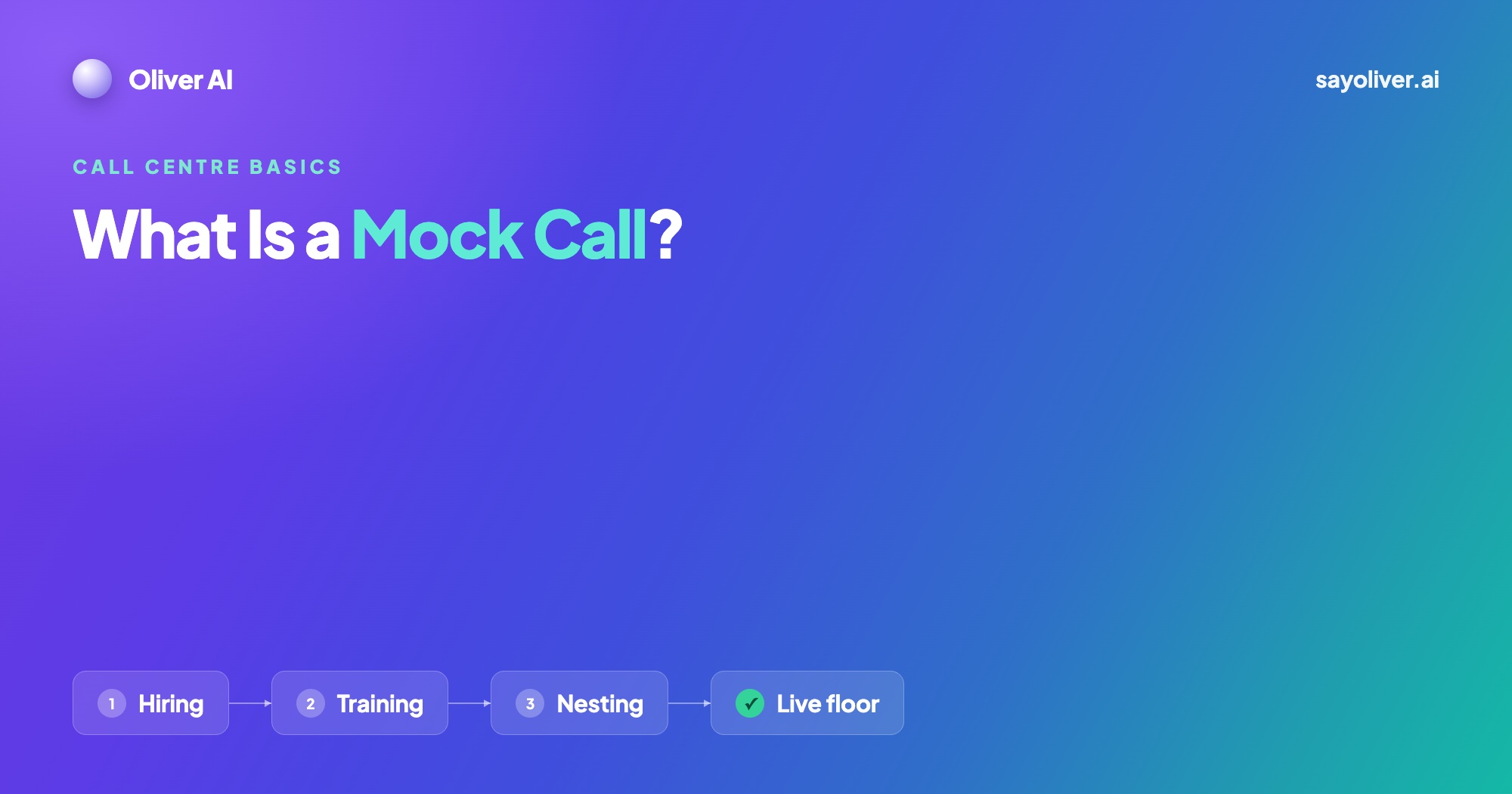
Most people meet the term at the hiring stage and assume that is the only place it appears. It shows up at four distinct points, and the criteria shift each time.
1. The final interview
The most common first encounter. After the initial screening and any English or typing assessments, a recruiter or team lead briefs you on a company type and a customer problem, then plays that customer. You have had no product training, so nobody expects correct answers about a real product. They are listening for delivery: clear English, a steady opening, whether you acknowledge frustration before starting a process, and whether you keep a structure when the customer wanders.
2. Product training
Once hired, you sit in classroom training on a specific account. Mock calls here test whether you can apply what you have just been taught: the actual call flow, the actual tools, the account's real policies. Unlike the interview, product knowledge now counts, and passing is usually a gate to the next week of training. There is more detail on how this stage works in call center training.
3. Nesting
Nesting is the supervised bridge between training and the live floor, and it is where mock calls get graded hardest, because they are scored against the same QA form used on real calls. Depending on the account it runs roughly one to four weeks, often mixing real calls with mock ones. This is also where most early attrition decisions get made, which is why extra practice during nesting compounds faster than it does anywhere else.
4. Recertification and account moves
The stage nobody warns you about. If you transfer to a different account, come back from extended leave, or your QA scores slip, you may be put through mock calls again to re-certify. Experienced agents sometimes find these harder than the original ones, because habits formed on one account do not transfer cleanly to another account's flow and compliance rules.
Practise a mock call against an AI customer, try it now, no sign-up needed.
Practise a mock call against an AI customerWhat actually happens in a mock call
The format is consistent enough that knowing the sequence removes most of the nerves. There are three parts, and the third is the one candidates most often waste.
The brief
You get told the company type, the customer's problem, and sometimes what tools you can pretend to have. It is short, often under thirty seconds, and you are allowed to ask a clarifying question before you start. Very few people do, and asking one reads as confidence rather than weakness.
The call
Usually five to ten minutes. The assessor plays the customer and will typically introduce at least one complication that was not in the brief, because a call that goes exactly as briefed tells them nothing. You are expected to handle it rather than stop and ask what to do.
The feedback
In hiring you may get a short verbal reaction; in training and nesting you get scored against a rubric, line by line. Ask which specific criterion cost you the most points. That single question turns a pass-or-fail moment into the only genuinely useful information you will get about your own delivery.
What a mock call is graded on
Scorecards differ between employers and accounts, but the categories are close to universal. The right-hand column is the version that actually loses points, which is usually more useful to know than the criterion itself.
| Criterion | What it means | What fails it |
|---|---|---|
| Opening | Brand, your name, an offer of help, at a steady pace | Rushing it, or sounding like you are reading it |
| Verification | Confirming identity before discussing the account | Discussing a balance or detail before verifying |
| Empathy | One line acknowledging the problem, then progress | Stacking three apologies, or skipping it entirely |
| Probing | Questions that diagnose rather than confirm your guess | Jumping to a fix after the customer's first sentence |
| Resolution | A specific action, a timeframe, and a reference | "I have escalated it" with no timeframe |
| Close | Recap, offer further help, branded sign-off | Ending as soon as the problem is solved |
| Control | Staying structured when the customer goes off-script | Going silent, or letting the call drift |
| Communication | Clear, understandable, appropriately paced English | Filler words, or speed that rises with nerves |
Practise a mock call against an AI customer, try it now, no sign-up needed.
Practise a mock call against an AI customerWhat a mock call is not
Most of the anxiety around mock calls comes from misreading what is being tested. Five things it is not.
- Not a product knowledge test, at the interview stage. You have not been trained. Inventing a confident-sounding policy is worse than saying you would check and coming back with a timeframe.
- Not a script recital. Assessors hear memorisation immediately, and it counts against you, because a memorised delivery is evidence you cannot adapt.
- Not an accent test. Clarity is scored; having an accent is not. Speed, filler words and swallowed word endings are what actually cost communication points.
- Not the same as a peer role play. A colleague who wants you to succeed will follow your lead. An assessor deliberately will not, which is why practice against a cooperative partner flatters you.
- Not necessarily one attempt. Plenty of employers run a second mock call, or a different scenario, if the first one was derailed by nerves rather than ability. Ask rather than assuming it is over.
What a mock call sounds like
A short example, annotated, so you can see where the marks are. This is deliberately an excerpt rather than a full script.
The exchange
Agent: "Thank you for calling, my name is Marco, how may I help you today?" Customer: "I have been charged twice and I have already called about this once." Agent: "I am sorry you have had to call twice about the same thing, that should not have happened. Let me get it sorted. For security, may I confirm your name and the last four digits of the card on the account?" Customer: "Is that really necessary? I just want the money back." Agent: "I understand, and I will be quick, I just cannot discuss the charges until I know I am talking to the account holder."
Why it scores
The opening is complete and unhurried. The repeat contact gets acknowledged before anything procedural, which is the single most-marked moment in a complaint call. Verification is held firmly when the customer pushes back on it, but the reason is explained rather than just restated, so it lands as protection rather than obstruction. And there is exactly one empathy line, not three. For full dialogues rather than an excerpt, see three worked mock call scripts or, if your account is telco, six full telco scripts.
Practise a mock call against an AI customer, try it now, no sign-up needed.
Practise a mock call against an AI customerWhy call center hiring leans on the mock call
In the Philippines, India and other large BPO hiring markets, the mock call is often the stage that decides the offer, and there is a straightforward reason. Everything else on an application is either trainable or unverifiable. Product knowledge is trainable in a week. Typing speed and English comprehension are already covered by earlier assessments. A CV tells the employer very little about how a person sounds at minute six of a call with someone who is angry.
The mock call is the only part of the process that tests the thing training cannot easily install: composure. That is also why the scenario is nearly always a complaint or a problem rather than a simple enquiry. An easy call does not separate candidates, so the assessor picks one that will.
It follows that the useful preparation is not memorising more scripts. It is getting enough repetitions out loud, against something that pushes back, that being interrupted stops feeling like an emergency.
How a mock call fits into the wider assessment
At the hiring stage the mock call almost never runs on its own. It is the last section of an assessment battery that usually also includes an English grammar exam, a typing test, a spoken-English assessment such as Versant, and a set of situational judgment questions, often all in one sitting on the same day.
That matters for how you prepare, because the other four sections respond to a week of drilling and the mock call does not. Typing improves with ten minutes a day; grammar improves with timed practice sets; the mock call only improves by being run out loud. If you are preparing for the whole day rather than just this one stage, the full call center assessment test breakdown covers what each section scores and in what order to prepare for them.
Practise a mock call against an AI customer, try it now, no sign-up needed.
Practise a mock call against an AI customerHow to prepare for a mock call
Four things, in order, the night before and the morning of. None of them involve memorising a script word for word.
Frequently asked questions
What is a mock call in a call center?
It is a simulated customer call used to assess or train an agent. A recruiter, trainer, or AI plays a customer with a specific problem, a double charge, a cancelled service, a complaint, and the agent handles the call as they would on the floor. It appears in hiring, in product training, during nesting, and again when agents move accounts or need to re-certify.
Why are mock calls important?
Because they test the one thing that is hard to train and hard to fake: how somebody handles a conversation that stops following the plan. Product knowledge can be taught in a week and English comprehension is already measured by earlier assessments. Composure under mild pressure is not visible on a CV, so employers create a situation where they can hear it directly.
What does mock call mean in Tagalog?
The term is used in English on Philippine BPO floors rather than translated, so you will hear "mock call" itself in training and interviews. If you want the plain-language sense: "mock" means simulated or pretend, so a mock call is a practice call, a pretend customer call used to train or test you. Knowing the English term is what matters, since that is what the recruiter will say.
Does Concentrix have mock calls?
Mock calls are standard across large BPO employers, and Concentrix is one of the names people most often ask about, so it is reasonable to expect one at final stage. That said, the exact format varies by site, by account and by role, so treat any specific description you find online as indicative rather than a guarantee. Prepare for the general format, a briefed scenario, a played customer, a graded call, and you are covered whoever the employer is.
How long does a mock call last?
Usually five to ten minutes for the call itself, plus a short brief beforehand and feedback afterwards. Interview mock calls sit at the shorter end. Training and nesting mock calls can run longer, because the trainer may deliberately extend the call to see whether your structure holds up past the opening few minutes.
Can you fail a mock call?
Yes, and in hiring it is usually the stage that ends applications. The common causes are not wrong answers: freezing after the opening, discussing account details before verifying, over-apologising instead of progressing, and closing without a specific next step. Some employers will offer a second attempt or a different scenario if nerves clearly derailed the first one, so it is worth asking rather than assuming.
How do I practise a mock call on my own?
Say both parts out loud and record yourself, listening back for pace and filler words rather than wording. That covers delivery but cannot test being interrupted or having verification refused, which is what the assessment actually measures. Running the scenario against free mock call practice closes that gap, because the customer pushes back and you get a transcript to review afterwards.
Are mock calls stressful?
For most people, yes, the first few, and that is expected rather than a sign you are unsuited to the work. The stress is almost always about being watched and interrupted, not the content of the call itself. It fades with repetitions: candidates who run several practice calls out loud before the real one report it feeling closer to a normal conversation, because being interrupted has already happened to them a few times and stopped being a surprise.
A mock call is a simulated call, but the thing it measures is not simulated at all: whether you stay composed and structured when a conversation stops cooperating. That is why more script memorisation does not move the score much, and why saying the words out loud against someone who interrupts you does. Learn the five-part flow, get comfortable being cut off, and the format stops being the part of the process you dread.
See it in Oliver
Ready when you are
Practise before the next real conversation.
No sign-up required. Pick the scenario, add your name, and speak with a realistic AI partner. Get a scorecard and transcript after every call.