Customer Service De-escalation Scripts and Techniques
By Dave Wilson · 6 min read · Updated 11 September 2026
When a customer is angry, the words a rep reaches for in the first thirty seconds decide whether the call calms down or escalates. De-escalation is not about having a perfect script, a script read robotically makes things worse, but about internalising a small set of techniques and phrases until they come out naturally under pressure. This guide gives you both: the scripts, and the reasons they work.
Why customers escalate
Anger on a service call is almost always secondary. The primary feeling is usually frustration at not being heard, anxiety about a problem that affects them, or a sense of unfairness. The customer is not really angry at the rep, they are angry at the situation, and the rep is who is in front of them.
That reframe matters because it tells you the goal is not to win the argument or defend the company. It is to make the customer feel heard and to move, quickly, toward a concrete next step. This is the foundation of de-escalating an angry customer, and almost every effective technique serves one of those two ends.
The core de-escalation sequence
Most successful de-escalations follow the same arc: acknowledge the emotion, take ownership of the path forward, then move to a fix. Skipping straight to the fix is the most common mistake, a customer who does not feel heard will reject even a good solution.
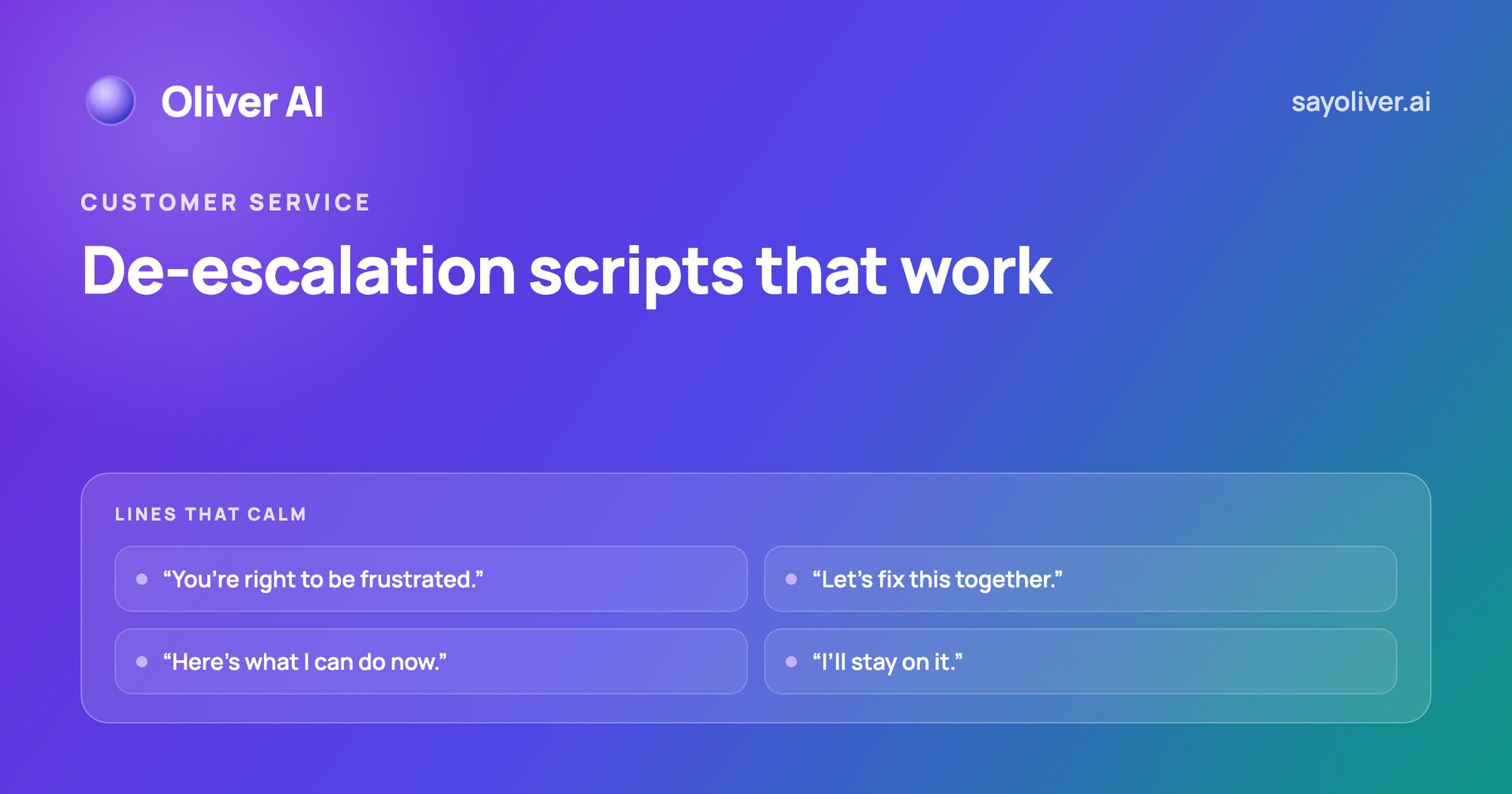
- Acknowledge: "I can hear how frustrating this has been, and I am sorry you have had to chase this."
- Take ownership: "You have reached the right person, I am going to stay with this until we have a clear answer."
- Move to the fix: "Here is what I can do right now, and here is what happens next."
Practise de-escalating an angry customer, try it now, no sign-up needed.
Practise de-escalating an angry customerScripts for common situations
Adapt the wording to your voice, the structure is what matters, not the exact words.
- Customer is repeating themselves: "I want to make sure I have this exactly right, because you should not have to explain it again, let me read back what I understand." (Signals they have been heard.)
- Customer is demanding something you cannot do: "I understand why you are asking for that. I cannot do exactly that, but here is what I can do, and I think it gets you to the same place." (Redirects without a flat no.)
- Customer is blaming the rep personally: "That is completely fair to be upset about, and I am going to own getting it fixed from here." (Absorbs without becoming defensive.)
- Customer threatens to cancel or leave a review: "I do not want to lose you over this, and I would feel the same way. Give me the chance to make it right today." (Acknowledges the leverage without panicking.)
Techniques that make the scripts work
The phrases only land if the delivery supports them. A few techniques do most of the heavy lifting.
- Lower your pace and volume: matching their energy escalates; deliberately slowing down pulls the temperature down.
- Use their name and "I" statements: it makes the exchange personal and accountable rather than corporate and evasive.
- Never say "calm down" or "you need to": both read as dismissive and almost always escalate.
- Confirm the fix explicitly: end by restating exactly what will happen and when, so the customer leaves with certainty, not hope.
Practise de-escalating an angry customer, try it now, no sign-up needed.
Practise de-escalating an angry customerWhy practice beats memorisation
Reps who only memorise scripts freeze the moment a real customer goes off-script, which they always do, and the genuinely difficult customers do it fastest. What holds up under pressure is having run the sequence enough times that acknowledge-own-fix is automatic, no matter what the customer throws out.
Customer service training software can support enabled practice and artifact review. Service and contact-centre practice scenarios with transcripts and scorecards; workflow maturity is validated per team. Repeat and coaching scope is confirmed per team.
Frequently asked questions
What do you say to de-escalate an angry customer?
Lead with acknowledgment before anything else: "I can hear how frustrating this has been, and I am sorry you have had to chase this." Then take ownership of the path forward before offering the fix itself. Customers who do not feel heard reject even a correct solution offered too early.
What are the 3 steps of de-escalation?
Acknowledge the emotion, take ownership of the path forward, then move to a concrete fix. Most failed de-escalations skip straight from acknowledgment to the fix, or skip acknowledgment entirely, and the customer stays escalated because they never felt heard.
What should you never say to an angry customer?
"Calm down" and "you need to" both read as dismissive and almost always escalate further, because they put the blame for the tone back on the customer instead of on the situation. Matching their volume or pace also escalates. Deliberately lowering your own pace and volume pulls the temperature down instead.
How do you practise de-escalation before a real call?
Say the scripts out loud against someone who interrupts and pushes back, not silently to yourself, since the failure mode on a real call is timing and delivery, not knowing the words. Free mock call practice runs an angry-customer scenario against an AI caller that reacts to what you actually say, with a transcript afterward showing where the sequence broke down.
Good de-escalation is not a magic phrase, it is a sequence: acknowledge, take ownership, move to a fix, delivered with a calm pace and genuine ownership. Scripts give you the words, but only repetition under pressure makes them yours. Practise the hard calls before they are real, and the real ones stop being frightening.
See it in Oliver
Ready when you are
Practise before the next real conversation.
No sign-up required. Pick the scenario, add your name, and speak with a realistic AI partner. Get a scorecard and transcript after every call.