Why Do You Want to Work in a Call Center? 5 Sample Answers
By Dave Wilson · 8 min read · 7 November 2026
When an interviewer asks "Why do you want to work in a call center?", they are checking two things: that you understand what the job is, and that you have a real reason to stay past training. The answer that works names one specific reason (helping people fix problems, building communication skills, a clear career path, or steady pay for your family), connects it to something you have already done, and shows you know the job means night shifts, targets and difficult callers. Keep it to 30 to 45 seconds. Below are the five themes interviewers accept, five sample answers by background, the lines that cost people the job offer, and the follow-up questions that usually come next.
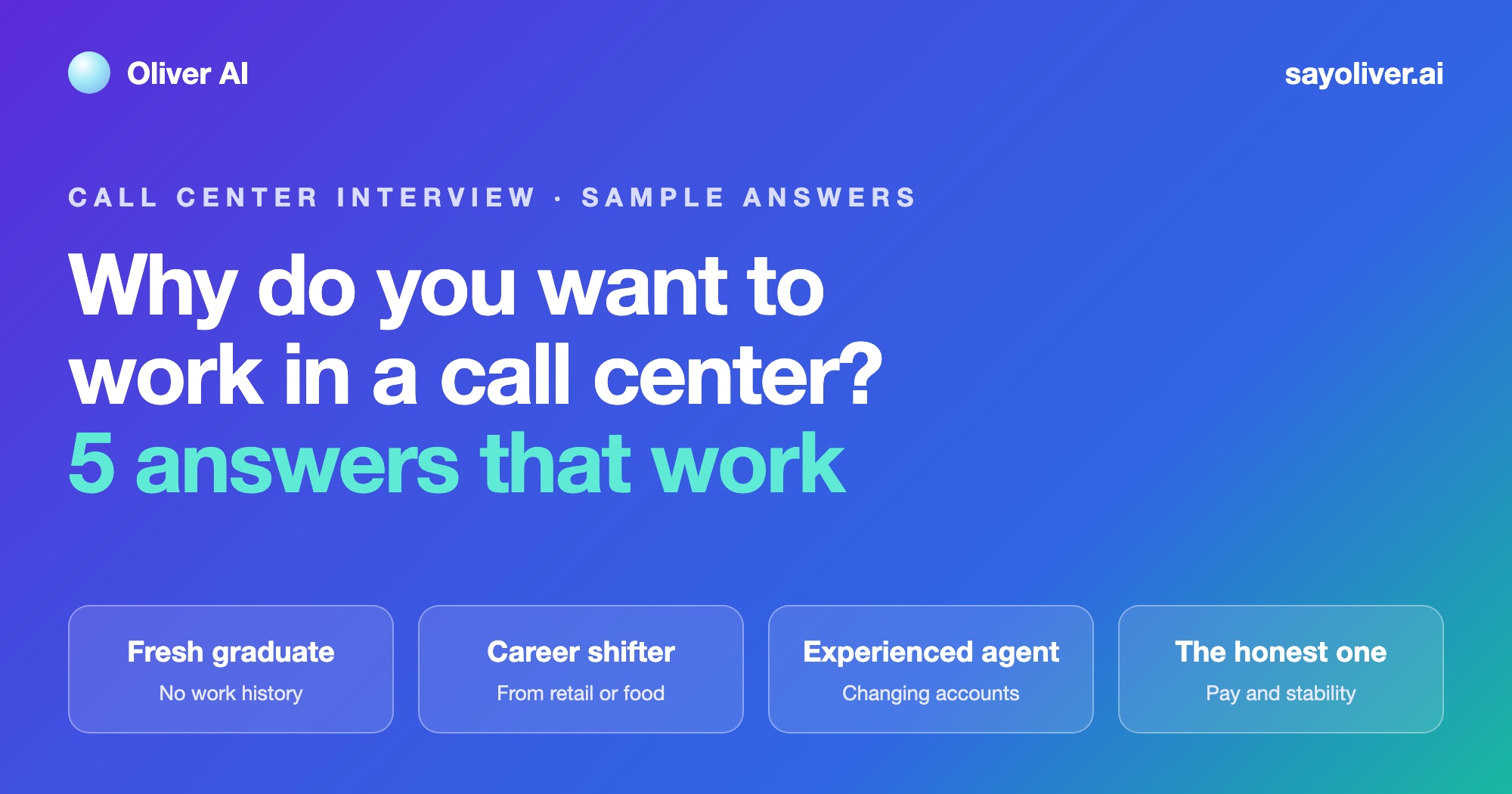
Why interviewers ask "Why do you want to work in a call center?"
Call centers spend weeks of paid training on every new hire, and many agents leave during training or nesting. This question is the recruiter's best early signal of who will stay. A vague answer suggests you applied everywhere and will leave for the first other offer.
It is also a quick English check. Your answer is usually the first unscripted thing you say in the initial interview, so the recruiter is listening to your grammar, pace and pronunciation as much as the content.
Key themes for a strong answer
Pick one main theme and support it with one example. Trying to cover all four in one answer makes it sound memorised.
Helping people and solving problems
You like turning a confused or frustrated person into a satisfied one. This works best with a real example: helping customers at a store counter, sorting out a family member's bill, being the classmate everyone asked for help.
Building skills and a career
Call center work builds communication, problem-solving and composure faster than most entry-level jobs, and there is a visible path from agent to SME, QA, trainer or team leader. Name the next role you are aiming for, because it tells the recruiter you plan to stay.
Working well with structure and targets
Some people like knowing exactly how they are measured. If you have hit sales quotas, school deadlines or production targets before, say so. It shows you will not be surprised by AHT, QA scores and schedule adherence.
Honest stability and pay
In the Philippines, interviewers know most applicants want the salary, the benefits and the night differential, and an honest answer about supporting your family is acceptable. It has to come with proof that you are ready for the work: night shifts, holidays and angry callers. The call center salary guide has the real numbers if you want to be specific.
Practise the mock call after the interview, free, with no account or card needed.
Practise the mock call after the interviewSample answers you can adapt
Change the details to your own life. An interviewer who hears the exact wording from a website three times a day will notice.
1. Fresh graduate with no work experience
"I just graduated and I want a job where I can build my communication skills while earning. During my OJT I was assigned to the front desk, and I found I liked answering people's questions and getting their problem to the right person. A call center lets me do that every day, with training and coaching on top. In two years I would like to be good enough to become an SME on my account."
2. Career shifter from retail or food service
"I have worked three years at a fast-food counter, so I already handle customers who are in a hurry or upset about a wrong order. I want to keep using that skill, but in a role with better pay, benefits and a career path. A call center gives me all three, and I am comfortable with shift work because I have been on a rotating schedule for years."
3. Experienced agent moving to a new account
"I have spent eighteen months on a telco account, and my QA scores have been consistently above target. I want to stay in the industry because I am good at it and I like the structure. I am applying for this account because I want to learn health care, which is more complex and has a clearer path to a QA or trainer role."
4. The honest pay-and-stability answer
"I will be honest: I am the main provider for my family, and a call center offers a stable salary, HMO and a night differential that most other jobs here do not. I know that means night shifts and difficult callers, and I am ready for that. I have worked nights before as a security guard, and I stayed calm with people who were not happy to see me. I want a job I can keep for years, not just a few months."
5. When they ask about this company specifically
"I have used your client's app myself, so I already know the questions customers are likely to call about. I also read that your site promotes many team leaders from inside, and that matters to me, because I want to grow here rather than move around between companies."
What not to say
Most weak answers are not wrong, they are just empty. These swaps turn a weak answer into one the recruiter can write down.
| Instead of | Say |
|---|---|
| "Because I like talking to people." | Name what you like about it: "I like figuring out what someone actually needs and getting them an answer." |
| "I need a job." (on its own) | "I want a stable job I can keep for years, and I am ready for the shifts that come with it." |
| "It's easy money." | Nothing. Recruiters hear this as "I will quit when it gets hard." |
| "My friends work here." | "My friends told me about the training and the growth here, and that is why I applied." |
| "Just while I look for something in my field." | Do not mention a short-term plan, even if you have one. |
| A two-minute life story | One reason, one example, one sentence about the future. Under 45 seconds. |
Practise the mock call after the interview, free, with no account or card needed.
Practise the mock call after the interviewFollow-up questions to expect
A good answer usually gets a follow-up. Prepare these alongside it.
"Why BPO and not another industry?"
Repeat your main theme with a different detail: the training, the career path, or the fact that BPO jobs reward skills more than degrees. If you studied something unrelated, say what carries over, for example "Nursing taught me to stay calm with worried people."
"Why should we hire you?"
Give one strength and one piece of evidence: "I stay calm with upset people. At my last job I handled the complaint desk on weekends." The interview questions for no experience page has more sample answers for this one.
"Are you okay with a night shift?"
Say yes only if it is true, and show you have thought about it: how you will sleep, how you will get to work. Recruiters reject people at the final interview who hesitate on this.
"How would you handle an irate customer?"
This often comes next because it tests whether your reason holds up under pressure. Describe a process rather than a personality claim. The irate customer guide has sample answers.
How to deliver your answer
The content matters less than how you say it. A clear, calm 40-second answer beats a perfect one read off memory.
- Use the three-part shape: your reason, one example from your own life, and where you want to be in a year or two.
- Practise it out loud until you can say it without notes, then change the wording slightly each time so it never sounds recited.
- Slow down. Nerves speed everyone up, and a rushed answer sounds less fluent than it is.
- Smile while you speak, especially on a phone screen. It changes your tone even when the recruiter cannot see you.
- Stop when you have finished. Long pauses are fine; adding a second, weaker reason is not.
Practise the mock call after the interview, free, with no account or card needed.
Practise the mock call after the interviewPractise the interview, then the mock call
This question opens the interview, and a mock call often closes it. You can rehearse both out loud before the real day. Job interview practice puts you in a short interview with an AI recruiter, and free mock call practice puts you on a call with an AI customer, with a transcript and score after each one.
Frequently asked questions
What is the best answer to "Why do you want to work in a call center?"
One specific reason backed by one real example, said in under 45 seconds. For example: "I like solving people's problems. At my last job I handled customer complaints at the counter, and I want a role where I do that every day with real training and a path to team leader."
Is it okay to say I want to work in a call center for the money?
Yes, if you say it professionally and show you are ready for the work. "I want a stable salary to support my family, and I am ready for night shifts and difficult callers" is acceptable. "It's easy money" is not.
Why do you want to work in customer service?
Answer the same way, with customer service as the reason: you like helping people get to a solution, and you have an example of doing it. Customer service roles care less about the industry and more about how you treat people.
Why do you want to work in a BPO company?
Talk about what BPO offers that other entry-level jobs do not: paid training, a clear career path from agent to SME, QA or team leader, and benefits. Then connect it to your own plans.
How long should my answer be?
Between 30 and 45 seconds spoken, which is about three or four sentences. Longer answers start to sound memorised and give the interviewer more grammar mistakes to notice.
Why are you applying for a call center job with no experience?
Say what you bring instead of what you lack: a customer-facing job, school work, or family responsibilities that show patience and clear communication. Then say why you want the training and career path a call center offers.
Interviewers ask "Why do you want to work in a call center?" to find out whether you understand the job and will stay past training. Pick one honest reason (helping people, building skills, structure and targets, or stability for your family), back it with one example from your own life, and say where you want to be in two years. Keep it under 45 seconds, avoid the empty lines, and prepare the follow-ups. Then rehearse it out loud, because the answer you have practised is the one that comes out calm.
See it in Oliver
Ready when you are
Practise before the next real conversation.
No sign-up required. Pick the scenario, add your name, and speak with a realistic AI partner. Get a scorecard and transcript after every call.