Mock Call Script for Telco Account: 6 Full Scripts You Can Read Out Loud
By Dave Wilson · 12 min read · Updated 16 August 2026
A mock call script for a telco account is a full practice dialogue that runs through six phases: opening spiel, account verification, probing, empathy and root cause, resolution plus a sales pitch, and closing. That upsell phase is what separates it from a generic customer service mock call. The six scripts below cover billing, data, no internet, modem troubleshooting, a plan upgrade, and a retention save.
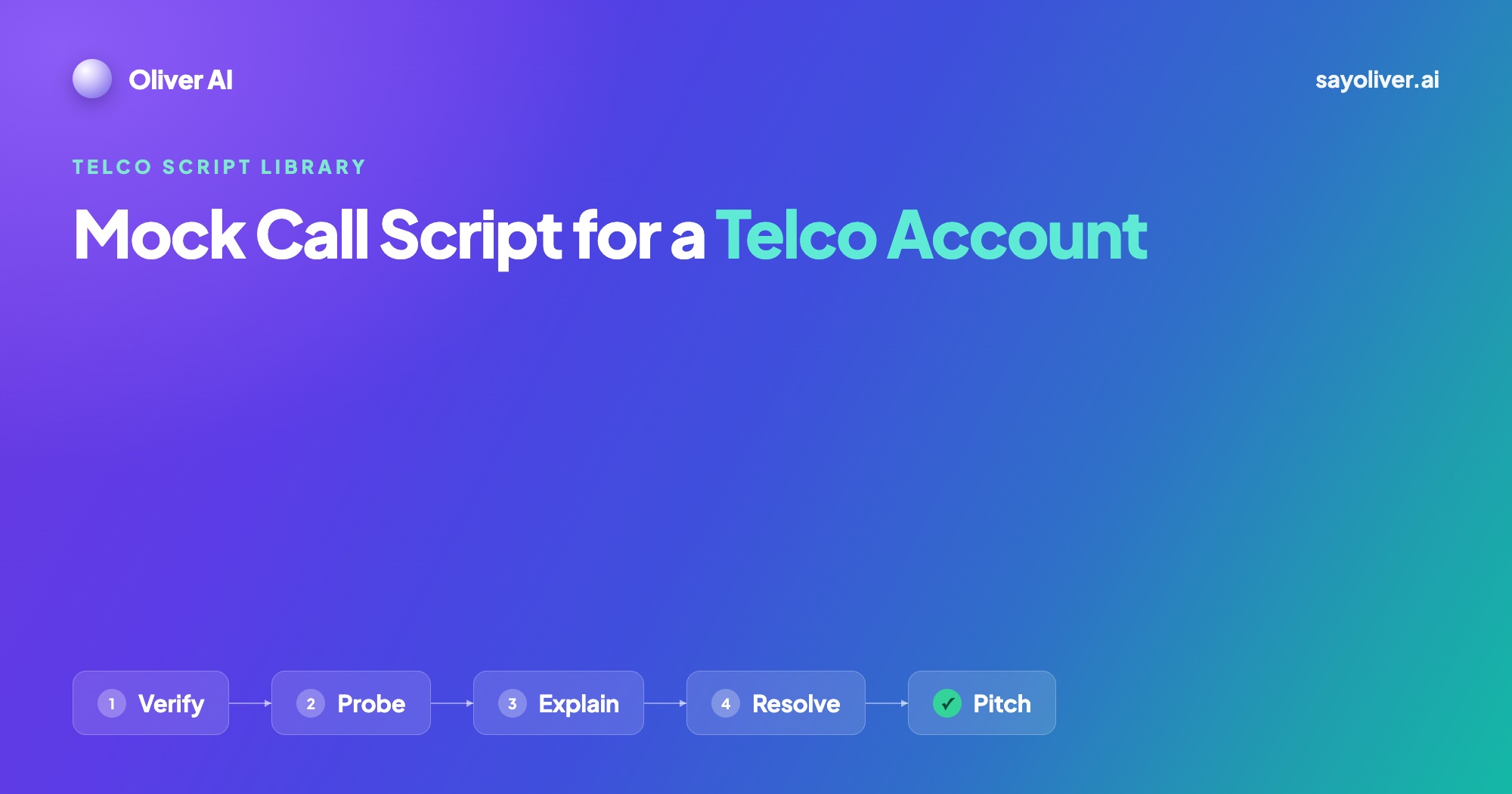
How a telco mock call differs from a generic customer service mock call
If you want the industry-agnostic version, the five-part flow every mock call follows is on its own page with three worked examples. This page assumes you have been told your account is telco, or that you are applying to one, and it goes deeper into the things a telco interviewer actually listens for.
The difference is not just vocabulary. A telco mock call verifies you against account-specific data, expects you to name real tools and real hardware, and almost always includes a moment where you are supposed to offer something. Candidates who prepare with a generic customer service script get through the first three phases cleanly and then freeze when the interviewer says "okay, now pitch me the upgrade."
| Generic customer service mock call | Telco mock call | |
|---|---|---|
| How you verify | Name, email, last four of the card | Account number or mobile number, registered address, date of birth, sometimes last four of the SIM |
| What you name out loud | The order, the ticket, the refund | The SOA, the bill cycle, the plan tier, the modem or ONU, the reference number |
| Is an upsell required | Rarely, and never scored | Usually, and often the thing being scored |
| Jargon expected | Almost none | Postpaid, prepaid, prorated, data cap, FUP, throttling, LOS light |
| How the interviewer pushes back | Gets annoyed, escalates | Questions the charge line by line, then resists the offer you just made |
The telco call flow: 6 phases, including the sales pitch
Every mock call script sample you find for a telco account, including the ones circulating as PDFs, is some version of the six phases below. Learn the phases and you can build a script for a scenario nobody warned you about, which is closer to what actually happens in the interview room.
Phase 1: Opening spiel
Brand, your name, an offer of help, in one breath. Three variants that all work: "Thank you for calling [Telco Name], my name is Marco, how may I help you today?" / "Thank you for calling [Telco Name] customer care, this is Marco speaking, what can I do for you?" / "Good afternoon, thank you for calling [Telco Name], Marco here, how can I assist?" Pick one and use the same one every time so it stops costing you attention.
Phase 2: Account verification
Nothing about charges, usage, or the account gets discussed until this is done. The standard telco combination is the mobile number or account number, plus two of: registered full name, registered address, date of birth, last four digits of the SIM. Ask for them together, not one at a time, and say why: "for security purposes, may I have your account number and the registered date of birth on the account?"
Phase 3: Probing
Three questions separate a billing issue from a plan issue from a network issue. When did you first notice it. Is it happening on one device or all of them. Has anything changed on the account or in the house recently. Ask them before you open anything, because the answer decides which tool you pull up and interviewers watch for whether you diagnose or guess.
Phase 4: Empathy and root cause
One empathy line, then the actual cause. One. Stacking three of them reads as stalling, and it is the most common thing that makes a mock call sound scripted. If you want more range than "I understand how frustrating that is," there is a longer list of empathy statements that do not sound rehearsed. Then say the cause in plain language: a data overage, a prorated charge from a mid-cycle plan change, a line fault in the area.
Phase 5: Resolution and the sales pitch
State the fix, the timeframe, and the reference number. Then, and only then, make the offer, and make it about the thing they just complained about. This is the phase most competing scripts leave out entirely, and it is the phase telco interviewers are usually grading. A resolution with no offer scores as incomplete on most telco scorecards.
Phase 6: Closing and recap
Recap what you did, repeat the reference number and the timeframe, ask if there is anything else, then close with the brand. "So to recap, I have credited the ₱299 back to your account, you will see it on your next SOA, and your reference number is 4471023. Is there anything else I can help you with today? Thank you for calling [Telco Name], have a good day."
Practise a telco billing call against an AI customer, try it now, no sign-up needed.
Practise a telco billing call against an AI customer6 mock call scripts for a telco account
Each mock call script for a telco account below runs all six phases end to end, so you can read it aloud without editing anything. Peso amounts and [Telco Name] are placeholders, swap in whatever your account uses. Read them for the shape and the specific phrasing, not to memorise word for word.
Script 1: Postpaid billing dispute, the bill is higher than usual
Agent: "Thank you for calling [Telco Name], my name is Marco, how may I help you today?" Customer: "My bill this month is ₱1,480. It is normally ₱999. What am I paying for?" Agent: "I can look into that with you right now. For security purposes, may I have your account number and the registered date of birth on the account?" Customer: "Account is 8820114, and the birthday is March 9, 1994." Agent: "Thank you. Give me about a minute to pull up your statement of account, is a short hold okay?" Customer: "Sure." Agent: "Thank you for waiting. I have your SOA open. Your plan is ₱999, and there are two other lines: a prorated charge of ₱182 and a data overage of ₱299." Customer: "Prorated? I did not change anything." Agent: "You upgraded from the ₱799 plan on the 14th, which is mid-cycle, so the bill covers the old plan up to the 13th and the new one from the 14th. That ₱182 is a one-time difference and it will not appear again next month." Customer: "Fine. And the ₱299?" Agent: "That is a data overage. Your plan includes 25GB and the account used 29GB, so the extra 4GB was charged at the standard rate. I can email you the daily usage breakdown so you can see which days it spiked." Customer: "Yes, send that. This is annoying, I did not get a warning." Agent: "That is a fair point, and I am sorry it landed as a surprise. Two things I can do: I am waiving ₱299 as a one-time courtesy since this is the first overage on the account, and I am switching on a data alert at 80 percent so you get a text before it happens again. Reference number for the waiver is 4471023." Customer: "Okay, that helps." Agent: "One more thing worth mentioning, since you went over this month and last month you were close: the ₱1,299 plan has 50GB instead of 25GB. That is ₱300 more, which is the same as the overage you just got charged, and it removes the risk entirely. Would you like me to move you to that for the next cycle?" Customer: "Let me think about it." Agent: "Of course, no pressure, and the alert is on either way. So to recap: ₱299 waived under reference 4471023, usage breakdown going to your email, and a data alert at 80 percent. Anything else I can help with today?" Customer: "No, that is all." Agent: "Thank you for calling [Telco Name], have a good day."
Script 2: Prepaid data promo did not register
Agent: "Thank you for calling [Telco Name] customer care, this is Marco, how can I help?" Customer: "I loaded ₱149 for the 10GB promo two hours ago and I still have no data." Agent: "Let me check the registration for you. May I have the mobile number and the registered name on it?" Customer: "0917 555 0142, under Liza Reyes." Agent: "Thank you, Ms. Reyes. Before I look, was the load a retailer load or did you buy through the app?" Customer: "Retailer, at the sari-sari store." Agent: "Got it, and did you get a confirmation text after you sent the keyword?" Customer: "I got one saying load received. Nothing about the promo." Agent: "That tells me what happened. The ₱149 went in as regular load, so the promo was never registered, the keyword either did not send or went to the wrong number. Your balance right now is ₱149, so nothing is lost. I can register the promo from my side now and it will be active in about five minutes." Customer: "Please do." Agent: "Registering it now. That leaves you ₱0 regular load and 10GB valid for seven days. You will get a confirmation text shortly, reference number 5510884." Customer: "So it was my fault?" Agent: "Honestly it is a common one, the keyword format changed and the old one still gets used. For next time it is the keyword and then the promo name, in one message, to 8080. Worth saving as a draft." Customer: "Okay noted." Agent: "And since you are loading ₱149 every week, there is a 30-day version at ₱499 with 30GB. Over a month that is ₱100 less than four weekly loads and you only register once. Want me to send you the details by text?" Customer: "Sure, send it." Agent: "Sent. To recap: promo registered under reference 5510884, active in five minutes, 10GB for seven days, and the monthly option is in your inbox. Anything else?" Customer: "No thanks." Agent: "Thank you for calling [Telco Name], enjoy the rest of your day."
Script 3: No internet at all, modem and ONU troubleshooting
This is the mock call script for internet connection issues that telco accounts test most often, because it is the highest-volume call type on the floor. Agent: "Thank you for calling [Telco Name], my name is Marco, how may I help you today?" Customer: "Our internet is completely down since this morning. Nothing works." Agent: "I will get that sorted with you. For security, may I have your account number and the registered address?" Customer: "9930277, 14 Mabini Street, Barangay San Roque." Agent: "Thank you. Before I check the line, can you look at the box on the wall and tell me which lights are on, and what colour?" Customer: "There is a red one at the bottom." Agent: "Is the word next to it LOS?" Customer: "Yes, LOS, and it is blinking red." Agent: "Thank you, that is actually useful. A blinking red LOS means the fibre signal is not reaching your ONU, so this is not a WiFi or device problem. Let us rule out the simple causes first. Can you unplug the power from the ONU, wait a full 30 seconds, then plug it back in? Do not just switch it off and on, the 30 seconds matters." Customer: "Okay, doing it now... it is back on. Still red." Agent: "Understood. One more check: is the thin fibre cable going into the ONU bent, pinched behind furniture, or has anything been moved in that room recently?" Customer: "There was a delivery yesterday, they moved the cabinet." Agent: "That is very likely it. The fibre cable is glass, it breaks from a sharp bend even when the outside looks fine. That is not something we can fix over the phone, it needs a technician to reterminate the cable. I am booking a field visit now, the next available slot is tomorrow between 9am and 12pm, and your reference number is 7702394." Customer: "Tomorrow? I work from home." Agent: "I hear you, and I am sorry, a broken fibre line needs someone physically there. Two things I can do in the meantime: I am flagging this as a no-service ticket so the days without connection are credited on your next SOA automatically, and I can text you a one-day mobile data promo so you are not offline today. Would that help?" Customer: "Yes, please do that." Agent: "Sending it now. To recap: technician tomorrow, 9am to 12pm, reference 7702394, days credited automatically, and the data promo is on its way by text. Someone should be home for the visit. Anything else I can help with?" Customer: "No, thank you." Agent: "Thank you for calling [Telco Name], and apologies again for the trouble."
Script 4: Slow internet, with a sales pitch
This is the telco sales mock call most interviewers use, because it tests whether you can troubleshoot honestly and still make an offer. Agent: "Thank you for calling [Telco Name], this is Marco, how can I help you today?" Customer: "The internet is so slow at night. It is fine in the morning." Agent: "Let me look at that with you. May I have your account number and date of birth for verification?" Customer: "7761003, June 22, 1988." Agent: "Thank you. Have you run a speed test, and roughly how many devices are on the WiFi at night?" Customer: "The test said 8 Mbps. And maybe nine or ten devices, we are five people." Agent: "Thank you, that is the whole picture in two numbers. Your plan is 25 Mbps, and you are getting 8 at peak. I can see no fault on your line and no outage in your area, so this is not a broken connection, it is ten devices sharing 25 Mbps at the exact hour everyone is streaming." Customer: "So there is nothing you can do." Agent: "There are two things. First, right now: your router is on channel 6, which is the most congested one in your area, and I am switching it to channel 11 from my side. That usually buys back a few Mbps at peak and costs nothing. Give it two minutes to reconnect." Customer: "Okay, done." Agent: "Second, the honest part. Channel changes help at the margin, but ten devices on 25 Mbps at 9pm will always feel slow. The 100 Mbps plan is ₱400 more per month, which is about ₱13 a day, and it is four times the capacity you have now. Based on the usage on this account you would stop noticing peak hours entirely. Shall I set that up to start on your next bill cycle?" Customer: "₱400 is a lot though." Agent: "It is a real increase, and I would not suggest it if the channel fix alone were going to solve it. You have called about slow speeds three times in two months, so the ₱400 is buying back those calls and the evenings behind them. If it helps, we can start it next cycle so there is no prorated charge this month, and you can move back down after 30 days if it does not feel worth it." Customer: "Alright, let us try it." Agent: "Done, 100 Mbps effective on your next cycle, reference number 8814507, and the channel change is already live tonight. To recap: channel switched now, plan upgrade next cycle, reference 8814507, and you can revert after 30 days. Anything else?" Customer: "That is all." Agent: "Thank you for calling [Telco Name], enjoy your evening."
Script 5: Plan upgrade upsell on an inbound call
Agent: "Thank you for calling [Telco Name], my name is Marco, how may I help you today?" Customer: "I just want to check my remaining data." Agent: "Happy to check. May I have the mobile number and registered name for verification?" Customer: "0918 220 4477, Dennis Cruz." Agent: "Thank you, Mr. Cruz. You have 1.2GB left, and your cycle resets in nine days." Customer: "Nine days? That is not going to last." Agent: "Probably not, based on your pattern, you have topped up mid-cycle in three of the last four months, around ₱250 each time." Customer: "Yeah, it always runs out." Agent: "Then this is worth two minutes. Your plan is ₱799 with 15GB. The ₱999 plan has 30GB. That is ₱200 more, and you are already spending around ₱250 on top-ups, so you would be paying less overall and stop running out." Customer: "How do I know I will actually use 30GB?" Agent: "You averaged 21GB the last three months counting the top-ups, so 30 gives you real headroom rather than a slightly bigger cliff. And if it turns out to be too much, you can move back down after one cycle with no fee." Customer: "What is the catch, is there a lock-in?" Agent: "No lock-in on an upgrade, that only applies to new lines with a device. You keep your number, nothing changes except the allocation." Customer: "Okay, do it." Agent: "Done. ₱999 with 30GB effective on your next cycle, reference number 6620391, and I am also switching on a data alert at 80 percent so you know where you stand mid-month. To recap: plan upgraded next cycle, reference 6620391, alert enabled, and you can revert after one cycle. Anything else I can help with?" Customer: "No, thanks." Agent: "Thank you for calling [Telco Name], have a great day."
Script 6: Disconnection request and retention save
Agent: "Thank you for calling [Telco Name], this is Marco, how can I help you today?" Customer: "I want to cancel my line." Agent: "I can help you with that. May I have your account number and the registered address first?" Customer: "5540118, 27 Rizal Avenue, Barangay Poblacion." Agent: "Thank you. Before I process it, can I ask what prompted the decision? It helps me make sure I am closing the right thing, and if it is something I can fix I would rather do that." Customer: "I am moving to my parents' place and they already have internet there." Agent: "That makes sense, and that is not something I am going to try to talk you out of. One question though: is the move permanent, or is this for a few months?" Customer: "Maybe six months, then I am back." Agent: "Then you have a third option besides cancelling. We can suspend the line for up to six months instead. You keep the same number and the same plan, there is no reconnection fee when you come back, and the monthly charge drops to ₱150 while it is suspended. Cancelling means the number is released and starting again later is a new application." Customer: "₱150 for nothing though." Agent: "Fair. It is holding the number and the plan price, which is worth it to some people and not to others. If the number is not important to you, cancelling is genuinely the cheaper choice and I will process it now." Customer: "Actually the number matters, it is on all my work documents. Let us suspend." Agent: "Good call. Suspension effective the 1st of next month, ₱150 monthly, six months maximum, and reference number 3319072. I am also noting the date so you get a reminder before it expires. If you decide to cancel during that window, one call and it is done, no fee." Customer: "Perfect." Agent: "To recap: line suspended from the 1st, ₱150 a month, number retained, reference 3319072. Anything else I can help with today?" Customer: "No, that was easier than I expected." Agent: "Thank you for calling [Telco Name], and good luck with the move."
Other telco scenarios your mock call could use
A mock call script for a telco account can also cover the scenarios below. These come up less often than billing and no-internet, but interviewers reach for them precisely because candidates have not rehearsed them. Each one turns on a single line.
- SIM replacement after loss or theft: block the old SIM before anything else, then verify identity harder than usual, because this is the call most often made by someone who is not the account holder.
- Roaming activation before travel: ask the destination and travel dates first, because the answer changes which product exists, and confirm the daily cap out loud so there is no surprise bill.
- Porting a number in from another carrier: set the expectation that the old line stays active until the switch completes, so they do not cancel it themselves and lose the number.
- Reconnection after cut-off for non-payment: state the exact amount and the time reconnection takes after payment posts, and never imply it is instant when it is four hours.
- Refund for a charge that should not be there: confirm the charge is wrong before promising anything, then give the credit timeline in bill cycles, not days, because that is how it actually lands.
Practise a telco billing call against an AI customer, try it now, no sign-up needed.
Practise a telco billing call against an AI customerHow to deliver the sales pitch in a telco mock call without sounding pushy
This is the part of the telco mock call that fails most candidates, and the part almost nobody writes about. The instinct is either to skip the offer entirely, which scores as an incomplete call, or to bolt a memorised pitch onto the end of a resolution, which sounds exactly like what it is. The five moves below are what makes the difference.
- Earn it first. Fix the actual problem before you offer anything. A pitch delivered before the customer feels heard is the one thing every scorecard penalises.
- Tie the offer to what they just complained about. If they called about an overage, the pitch is more data. If they called about slow speeds at 9pm, the pitch is capacity. Anything else is a product announcement.
- One offer, not three. Giving a choice of three plans is not helpful, it moves the work back to them. Pick the one that fits and name it.
- Frame the price against something real. "₱400 more" is a cost. "₱400 more, which is less than the overage on this bill" is a comparison, and comparisons are what people actually decide on.
- Close with a question, not permission. "Shall I set that up for your next cycle?" moves. "Would you be interested in hearing about our plans?" invites a no and wastes the setup you just built.
Before
Agent: "I have processed the credit. Also, before you go, we have several new plans available with more data, would you be interested in hearing about them?" Customer: "No, I am fine, thanks." (The offer arrived as a change of subject, so it got treated as one.)
After
Agent: "I have waived the ₱299 overage, reference 4471023. On that, though: you went over this month and you were close last month. The ₱1,299 plan doubles your data for ₱300 more, which is the same as the overage I just waived, so it removes the problem instead of us doing this again. Shall I move you across for the next cycle?" Customer: "Actually, yes." (Same offer, tied to the same complaint, priced against a number the customer already cares about.)
Telco terms to know before your mock call
Half of what makes a candidate sound like they have worked in telco is using these correctly, without pausing first. If you are on day two of nesting, this is the table to read before the mock call rather than the scripts.
| Term | What it means | What you say on the call |
|---|---|---|
| Postpaid | Billed monthly after use, on a plan | "Your plan is billed at the end of each cycle." |
| Prepaid | Load first, use until it runs out | "Your current balance is ₱149." |
| MIN | Mobile Identification Number, the subscriber number | "May I have the mobile number on the account?" |
| SOA | Statement of Account, the monthly bill | "I am looking at your SOA for this cycle now." |
| Bill cycle | The monthly period the bill covers | "Your cycle runs from the 15th to the 14th." |
| Cut-off | The date service is suspended for non-payment | "Cut-off is five days after the due date." |
| Prorated charge | A part-month charge after a mid-cycle change | "That ₱182 is a one-time prorated charge from the upgrade." |
| Data cap / FUP | The allowance before speeds are reduced | "Your plan includes 25GB before the fair use policy applies." |
| Throttling | Deliberately reduced speed after the cap | "Speeds are reduced after the cap rather than cut off." |
| Modem vs ONU | Modem for DSL or cable, ONU for fibre | "Can you check the lights on the ONU, the fibre box on the wall?" |
| LOS light | Loss of Signal indicator on a fibre ONU | "A blinking red LOS means the fibre signal is not reaching you." |
| Reference number | The ticket ID for what you just did | "Your reference number is 4471023." |
Practise a telco billing call against an AI customer, try it now, no sign-up needed.
Practise a telco billing call against an AI customer5 mistakes that fail a telco mock call
Almost every failed mock call script for a telco account fails in one of these five places, and four of them are fixable in a single practice run.
- Reciting the spiel perfectly, then freezing. The opening is the one line candidates over-rehearse, so it arrives smooth and the silence after it is louder. Practise the first question after the spiel, not the spiel.
- Discussing charges before verifying. Naming a balance or a plan detail before identity is confirmed is an automatic fail on most telco scorecards, regardless of how the rest of the call goes.
- Stacking three empathy lines. "I understand. I apologise. I know how frustrating that is." Three in a row reads as filler while you think. Use one, then say the cause.
- Skipping the sales pitch. A resolved call with no offer is scored as incomplete on a telco account. If you genuinely cannot find a relevant offer, say why out loud rather than saying nothing.
- Closing without a reference number or a timeframe. "I have escalated it" is not a resolution. "Reference 7702394, technician tomorrow between 9 and 12" is.
How to save these telco mock call scripts as a PDF
Most people searching for a mock call script for a telco account PDF end up on a document host that asks them to sign up, upload a file of their own, or pay before it will show the whole thing. This page is the free version, and turning it into a PDF takes about ten seconds.
- On a computer: press Ctrl+P, or Cmd+P on a Mac, to open the print dialog.
- Change the destination or printer to "Save as PDF", then save it wherever you keep your interview notes.
- On a phone: use the browser share button, then "Print" on Android or "Options, Print" in Safari, and save the result to Files.
Practise a telco billing call against an AI customer, try it now, no sign-up needed.
Practise a telco billing call against an AI customerHow to practise a telco mock call script out loud
Call center mock call practice is not reading. Reading a script teaches you the words, and the words are the part you will have no trouble with. What decides the mock call is the moment the customer interrupts your spiel, questions a charge you have not looked at yet, or says no to the offer you just made, and none of that happens on a page. The steps below are how the scripts above turn into something you can actually do.
Practising with a friend works until you have run it twice and they start following your script instead of fighting it. The alternative is running it against free mock call practice that plays the customer, pushes back on the charge, and gives you a transcript afterwards so you can find the exact sentence where you lost the thread.
Frequently asked questions
How do you make a mock call script for a telco account?
Write the six phases down as headings first: opening spiel, account verification, probing, empathy and root cause, resolution plus a sales pitch, and closing. Then fill in two or three lines per phase for one specific scenario, such as a high bill or no internet. Build the script around the phases rather than trying to write a conversation from the top, because the phases are what gets scored.
What is the best opening spiel for a telco account?
Brand, your name, and an offer of help, in one sentence: "Thank you for calling [Telco Name], my name is Marco, how may I help you today?" There is no clever version that scores better. What matters is that you say the same one every time until it costs you no attention, so the pause after it does not catch you out.
Is there a mock call script for telco account PDF I can download?
The versions circulating as PDFs are mostly uploads on document-sharing sites that ask you to sign up or pay before showing the full script. This page has six complete scripts with nothing gated, and you can save it as a PDF yourself with Ctrl+P or Cmd+P and choosing "Save as PDF" as the destination.
What is a mock call script for internet connection problems?
It is a practice dialogue for a customer whose connection is down or slow, and it turns on one thing: reading the lights on the modem or ONU before you touch anything else. A blinking red LOS light means the fibre signal is not arriving, so it is a line fault rather than a WiFi problem, and the call becomes a power-cycle, a cable check, then a technician booking with a reference number.
What is an example of positive scripting in a telco call?
Positive scripting says what you can do instead of what you cannot. "I cannot waive that charge" becomes "what I can do is credit ₱299 as a one-time courtesy and switch on an alert so it does not happen again." Same limits, but the sentence ends on the action rather than the refusal, which is what interviewers listen for.
What is the best script for a follow-up call after a telco ticket?
Open by naming the reason you are calling and the reference number, because they have spoken to several people by now: "Good afternoon, this is Marco from [Telco Name], I am following up on reference 7702394 about the fibre line at your address." Then state the current status, the next step with a timeframe, and confirm nothing new has come up before you close.
How do I practise a telco mock call alone?
Say both parts out loud and record yourself, then listen for the pauses rather than the wording. That gets you most of the way, but it cannot test being interrupted or having an offer refused, which is what the mock call actually measures. Running the scenario against free mock call practice covers that gap, because the customer pushes back and you get a transcript afterwards.
A telco script is worth exactly what you can improvise around when the customer answers something it did not predict, and they will. The interviewer already knows you can read. What they are listening for is whether you verify before you talk about money, whether you name the cause in plain language, and whether you can make an offer at the end that sounds like it belongs to the conversation you just had. All three of those are things you can only find out by saying them out loud.
See it in Oliver
Ready when you are
Practise before the next real conversation.
No sign-up required. Pick the scenario, add your name, and speak with a realistic AI partner. Get a scorecard and transcript after every call.