How to De-escalate an Angry Customer
By Dave Wilson · 5 min read · 28 May 2026
Knowing how to de-escalate an angry customer is one of the most important skills in customer service, and one of the hardest to develop in a classroom. Real de-escalation happens in the moment, under pressure, when every instinct is telling you to defend yourself or the company.
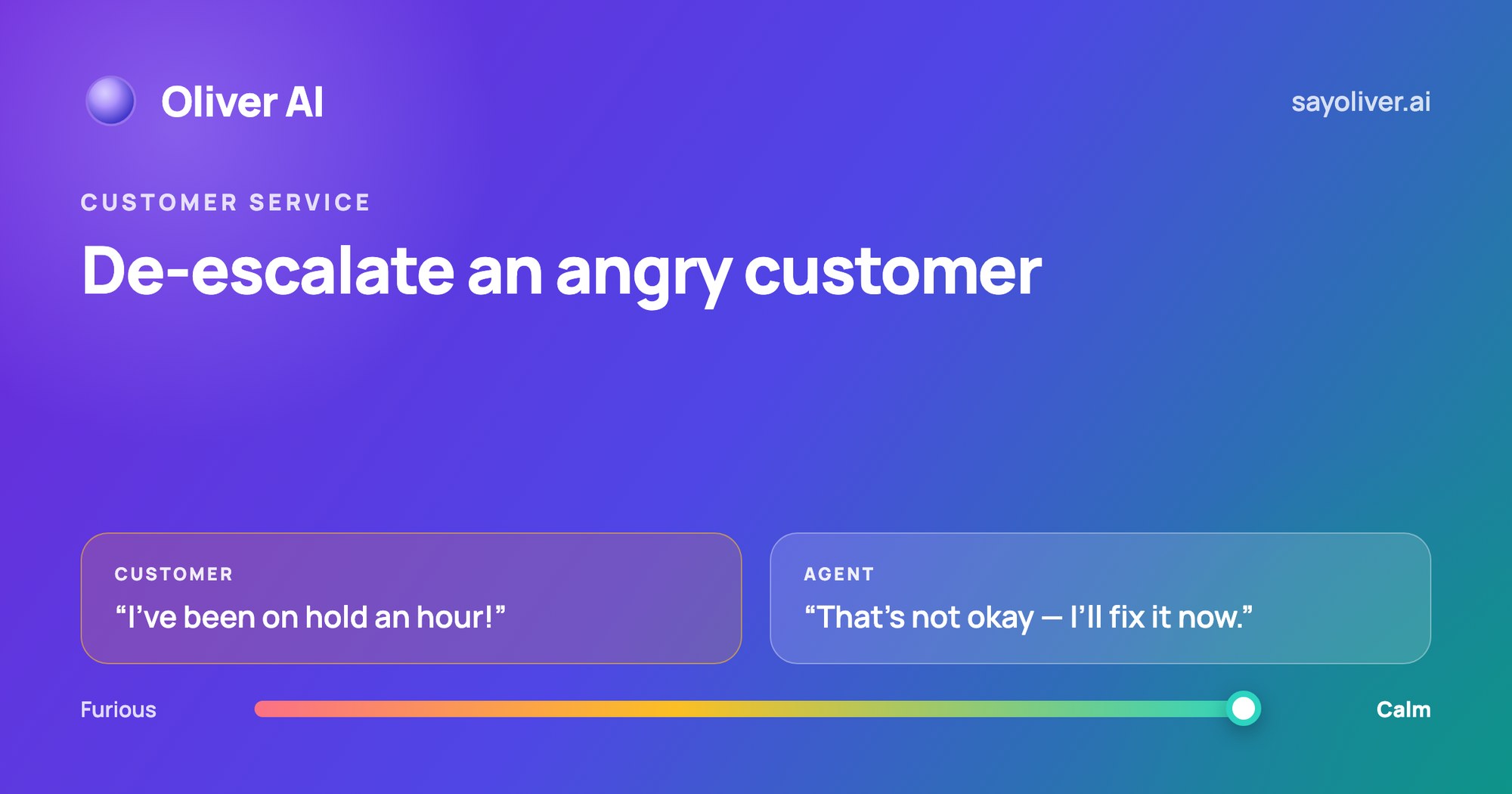
What escalation actually looks like
An escalating customer is not just angry. They feel unheard. The anger is usually the second emotion; frustration, disappointment, or fear came first. By the time they are shouting or threatening to cancel, something has already gone wrong that they believe nobody took seriously.
Recognising this changes how you respond. You are not managing a complaint. You are making someone feel heard, often for the first time in the interaction. The same instinct underpins how you handle difficult customers of every kind, not just the loud ones.
The instinct that makes it worse
When someone is hostile, the natural response is to become defensive or to explain. Both of these escalate the situation. Explaining, even when you are factually correct, signals that you care more about being right than about the customer's experience.
Similarly, jumping straight to solutions before the customer feels heard often backfires. They will reject the solution, not because it is wrong, but because they are not ready to receive it.
Practise de-escalating an angry customer, try it now, no sign-up needed.
Practise de-escalating an angry customerA de-escalation framework
The most reliable de-escalation approach follows three stages: acknowledge, align, act.
- Acknowledge: Name what you are hearing without judgment. "It sounds like this has been going on for a while and you're really frustrated. That's completely understandable."
- Align: Show you are on the same side. "My goal right now is to get this sorted for you."
- Act: Propose a specific next step, not a general promise. "Here's what I'm going to do in the next ten minutes."
Phrases that work
The language you use matters as much as the intent behind it. These phrases consistently help lower the temperature, and you can build a wider library from these customer service de-escalation scripts.
- "I completely understand why you're frustrated. This should not have happened."
- "You're right to expect better from us."
- "I'm not going to make excuses. Let me focus on fixing this."
- "Can I take a moment to make sure I've got the full picture?"
- "Here's exactly what I'm going to do next."
Practise de-escalating an angry customer, try it now, no sign-up needed.
Practise de-escalating an angry customerWhy practice matters
De-escalation is a physical skill as much as a verbal one. Your tone of voice, your pace, your willingness to absorb anger without flinching: these are things you develop through repetition, not theory.
Practising with an AI partner that plays a genuinely difficult customer gives you useful repetition before a real conversation. For teams, scope contact-centre practice as a guided pilot with an agreed scenario, cohort, and evidence review.
The best customer service teams do not wing de-escalation. They practise it. When the real call comes in, the rep who has already heard that level of anger, and found their footing, handles it in a way that turns a frustrated customer into a loyal one.
See it in Oliver
Ready when you are
Practise before the next real conversation.
No sign-up required. Pick the scenario, add your name, and speak with a realistic AI partner. Get a scorecard and transcript after every call.