How to Run a Discovery Call
By Dave Wilson · 7 min read · Updated 13 August 2026
Knowing how to run a discovery call is the single most valuable skill in B2B sales, and the one most reps skip straight through. Discovery is not a box to tick before the demo. It is the moment you decide whether there is a real deal in front of you, and whether the prospect decides you are worth their time.
What is a discovery call
A discovery call is a structured conversation in which a sales rep learns about a prospect's current situation, the problems they are trying to solve, and what it would mean to solve them. The word "discovery" matters: you are finding out, not presenting.
Done well, discovery builds genuine trust. The prospect feels heard. You walk away with enough context to tailor everything that follows, or to disqualify the deal before everyone wastes more time.
| Moment | Weak version | Strong version |
|---|---|---|
| Opening | "How's everything going?" | "I want to make sure I understand what's actually going on for you, what prompted this call?" |
| Hearing a problem | Pivots straight to a feature that fixes it | Asks what that problem costs before mentioning the product at all |
| Buyer pushes back on scope | Agrees to send more info and moves on | Names the pushback directly and asks what would need to be true to move forward |
| Ending the call | "I'll send over some information" | Proposes one specific next action tied to the priority the buyer just named |
Do the homework before you dial
The single most common gap between a rep who runs a strong discovery call and one who does not is not a question technique, it is preparation. Spend ten minutes on the prospect's company, recent news, their industry, and whatever their role suggests they care about, before the call starts. It changes the first two minutes from generic small talk into something that signals you did not just show up.
This is not about performing research back at the prospect. It means you do not waste their time asking things you could have looked up, and you can ask a sharper first question: "I saw you just [expanded into a new market / hired a VP of X], is that connected to what prompted this call?" tells the prospect more about how you work than anything you could say about your product.
Practise a discovery call, try it now, no sign-up needed.
Practise a discovery callThe biggest discovery call mistakes
Most reps treat discovery as a warm-up for the demo. They ask a few surface questions, then pivot to showing the product the moment they sense any interest. The result is a demo pitched at the wrong problem, for the wrong buyer, at the wrong time.
Other common mistakes: talking more than listening, asking leading questions that telegraph the answer you want, and forgetting to ask about impact: why does this problem actually matter to the business? Getting the discovery call questions right is what separates a real conversation from an interrogation.
How to open a discovery call
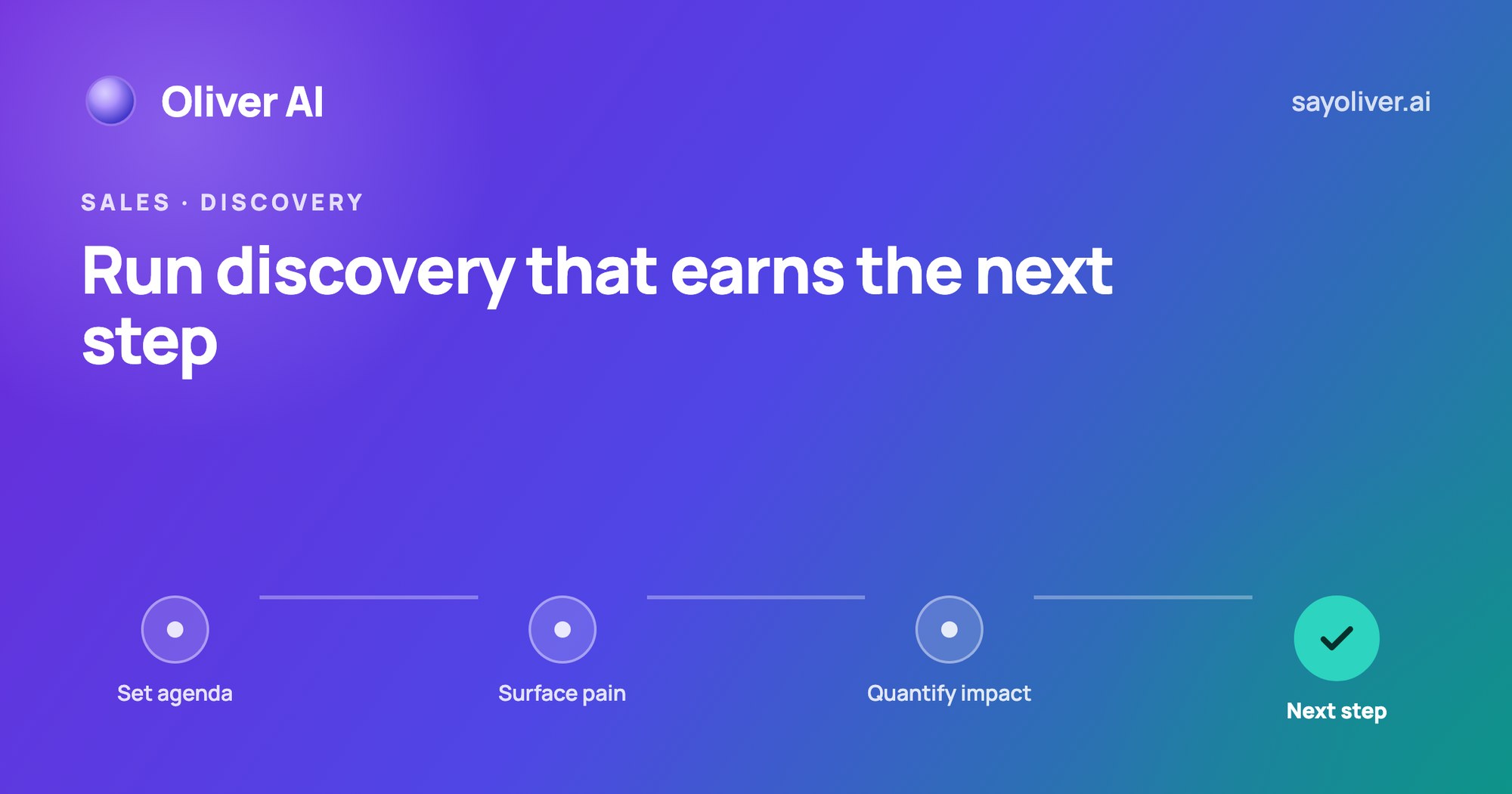
Set an agenda in the first 60 seconds. Tell the prospect how long you have, what you want to cover, and confirm they are happy with that. This signals respect for their time and gives you a framework to return to if the call drifts.
Then ask an open question about their world, not about your product. Something like: "Before I show you anything, I want to make sure I understand what's actually going on for you. What prompted you to take this call today?"
Practise a discovery call, try it now, no sign-up needed.
Practise a discovery callQuestions that uncover real pain
The best discovery questions dig below the surface. Start with situation questions to understand context, then move to problem questions that surface what is not working, then impact questions that reveal the cost of the problem.
- "Walk me through how you currently handle [process]."
- "What breaks down most often with that approach?"
- "What does that cost you, in time, revenue, or something else?"
- "Who else feels the impact when this goes wrong?"
- "If you solved this in the next six months, what would that unlock?"
Why are our discovery calls not converting?
If discovery calls are happening but deals are not progressing, the cause is almost always one of four things.
Impact was never quantified
The call surfaced symptoms but never quantified impact, so the prospect left without a number that justifies changing anything.
The rep pitched too early
Discovery turned into a demo the moment the rep sensed interest, losing the chance to build the business case first.
The wrong person was on the call
Genuine pain came through, but the person on the call has no authority to act on it.
The call ended without a next step
There was no specific, agreed action at the end, and "I'll send some info" quietly became the deal's tombstone.
Practise a discovery call, try it now, no sign-up needed.
Practise a discovery callDiagnose before you fix it
The fix is diagnostic, not motivational. Pull the transcripts of your last ten discovery calls and check each against those four failure modes, most teams find one dominant pattern, not ten different problems. Then have reps rehearse that specific moment until it is fixed; running the same scenario against an AI buyer that pushes back is the fastest way to get those repetitions in.
How to earn a next step
A discovery call that ends with "I'll send you some info" is a discovery call that is dying. Earn the next step by summarising what you heard, confirming you understood it correctly, and proposing a specific next action tied to their problem, not your process. Weak qualification here is also where deals later stall on price, so it pays to learn how to handle price objections before they surface.
Try: "Based on what you've shared, it sounds like [specific pain] is the real priority. The most useful next step I can think of is [specific action]. Does that make sense to you, or is there something more pressing I should address first?"
Practise a discovery call, try it now, no sign-up needed.
Practise a discovery callFrequently asked questions
How do you make a discovery call?
Research the prospect first, open by stating an agenda and confirming the prospect is aligned with it, then ask open situation and problem questions before moving to impact, what the problem actually costs them. Close by summarising what you heard and proposing one specific next step tied to their stated priority, not a generic "I will send some info."
What should you ask during a discovery call?
Start broad with situation questions about how they currently handle the process in question, then narrow to problem questions about what breaks down, then impact questions about what that costs in time, revenue, or something else. Discovery call questions that actually work has the fuller list, organised the same way.
Is a discovery call the same as a sales call?
A discovery call is a specific type of sales call, the first structured conversation focused on understanding the prospect's situation rather than presenting or closing. Later sales calls, a demo, a proposal review, a negotiation, build on what discovery uncovered, so a discovery call that skips straight to pitching undermines the calls that come after it too.
How long should a discovery call be?
Most B2B discovery calls run 20 to 30 minutes: enough time to open properly, ask enough questions to genuinely understand the situation, and close with a real next step, without running so long that it turns into an unplanned demo. Setting the time explicitly in the opening agenda is what keeps it inside that window.
Discovery is a skill, not a script. The reps who consistently convert at the highest rate are the ones who practise asking better questions before they are in front of a real buyer. The fastest way to sharpen that skill is to run practice calls where someone pushes back, so the first time you face a hard question, it is not in a live deal. That is exactly what AI sales roleplay is built for, and our AI roleplay for sales puts a realistic buyer in front of you on demand.
See it in Oliver
Ready when you are
Practise before the next real conversation.
No sign-up required. Pick the scenario, add your name, and speak with a realistic AI partner. Get a scorecard and transcript after every call.