How to Handle Price Objections
By Dave Wilson · 8 min read · Updated 13 August 2026
Knowing how to handle price objections is what separates reps who discount reflexively from those who hold value and still close deals. Price objections are rarely about price. They are almost always about perceived value, and that is something you can address.
Why the price objection happens
A buyer raises a price objection when they are not convinced the cost is justified by the outcome. That gap usually opens in discovery: either the pain was not surfaced clearly enough, the impact was not quantified, or the wrong stakeholder is in the room.
In other words, a price objection late in the process is often a discovery problem in disguise. The groundwork was not laid. This is why learning to run a discovery call that quantifies impact does more for your close rate than any clever rebuttal.
The mistake reps make
The instinct when a buyer says "that's too expensive" is to discount. It is quick, it removes the tension, and it feels like progress. But discounting without resolving the underlying concern trains buyers to object every time, and signals that your original price was not real.
The other common mistake is getting defensive. Listing features and justifications when a buyer is questioning value rarely helps. It makes the rep sound rattled.
Practise a price objection, try it now, no sign-up needed.
Practise a price objectionA framework for handling price
When a price objection lands, slow down. The goal is not to rebut. It is to understand.
- Acknowledge: "I hear you, that's a meaningful number."
- Clarify: "Is it the total cost, the timing, or how it compares to what you're spending today?"
- Reconnect to impact: "Earlier you mentioned [specific pain] was costing you [specific amount]. Help me understand how this compares."
- Reframe: "What would it need to look like to feel like a fair deal for you?"
Phrases that hold value
There is a difference between holding firm and being inflexible. These phrases help you stay grounded without sounding dismissive.
- "We price where we do because [specific reason tied to their outcome]."
- "I want to make sure we're solving the right problem before we talk about adjusting anything."
- "Most customers in your situation find the ROI shows up in [specific timeframe]. Does that match what you're seeing?"
- "I can explore what flexibility looks like, but first help me understand what's driving the concern."
Practise a price objection, try it now, no sign-up needed.
Practise a price objectionThe 7 most common price objections, and what each really means
Most price objections are one of seven scripts, and each one is telling you something different. Diagnose which one you are actually hearing before you respond, the wrong response to the right objection is how deals stall. (For objections beyond price, our guide to common sales objections and rebuttals covers the full set.)
"It's too expensive."
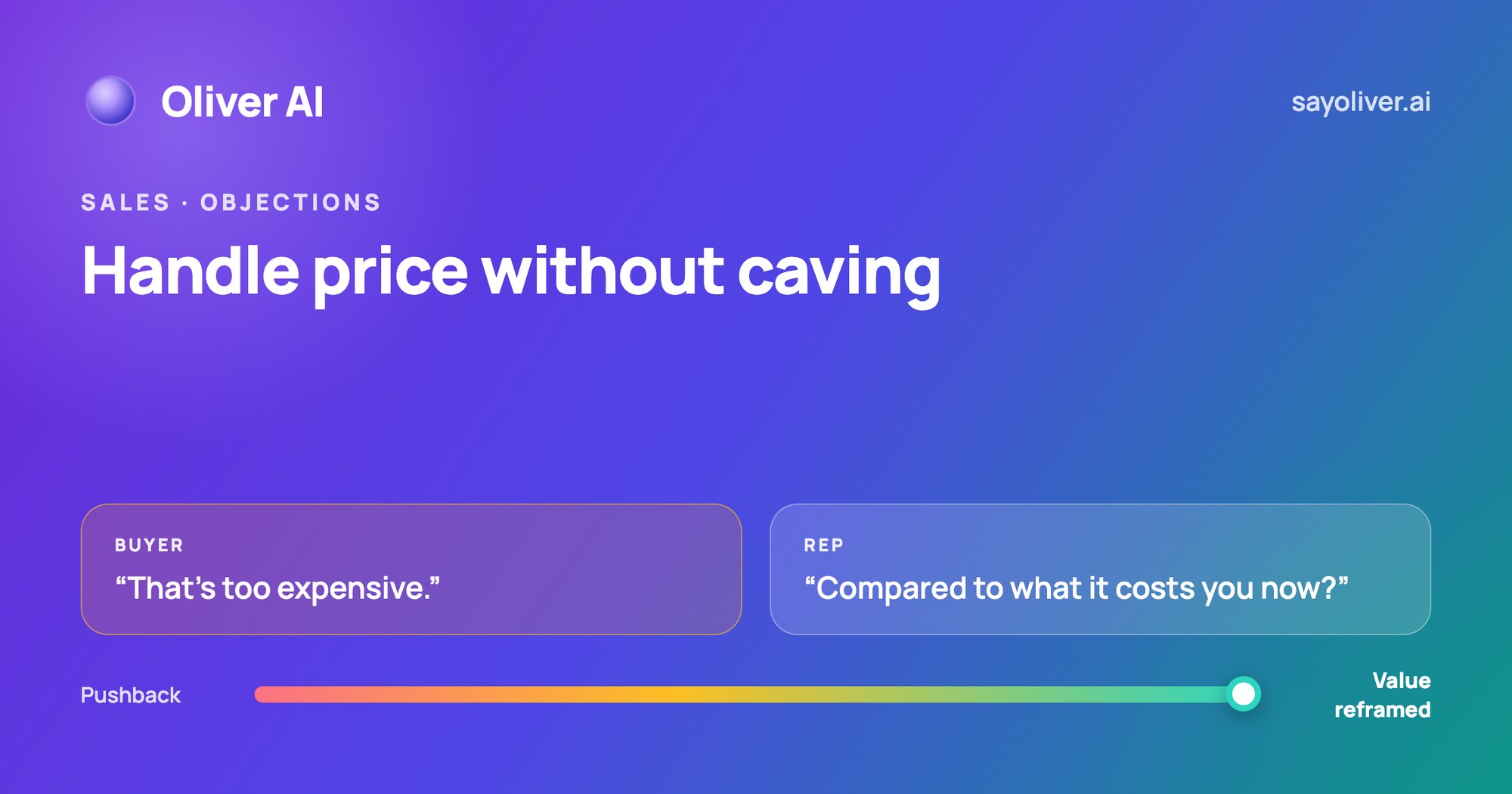
Usually means: I don't see enough value yet. Respond: "Compared to what? Help me understand what you're weighing it against, the status quo, another tool, or the budget you had in mind."
"We don't have budget."
Usually means: this isn't a priority yet, or the wrong person is in the room. Respond: "If budget weren't the issue, would this be something you'd move on this quarter?" Our guide to the no-budget objection goes deeper.
"Your competitor is cheaper."
Usually means: I like you but need to justify the difference. Respond: "They're a good product. The difference in price comes down to [specific capability tied to their pain], is that something you'd use?"
"Can you do a discount?"
Usually means: I'm ready to buy and testing what's possible. Respond: "What would make this feel like a fair deal? If it's truly the number, let's talk about scope, I'd rather adjust what's included than pretend the price wasn't real."
"We could build/do this ourselves."
Usually means: I haven't costed the alternative honestly. Respond: "Some teams do. When you factor in [time, maintenance, opportunity cost], most find it costs more, want to walk through that math together?"
"Not this quarter."
Usually means: the pain isn't urgent enough yet. Respond: "What changes next quarter? If the problem is costing you [impact from discovery] every month, waiting has a price too."
"I need to think about it."
Usually means: there's an unspoken concern. Respond: "Of course. So I make sure you have what you need, is it the price itself, the timing, or something about the fit?"
| What they say | What it usually means |
|---|---|
| "It's too expensive." | They don't see enough value yet |
| "We don't have budget." | Not a priority yet, or the wrong person is in the room |
| "Your competitor is cheaper." | They like you but need to justify the difference |
| "Can you do a discount?" | Ready to buy, testing what's possible |
| "We could build/do this ourselves." | They haven't costed the alternative honestly |
| "Not this quarter." | The pain isn't urgent enough yet |
| "I need to think about it." | There's an unspoken concern they haven't named |
Practise before it's live
Price objections feel high-stakes in the moment. The best way to handle them calmly is to have heard them before, in a low-stakes environment where you can try different approaches, stumble, and try again.
That is exactly what AI roleplay practice is built for. You face a realistic buyer who pushes back on price, and you get coaching on how you responded. The best AI sales roleplay software lets you rehearse the objection until your composure is automatic.
Practise a price objection, try it now, no sign-up needed.
Practise a price objectionFrequently asked questions
What is a price objection?
A price objection is any pushback from a buyer about cost: "it's too expensive", "we don't have budget", "your competitor is cheaper". It is rarely a final no. In most cases it signals that the buyer does not yet see enough value to justify the number, which means the real work is reconnecting the price to the problem it solves.
How do you respond to a price objection?
Slow down and diagnose before you defend. Acknowledge the concern, clarify what is driving it (total cost, timing, or comparison), reconnect to the impact the buyer described in discovery, and then ask what a fair deal would look like. Discounting before you understand the objection resolves the tension but trains the buyer to object every time.
Should you ever discount to overcome a price objection?
Sometimes, but only after the underlying concern is understood, and ideally by adjusting scope rather than just the number. A discount given the moment a buyer flinches signals the original price was not real. If you do flex, trade it for something: a longer term, a case study, an introduction.
Why do price objections happen so late in a deal?
Because the groundwork was missed earlier. When pain is not quantified in discovery, the buyer has no number to weigh the price against, so the price becomes the only number in the conversation. Late price objections are usually discovery problems in disguise.
Handling price objections well is not about being clever. It is about having done the discovery work to justify value, and having the composure to slow down when pressure arrives. Both of those things come from practice, and it helps to study the wider craft of how to handle sales objections too.
Ready when you are
Practise before the next real conversation.
No sign-up required. Pick the scenario, add your name, and speak with a realistic AI partner. Get a scorecard and transcript after every call.