Call Center Script Best Practices: How to Actually Use One
By Dave Wilson · 8 min read · 16 September 2026
Most guides to call center script best practices are written for the person designing the script: a contact center manager deciding what goes on the card. If you are the one who has to say that card out loud on a real call, or in a mock call during hiring, those guides do not answer your actual question, which is how much of this you have to say word for word, and what to do the moment the customer stops following along. This page is written from your side of the desk. Five rules, in the order they matter once you are actually on a call, not once you are writing one.
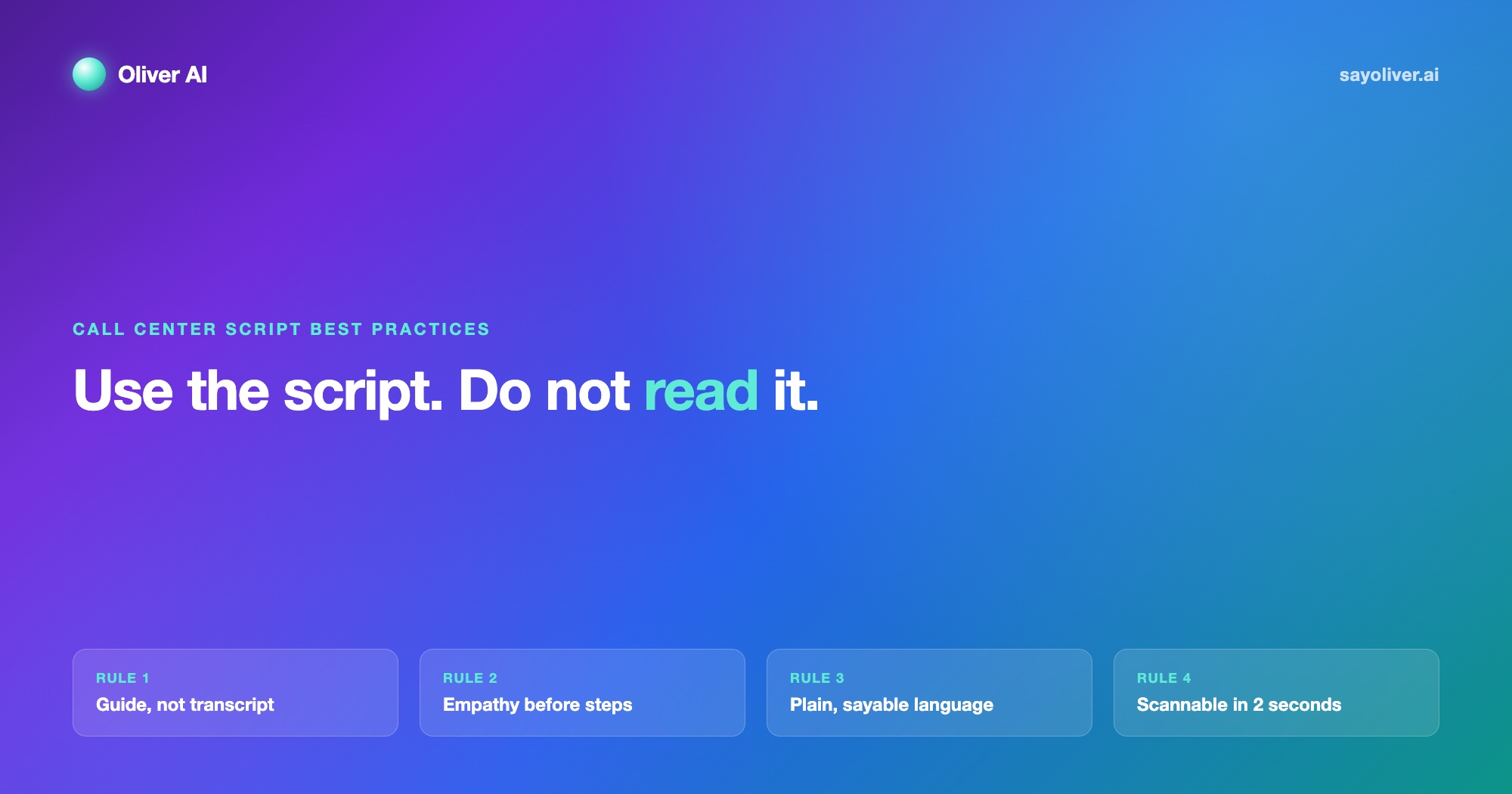
The idea behind every rule below: a script is a floor, not a cage
A script exists to guarantee a minimum, that every caller gets a proper greeting, gets verified before you touch their account, and hears a clean close. It was never meant to be the full transcript of a good call, because a real customer does not read from the other half of the page. The moment you treat every line as mandatory, you stop listening for what the customer actually said and start hunting for the next line on the card, and callers can hear the difference immediately.
The fix is knowing which lines are actually fixed and which ones are yours to say in your own words. On almost every account, that is a much shorter list than new agents assume: the opening, the closing, and anything with a compliance or legal requirement attached. Everything in between, probing, empathy, explaining a policy, is intent you deliver, not text you recite. Call center script examples breaks the whole call down stage by stage if you want the actual lines; this page is about the rules for using them well once you have them.
Rule 1: use it as a guide, not a transcript
Memorize the opening and closing word for word, since those two are usually the only parts a QA scorecard checks for exact compliance language. Learn everything else as a sequence of steps, not a sequence of sentences. If you know you are in the verification stage, you can verify a customer in your own words. If you have only memorized a verification sentence, you have nothing to say the moment the customer answers differently than the script assumed.
| Situation | Reading it word for word | Using it as a guide |
|---|---|---|
| Customer answers before you finish the question | You keep reading the rest of the scripted question anyway | You drop the rest of the line, you already have what you needed |
| Customer gives an answer the script did not anticipate | You repeat the question, hoping for the expected answer | You ask a follow-up in your own words to get what you actually need |
| You lose your place mid-script | You go silent while you search for the exact line | You say what the step is for in plain language and keep moving |
Practice saying these lines out loud, try it now, no sign-up needed.
Practice saying these lines out loudRule 2: lead with empathy before you follow the steps
A script that jumps straight to verification or diagnosis on a call where the customer is clearly upset will make you sound like you did not hear them. Acknowledge the specific thing that went wrong before you move to the next step, even if the step you are about to do is the right one. "That is frustrating, being charged twice for the same order" costs you two seconds and buys you a customer who is now willing to sit through verification.
Avoid the reflex line "I understand how you feel." It is the single most-flagged phrase in QA calibration across contact centers, precisely because it is what a script sounds like when nobody actually listened. Name the specific thing that happened instead. Empathy statements for customer service has the fuller list of phrases that work and the ones that do not.
Rule 3: say it the way you would actually talk
A line written to sound thorough on paper often sounds like jargon out loud. "I will need to initiate a verification protocol before proceeding with account modifications" is accurate and useless; a customer has to translate it before they can answer it. "I just need to check a couple of details before I make any changes, is that okay?" says the same thing and gets a faster yes.
A rough test that works on any line before you use it live: read it out loud once. If it does not sound like something you would actually say to a person standing in front of you, it will not survive contact with a real caller either. Scripts written by people who do not take calls tend to fail this test more than the ones written by people who do.
Practice saying these lines out loud, try it now, no sign-up needed.
Practice saying these lines out loudRule 4: format it so you can find your place in two seconds
A script you have to read top to bottom mid-call is a script you will lose your place in the moment a customer talks over you. The scripts that actually work on the floor are formatted for scanning: short bulleted lines under a clear stage heading, not paragraphs of prose. If your team hands you a script as a dense block of text, break it into stage headings and bullets yourself before your first shift, since you are the one who has to find the right line under pressure, not the person who wrote it.
Keep a personal cheat sheet of the four or five lines you specifically keep fumbling, not the whole script. Nobody scans an 80-line document mid-call. Everyone can scan five lines taped next to their monitor.
Rule 5: flag the line that never works
Scripts get written once and used thousands of times, which means the agent saying the lines finds out they are broken long before whoever wrote them does. If a line reliably makes customers defensive, or a verification question reliably confuses people, that is real information your team lead or QA reviewer needs, and most of them genuinely want it. Most corporate guides frame this step as something a training manager does on a quarterly review; on the floor, it starts with you noticing and saying something the same week, not waiting for the next audit.
This is also the difference between a script that gets better over time and one that quietly gets ignored. Agents route around a line that does not work by improvising past it silently, and if nobody ever reports it, next year's new hire gets handed the same broken line with no warning.
Practice saying these lines out loud, try it now, no sign-up needed.
Practice saying these lines out loudWhat this actually looks like in your first week on the floor
During nesting, the gap between reading a script and using it well shows up fast. You will have the card in front of you, and you will still freeze the first time a customer answers a question you did not expect, because reading a script silently at your desk the night before does not train the reflex you need at 9am with a real caller waiting. The five rules above are not extra polish, they are what separates an agent who sounds like they are reading from one who sounds like they know what they are doing, in week one, not month three.
Reading the rules is not the same as sounding natural
You can agree with everything above and still sound robotic on your first ten real calls, because natural delivery is a spoken skill, not a reading skill. It only comes from saying the lines out loud enough times that you stop thinking about them mid-sentence.
Free mock call practice runs the same five stages against an AI customer who interrupts, answers unpredictably, and does not wait politely while you find your place on the card, then hands back a transcript and a score so you can see exactly which rule you are not applying yet. Run the stage you keep fumbling five or six times and the script stops being something you read.
Practice saying these lines out loud, try it now, no sign-up needed.
Practice saying these lines out loudFrequently asked questions
What are the best practices for a call center script?
Treat it as a guide rather than a transcript, memorizing only the compliance-checked opening and closing word for word. Lead with a specific empathy statement before you move to the next step. Keep the language plain enough to say out loud without sounding like a manual. Format it for scanning under pressure, short bullets under stage headings, not paragraphs. And flag the lines that consistently do not work back to whoever owns the script, rather than quietly working around them.
How do you make a call center script sound natural?
Say the intent of the line in your own words instead of reading it verbatim, outside of the opening, closing, and any line with a compliance requirement attached. Read every new line out loud before you use it live, since lines that look fine on the page often do not fit naturally in a mouth. Naturalness comes from repetition, not from memorizing a better version of the same words.
What should a call center script include?
A usable script covers the five stages of a call, opening, verification, probing and empathy, resolution, and closing, with the compliance-required parts written out in full and everything else left as prompts rather than full sentences. A script that reads like a movie transcript encourages word-for-word delivery, which is what makes agents sound scripted.
Can new agents deviate from the script?
Yes, everywhere except the compliance-checked opening, closing, and any required disclosure language. QA rubrics generally score adherence to the stage structure and required elements, not identical wording, and most also score naturalness, so word-for-word delivery outside the required parts can cost points rather than earn them.
How often should a call center script be updated?
Whenever a line stops working, not on a fixed schedule. A script that only gets reviewed on a quarterly audit stays broken for months after agents have already noticed the problem, which is why the fastest-improving teams are the ones where agents report a bad line the week they find it rather than waiting to be asked.
Every rule above comes back to the same idea: a script guarantees a minimum, it does not replace judgment. Memorize the two or three lines that are genuinely fixed, learn the stages instead of the sentences for everything else, and say it the way you would actually talk. The only part no article can do for you is the repetition that makes it automatic, which is the difference between an agent who is still reading and one who has stopped needing to.
See it in Oliver
Ready when you are
Practise before the next real conversation.
No sign-up required. Pick the scenario, add your name, and speak with a realistic AI partner. Get a scorecard and transcript after every call.