Voice and Accent Training: What It Covers and How to Practice It Yourself
By Dave Wilson · 8 min read · 16 August 2026
Voice and accent training is the term used across Indian and Philippine BPOs for the coaching that turns a technically correct English speaker into someone easy to understand on a call: clear pronunciation, a reduced mother-tongue accent, and a delivery that does not force the listener to concentrate. Every course selling it online is the same shape, a paid, live class run by a corporate training institute or a marketplace tutor, often billed by the hour. What almost none of them mention is that the four skills the training actually covers, phonetics, articulation, intonation, and modulation, respond to daily self-practice the same way any spoken skill does, and the part that matters most, holding your delivery together on an actual call rather than in an isolated drill, does not require a classroom at all.
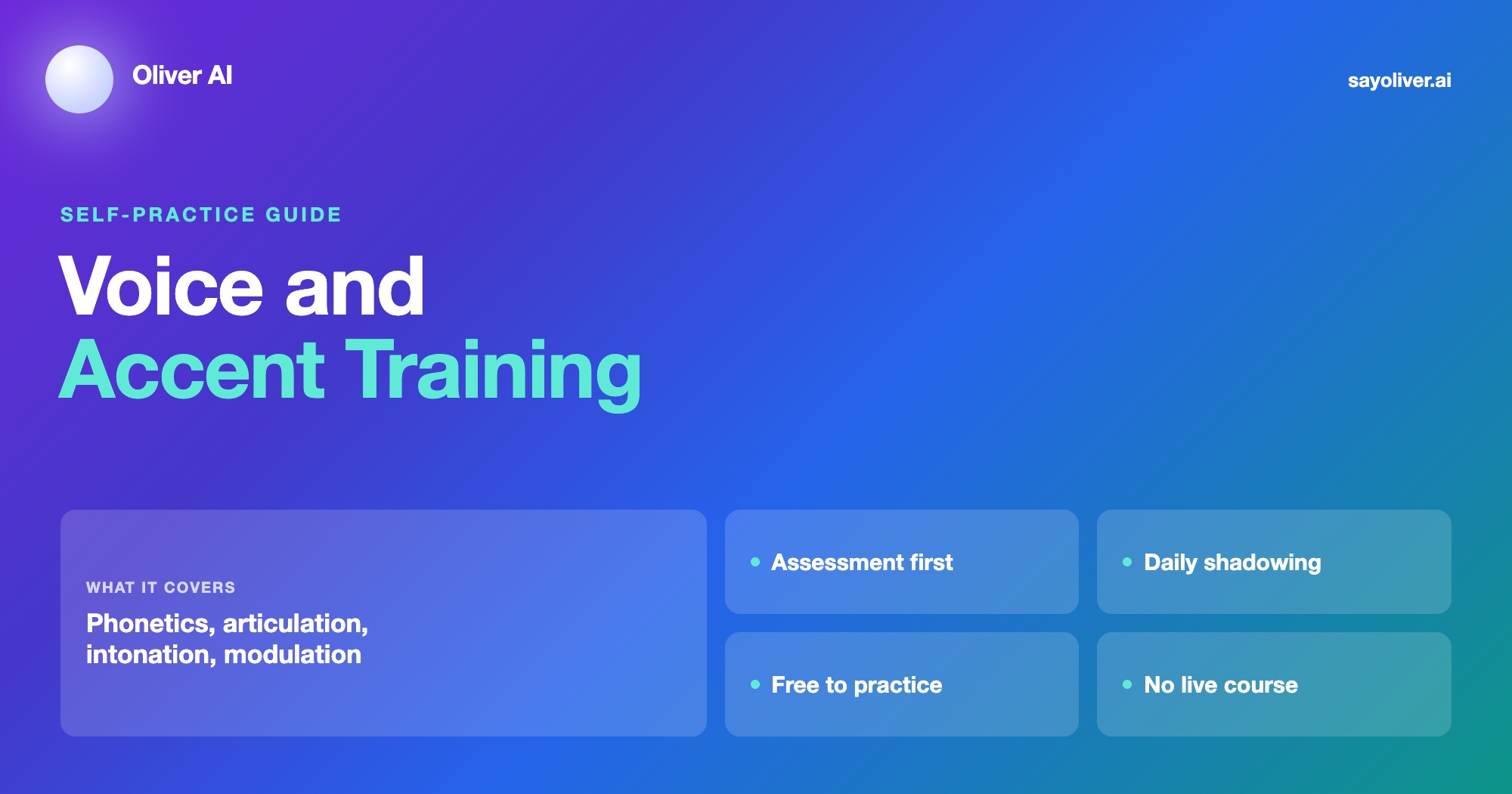
What voice and accent training actually covers
Strip away the marketing and voice and accent training breaks into four skills, each one testable and each one practiceable on your own once you know what you are drilling.
Phonetics
Learning the exact vowel and consonant sounds of the target accent, usually neutral or American English for international voice process work, often taught with the International Phonetic Alphabet so you can see the difference between a sound you are making and the one you are aiming for.
Articulation
Controlling your lips, tongue, and jaw to form each sound distinctly instead of blurring words together. This is the skill that most affects whether a caller has to ask you to repeat yourself.
Intonation
The rise and fall of pitch across a sentence. English carries meaning in intonation, a statement that rises at the end sounds like a question, and getting this wrong is one of the fastest ways a fluent speaker still sounds hard to follow.
Modulation
Adjusting your volume, pace, and projection so you sound engaged and professional rather than flat or rushed. This is the skill that most improves with confidence, and the one that suffers most under call pressure.
Accent neutralization and mother tongue influence, in plain terms
Mother tongue influence, usually shortened to MTI, is the set of pronunciation and rhythm patterns a first language carries into a second one, a Hindi speaker's retroflex "t" and "d", a Filipino speaker swapping the "f" and "p" sounds, stress landing on a different syllable than a native English speaker would place it. Accent neutralization training targets these specific, identifiable patterns rather than trying to erase an accent wholesale.
The goal on an international voice account is not to sound like you are from a specific country. It is to remove the two or three patterns most likely to cause a caller on the other end of a bad phone line to mishear a word, an account number, or a name. That is a narrow, learnable target, not a personality change, and most training programs that are worth the money treat it that way.
Practice your delivery live against an AI customer, free, with no account or card needed.
Practice your delivery live against an AI customerHow the training actually happens: assessment, shadowing, drills
Every legitimate voice and accent program, paid or self-taught, uses some version of the same three-step method.
Assessment
Recording your own speech and comparing it against a target, either a trainer's ear or your own side-by-side listening, to identify the two or three specific patterns actually causing you to be misunderstood, rather than trying to fix everything at once.
Shadowing
Listening to a native or neutral-accent speaker and repeating what they say a fraction of a second behind them, matching their rhythm and intonation in real time rather than reading a script at your own pace. This is the single most-recommended technique across every voice and accent program because it trains the ear and the mouth together.
Drills
Repetition of word stress, connected speech, and pacing exercises, done daily in short sessions rather than one long weekly class, since pronunciation muscle memory responds to frequency more than duration.
The gap: every course on the market is a paid, live class
Search for voice and accent training and page one is corporate training institutes, image-consulting academies, and tutor marketplaces, each one selling a scheduled, instructor-led course, commonly ₹5,000 to ₹25,000 for a multi-week program. None of them offer a free way to actually rehearse a full conversation on your own between sessions, and the format itself, a trainer correcting you in a group class, is lecture time, not practice time.
That gap matters because assessment and shadowing, the first two steps of the method every course teaches, do not require a live trainer at all. A recording app and a native-speaker audio clip cover both. What a self-taught routine is missing is the third and hardest part: holding your pronunciation, pace, and modulation together while you are also thinking on your feet, which only happens in an unscripted, back-and-forth conversation, not a drill.
Practice your delivery live against an AI customer, free, with no account or card needed.
Practice your delivery live against an AI customerFrequently asked questions
Is voice and accent training worth the cost?
The classroom hours matter less than what most people assume. Assessment and shadowing, the first two steps of the method, do not need a paid trainer, a recording app and native-speaker audio cover both. Where a paid course earns its price is expert feedback on patterns you cannot hear in your own voice and a fixed schedule that forces consistency. If you already have the discipline to practice daily on your own, a free routine gets you most of the way there.
How can I train my speaking voice on my own?
Record a short baseline to find your two or three hardest patterns, shadow native-speaker audio for ten minutes a day to train rhythm and intonation together, drill the specific sounds from your baseline in isolation, and then practice full, unscripted conversations so the sounds hold up under real thinking-on-your-feet pressure, not just in a rehearsed line.
What is mother tongue influence (MTI)?
MTI is the set of pronunciation, stress, and rhythm patterns a first language carries into spoken English, for example a Hindi speaker's retroflex consonants or a Filipino speaker swapping the "f" and "p" sounds. Accent neutralization training targets these specific, identifiable patterns rather than trying to change an accent wholesale.
Is voice and accent training only for call center or BPO jobs?
Most people searching for it are preparing for international voice process, sales, or customer service roles, since clear pronunciation on a phone line with no visual cues is where an accent most affects comprehension. The same four skills, phonetics, articulation, intonation, and modulation, apply to any spoken-English role, including in-person customer-facing work.
How long does it take to neutralize an accent?
Individual patterns, a single sound or a stress habit, commonly show visible improvement within two to four weeks of daily ten-minute practice. A fuller, more natural-sounding shift across intonation and modulation together usually takes several months of consistent practice, since it is muscle memory being rebuilt, not a fact being memorized.
Can I practice voice and accent training for free?
Yes, for the assessment and shadowing stages, a recording app and free native-speaker audio (podcasts, news clips) cover both. The part that is harder to replicate for free is expert ear feedback on patterns you cannot hear yourself, and realistic conversation practice where you do not know what is coming next, which is what an AI mock call adds once your isolated drills are steady.
The four skills a voice and accent course sells you, phonetics, articulation, intonation, and modulation, are real, and so is the value of expert feedback on patterns you cannot hear in your own voice. What is not required is a scheduled classroom for the daily practice in between. Assess your own baseline, shadow ten minutes a day, drill the specific pattern, and then test whether it holds up in a real, unscripted conversation, since that is the only condition your accent actually gets judged under.
See it in Oliver
Ready when you are
Practise before the next real conversation.
No sign-up required. Pick the scenario, add your name, and speak with a realistic AI partner. Get a scorecard and transcript after every call.