Inbound vs Outbound Calls: Meaning, Examples, and What the Job Is Like
By Dave Wilson · 8 min read · 2 October 2026
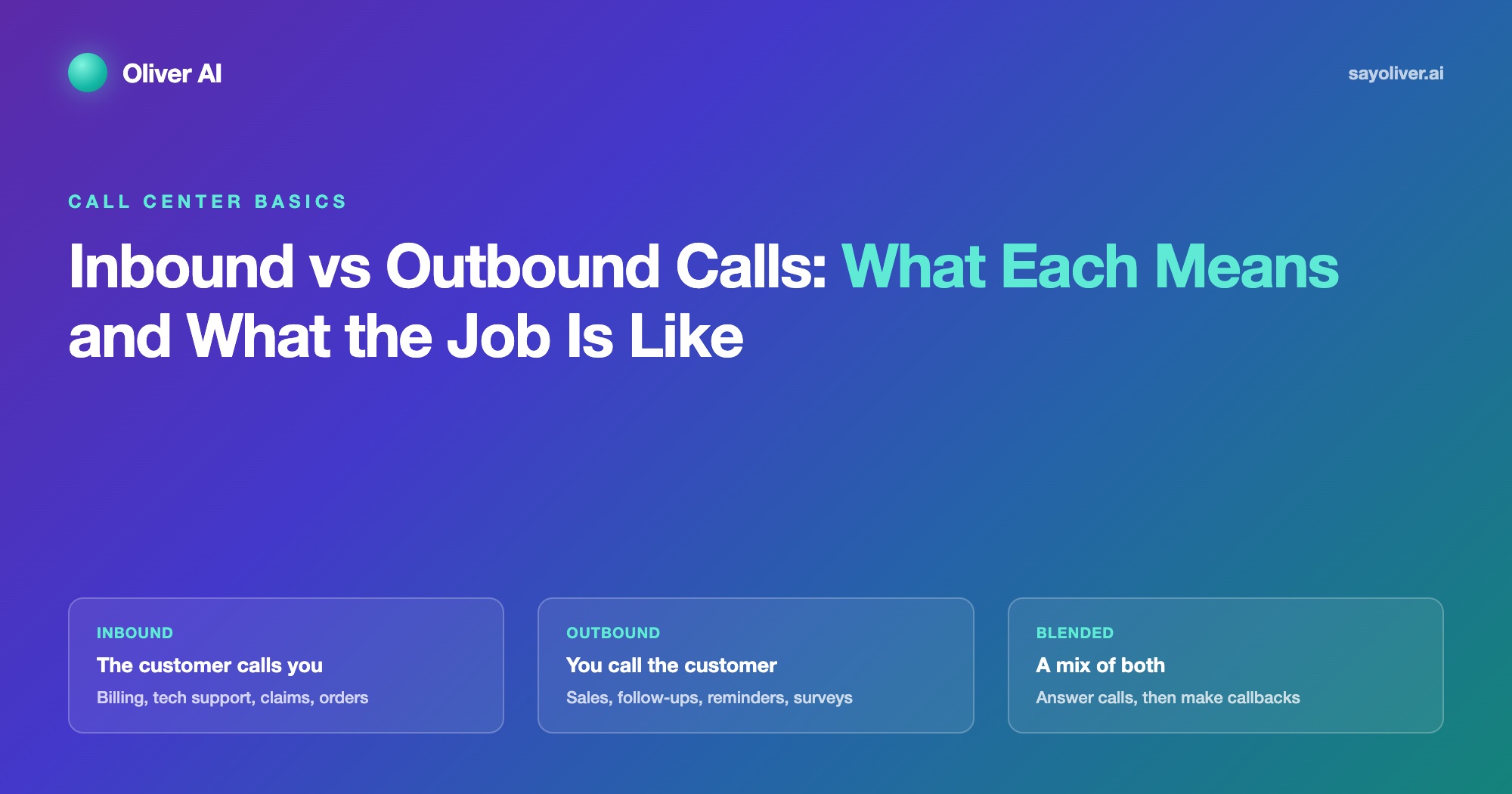
An inbound call is a call the customer makes to the company. An outbound call is a call the company, usually an agent, makes to the customer. That is the whole definition, and every page that ranks for it stops there, because almost all of them are written by dialer and phone-system vendors selling software to the business. If you searched this because a job ad said "inbound account" or "outbound sales", or because a recruiter is about to ask you the difference in an interview, the definition is the easy part. What you actually need to know is what each kind of call is like to take for eight hours, which one suits a first BPO job, and how to explain the difference out loud in a way that shows you understand the work.
What an inbound call means
An inbound call is any call that starts with the customer. They dialed the hotline, so they already have a reason to be on the phone: a bill they do not understand, an internet connection that dropped, a claim that was denied, an order that never arrived. The agent answers, opens with the call center opening spiel, verifies the account, and works the problem the customer brought.
Most entry-level BPO openings are inbound customer service or technical support. When a job ad names an account, such as telco, health care, retail, or banking, it is nearly always describing the kind of inbound caller you will be answering. The account-specific mock call scripts on this site, for telco, health care, retail and financial accounts, are all inbound calls for that reason.
What an outbound call means
An outbound call is any call that starts with the company. The agent dials, often through an auto-dialer that connects the next number in a list the moment the last call ends, and the person who picks up was not expecting to hear from them. That single difference changes the whole call: on an inbound call the customer wants something from you, on an outbound call you want something from the customer, even if it is only two minutes of their time.
Practice an inbound call, free, with no account or card needed.
Practice an inbound callCommon purposes of outbound calls
Not every outbound account is cold sales. These are the five you will see named in job ads most often.
Sales and telemarketing
Calling a list of people to offer a product, plan, or upgrade. This is the hardest outbound work for a new agent because most calls end in a no, and many accounts pay part of the salary as commission on closed sales.
Lead generation and appointment setting
Calling businesses or people who showed some interest, filled in a form, or match a profile, to qualify them and book a meeting for a salesperson. You are not closing the sale yourself, only earning the next step.
Customer follow-ups
Calling existing customers after a purchase, a support ticket, or a cancellation request. These callers already know the company, so the opening is easier than cold sales.
Reminders and collections
Appointment reminders, payment due notices, and overdue account collections. Collections in particular is its own skill set, closer to de-escalation than to sales.
Surveys and research
Calling to collect feedback or market research answers. Low pressure, short calls, and often the gentlest introduction to outbound work.
Inbound vs outbound: the difference side by side
Put next to each other, the two jobs share a headset and a call flow and very little else.
| Inbound | Outbound | |
|---|---|---|
| Who starts the call | The customer | The agent or the dialer |
| Why the customer is on the line | They have a problem or a question | They were called, often without warning |
| What the agent is trying to do | Resolve the issue on the first call | Earn the next step: a sale, a booking, a payment |
| Hardest moment | An upset caller who has already tried once | The first ten seconds before they hang up |
| How you are usually measured | Average handle time, first call resolution, CSAT, QA score | Calls made, contact rate, conversions or appointments set |
| Typical first-job accounts | Telco, health care, retail, banking, tech support | Sales, lead generation, collections, surveys |
Practice an inbound call, free, with no account or card needed.
Practice an inbound callWhat the job is actually like on each side
The table describes the work. This is what it feels like.
A day on an inbound account
Calls arrive back to back, and you do not choose which ones you get. The pressure comes from the queue and from the caller: you have to verify, diagnose, and fix the problem inside a target handle time while someone who is already frustrated explains it, sometimes for the second or third time. The upside is that the customer wants your help, so a good call ends with someone thanking you. The skills that decide whether you pass nesting are listening, staying calm with an upset caller, and knowing the system well enough that you are not searching for screens mid-call. De-escalation scripts cover the hardest version of this call.
A day on an outbound account
You hear "no" more than anything else, and on a cold sales list a large share of people hang up before you finish your first sentence. The pressure comes from targets: dials per hour, contacts, and conversions, reviewed daily. The upside is more control, since you set the pace of the call, and on commission accounts a strong week pays more than inbound would. The skills that matter are a confident opening, handling the brush-off without sounding pushy, and recovering quickly from rejection so the next call does not carry the last one. AI cold call practice covers the outbound opener and brush-off specifically.
Blended accounts
Some accounts mix both: you answer inbound calls and also make outbound follow-ups or callbacks, sometimes with chat or email in between. Job ads call these blended accounts. They suit agents who like variety and are the most common next step after a first inbound role.
Which one is better for a first call center job?
For most people with no experience, inbound is the easier start. The customer comes to you with a reason to talk, the training covers the exact problems you will hear, and the call flow is predictable enough to learn from scripts. Outbound sales asks for the hardest skill in the job, holding a stranger on the line who did not ask to be called, before you have any of the easier ones.
Outbound is the better fit if you are motivated by commission, handle rejection without taking it personally, and would rather lead a conversation than respond to one. Survey and follow-up accounts are a gentle middle ground if you are unsure. Whichever you apply for, expect the interview to test it: inbound hiring rounds usually include an angry or confused customer in the mock call, outbound rounds usually ask you to pitch something on the spot.
Practice an inbound call, free, with no account or card needed.
Practice an inbound callHow to answer "What is the difference between inbound and outbound calls?" in an interview
This is a standard screening question in BPO interviews, especially for applicants with no call center background, and it appears in the call center interview questions list for that reason.
Why they ask it
The recruiter is not checking whether you memorized a definition. They want to know whether you understand what the account you applied for will ask of you, and whether you can explain something clearly and briefly, which is the job itself.
How to answer
Give the one-line definition of each, add one example of each, then connect it to the role you applied for. Keep it under thirty seconds spoken out loud. Ending on why you suit this account is what turns a definition into an answer.
Sample answer for an inbound role
"Inbound calls are calls customers make to the company, like someone calling about a wrong bill or a slow connection. Outbound calls are calls the agent makes to the customer, like a sales offer or a payment reminder. I applied for an inbound account because I am good at staying patient while someone explains a problem, and I like the feeling of actually fixing it for them before the call ends."
Sample answer for an outbound role
"Inbound is when the customer calls the company for help, and outbound is when the agent calls the customer, usually to offer something or follow up. Outbound is harder at the start because people are not expecting your call, so the first few seconds matter a lot. I applied for outbound because I do not take a no personally, and I would rather lead a conversation than wait for one."
Practice both kinds of call before you are on the floor
Knowing the difference gets you through the interview question. It does not get you through the mock call round or your first week of nesting, because both kinds of call are spoken skills: an inbound caller who interrupts your verification, or an outbound prospect who says "not interested" four words into your opener.
Free mock call practice runs an inbound customer service call against an AI caller in your browser, with a transcript and score after, so you can rehearse the call most first jobs are built around. If you are going for an outbound sales role, run the same practice on a sales scenario and focus on the first fifteen seconds, since that is where most outbound calls are won or lost.
Practice an inbound call, free, with no account or card needed.
Practice an inbound callFrequently asked questions
What is the meaning of an inbound call?
An inbound call is a call that a customer makes to a company, such as calling a hotline about a bill, a technical problem, or an order. In a call center, inbound agents answer these calls and resolve the issue the customer called about.
What is the meaning of an outbound call?
An outbound call is a call that a company or its agent makes to a customer or prospect, for example a sales offer, a follow-up after a purchase, a payment reminder, or a survey. The person receiving the call usually did not ask for it.
What is an example of an outbound call?
A telco agent calling an existing customer to offer a plan upgrade before their contract ends is an outbound call. So is a bank calling about an overdue payment, or a clinic calling to remind a patient about an appointment.
Is inbound or outbound easier?
For most new agents, inbound is easier to start with, because the customer called with a reason and the training covers the problems you will hear. Outbound, especially cold sales, means more rejection and target pressure, though it can pay more on commission accounts.
What is a blended account in a call center?
A blended account mixes inbound and outbound work, and sometimes chat or email as well. An agent might answer customer calls for most of the shift and make follow-up or callback calls in between.
Inbound means the customer called you, outbound means you called the customer. The definition takes one sentence; the difference in the job takes a shift to feel. Inbound is about solving someone's problem under time pressure, outbound is about earning a stranger's attention under target pressure, and most first BPO jobs start on the inbound side. Know which one you applied for, be ready to explain it in thirty seconds, and rehearse that kind of call out loud before the interview asks you to do it live.
See it in Oliver
Ready when you are
Practise before the next real conversation.
No sign-up required. Pick the scenario, add your name, and speak with a realistic AI partner. Get a scorecard and transcript after every call.