Call Center Nesting: What to Expect and How to Get Through It
By Dave Wilson · 8 min read · 9 September 2026
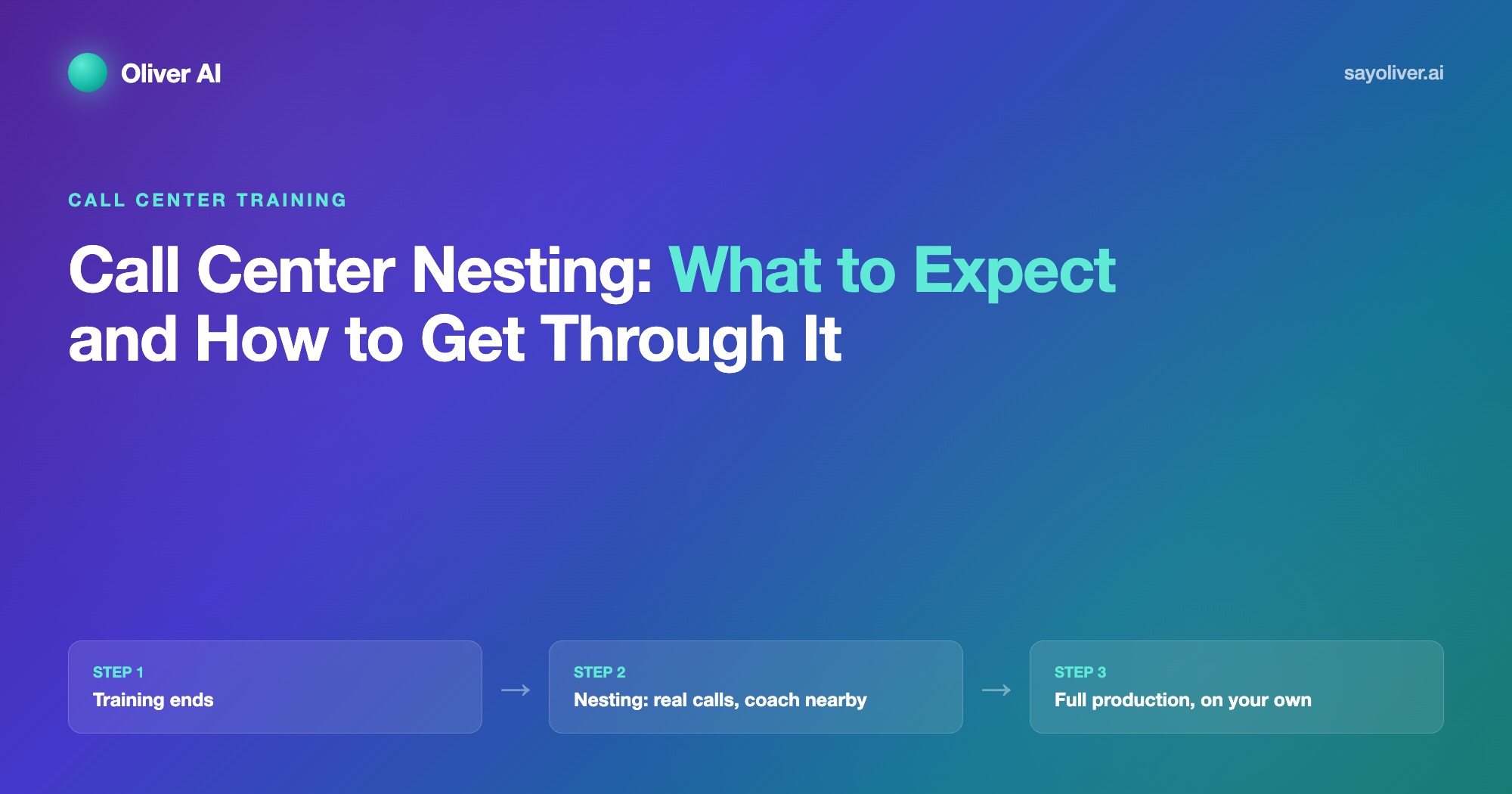
Nesting is the stage between classroom training and the production floor, where new hires start taking real calls with a coach nearby instead of practicing on scripted role-plays. Most of what comes up when you search for it is either a dry definition from a BPO vendor blog or a Reddit thread from someone panicking on their first day, and neither one tells you what actually changes or how to walk in prepared. This page covers what nesting involves, why it feels harder than training even though the calls are supposed to be simpler, and what to do before it starts.
What nesting actually is
Nesting is the supervised transition between finishing classroom training and working full production on your own. You take live customer calls, chats, or emails, but a coach or team leader is nearby, either sitting next to you or listening in remotely, ready to step in if a call goes somewhere your training did not cover. It is the first time the person on the other end of the line is a real customer with a real, unpredictable problem instead of a trainer reading from a scenario card.
The word comes from the idea of a bird staying close to the nest before it can fly on its own. In BPO use, a "nesting batch" is the group of new hires going through this phase together, usually still tracked as one cohort by the same trainers who ran their classroom sessions.
What changes once nesting starts
Training and nesting look similar from the outside, a room of new hires and a trainer, but four things change at once.
Real calls, on a shorter shift
You take live calls, but usually for four to five hours of an eight-hour shift rather than a full day on the phones. The remaining hours go to side-by-side coaching, reviewing your own recorded calls, and going over the metrics from that day.
A coach who can hear the call as it happens
Unlike a mock call graded afterward from a transcript, a nesting coach is often listening live and can step in mid-call if you get stuck, which is reassuring in the moment but also means mistakes are visible in real time, not softened by a delay before feedback.
Simple calls first, harder ones as you go
Most nesting programs start you on shorter, lower-stakes transactions and add complexity as your comfort with the tools and the account improves, rather than putting a brand-new agent straight onto the hardest call type on day one.
Metrics start counting, gently
Average handle time and customer satisfaction get tracked from your first nesting call, but most accounts treat the numbers as a learning signal during this phase rather than a pass or fail line, at least at the start. How strictly that is enforced varies a lot by account, which is why some nesting experiences feel relaxed and others feel like the metrics already matter.
Rehearse an unscripted call before nesting starts, try it now, no sign-up needed.
Rehearse an unscripted call before nesting startsWhy nesting feels harder than training, even though the calls are simpler
This is the part that catches people off guard, and it is why so many nesting search results are Reddit posts asking if it is normal to feel overwhelmed. Training calls are rehearsed: you know roughly what the customer on the other end of a role-play is going to say, because a trainer wrote the scenario. A real caller does not follow that script. They interrupt, answer a different question than the one you asked, get frustrated for a reason that was never covered in the deck, or ask something your training genuinely did not include.
The jump in difficulty is not really about skill. It is about unpredictability. Someone who scored well on every training quiz can still freeze on their first live call, not because they do not know the material, but because they have never had to apply it to something that did not go the way they expected. That gap is normal, it shows up for almost everyone, and it closes with a small number of real calls, not with more studying of the same script.
How to prepare for nesting before it starts
You cannot rehearse the exact calls you will get during nesting, since the point is that they are unscripted. You can reduce how much of your mental bandwidth goes to basic execution so more of it is free for the unexpected part of the conversation.
- Practice responding to a caller who goes off-script, not just reciting the script. Reading your opening spiel smoothly does not prepare you for a customer who answers your first question with a complaint about something else entirely.
- Get comfortable with a few seconds of silence while you think. New agents often fill dead air with filler words or a rushed, wrong answer because pausing feels like failure. A short pause to think reads as competent; a fast wrong answer does not.
- Learn your tools cold before your first nesting call. If pulling up the account screen or the knowledge base is still slow and manual, that is attention taken away from actually listening to the customer.
- Rehearse the account-specific calls most likely to come up. Mock call scripts by account type cover the transactions that repeat most often, so the shape of the call is at least familiar even when the specific words are not.
- Run a full unscripted conversation against something that talks back and does not follow a script either. Free mock call practice puts you against an AI customer who can go off-topic, get frustrated, or ask something unexpected, which is a closer rehearsal for nesting than reading a script alone.
Rehearse an unscripted call before nesting starts, try it now, no sign-up needed.
Rehearse an unscripted call before nesting startsFrequently asked questions
What happens during nesting in a call center?
New hires take real customer calls, chats, or emails on a reduced shift, usually four to five hours instead of a full eight, with a coach or team leader listening in and able to step in if a call goes somewhere training did not cover. The remaining shift hours go to coaching, call review, and going over performance metrics.
How long does call center nesting last?
It varies by account and company, commonly one to four weeks, though some run shorter or longer depending on how complex the account is and how quickly a cohort is hitting its metrics.
Do you get paid during nesting?
Yes, nesting is paid time, the same as training in most BPOs, since you are doing real production work, just at reduced volume and with support nearby. Pay structure specifics depend on the employer.
What happens if you fail nesting?
Policies vary by company. Some extend the nesting period for more coaching, some move a struggling agent to a different account better suited to their strengths, and some end employment if metrics do not improve after extra support. Most struggling new agents are not failing from lack of knowledge, they are failing from lack of practice handling calls that do not follow a script.
How is nesting different from training?
Training uses scripted role-play scenarios with predictable, low-stakes practice partners. Nesting uses real customers who do not follow a script, interrupt, or ask things training never covered, which is why nesting often feels like a bigger jump in difficulty than the actual complexity of the calls would suggest.
Nesting feels harder than training because it is less predictable, not because the calls themselves are more complex than what you already learned. The agents who struggle most are usually the ones who only ever rehearsed the script, not a conversation that could go somewhere the script did not plan for. Get comfortable with a caller who goes off-topic, learn your tools until they are automatic, and run a few unscripted practice calls before your first real one, so nesting is the second time you have handled a surprise, not the first.
See it in Oliver
Related reading
Keep going.
Ready when you are
Practise before the next real conversation.
No sign-up required. Pick the scenario, add your name, and speak with a realistic AI partner. Get a scorecard and transcript after every call.