How to Handle an Irate Customer: Steps, a Full Call Script and the Interview Answer
By Dave Wilson · 9 min read · 21 October 2026
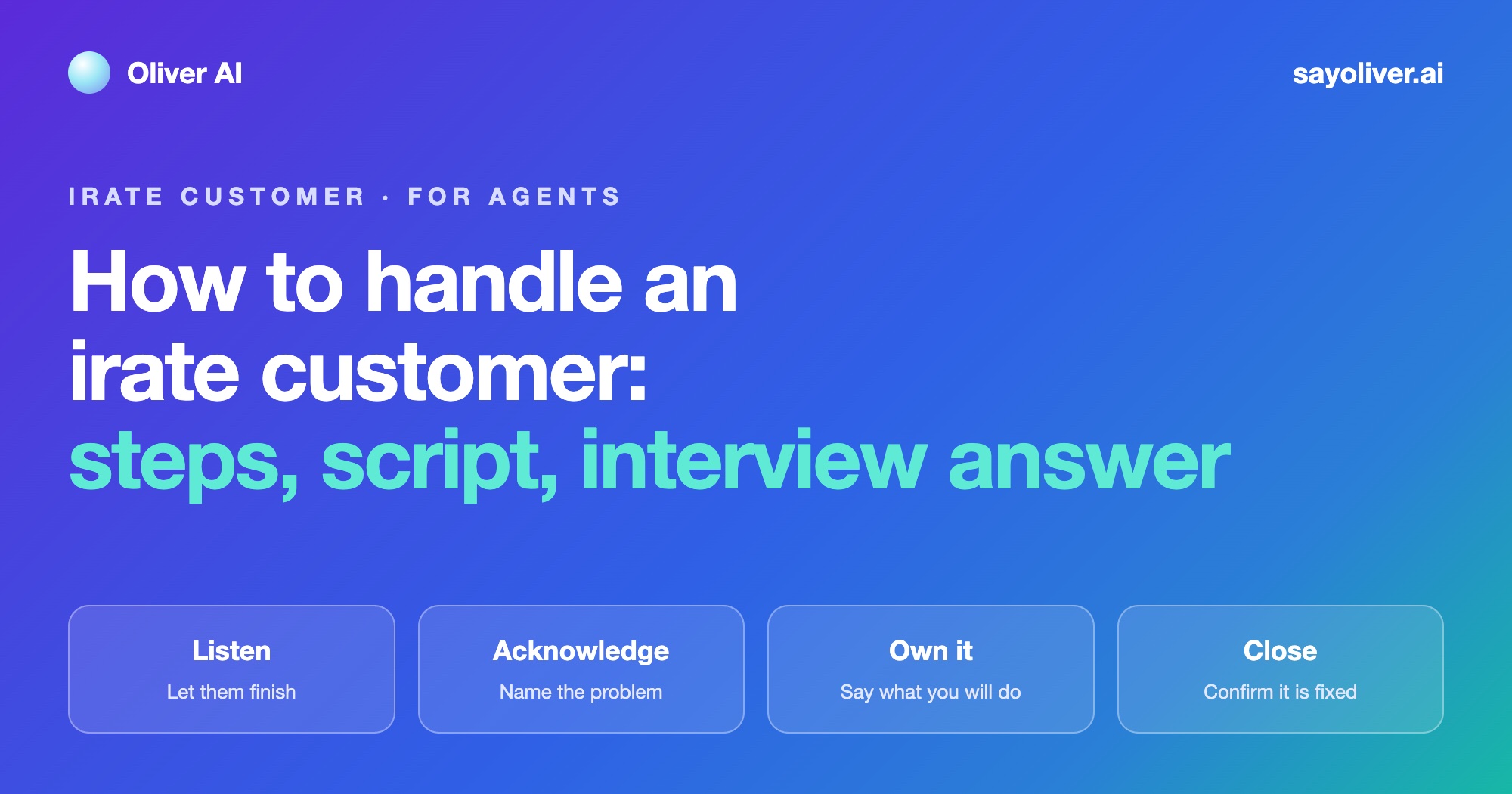
To handle an irate customer, let them finish without interrupting, name the specific problem back to them, apologise once for the experience, verify the account, say exactly what you will do and by when, and confirm the fix before you close. Most guides on this topic are written by software companies for support managers. This one is for the agent on the call and the applicant who is about to be asked "How will you handle an irate customer?" in an interview, so it includes the words to say, a full irate call line by line, and sample interview answers.
Irate customer meaning
Irate means very angry. In a call center, an irate customer or irate caller is one who is already angry when the call connects, usually because something went wrong more than once: a second wrong bill, a third call about the same outage, a refund that was promised and never arrived, or a long wait in the queue. They are angry at the company, and you are the first person they can say it to.
An irate caller is different from an abusive one. Shouting and complaining is irate, and it is your job to handle it. Cursing at you personally, insults and threats are abuse, and most accounts have a separate policy for that, covered further down.
How to handle an irate customer in six steps
These are the steps QA listens for on an irate call, in the order they happen.
1. Let them finish
Do not interrupt, even to verify. An irate caller who is cut off starts again from the beginning, louder. Use short signals that you are still there, such as "Okay" or "I'm with you", and write down the details while they talk: dates, amounts, what the last agent promised.
2. Name the specific problem
Repeat the problem back in one sentence with the details they gave: "You were charged twice for September, and you already called about it last week." This does more than a general empathy line, because it proves you listened. The empathy statements guide has more lines built the same way.
3. Apologise once, for the experience
"I'm sorry you had to call again about this." Apologise for what they went through, once, then move on. Repeating "I'm sorry" five times sounds scripted and makes the call longer without fixing anything.
4. Verify, and say why
You still have to verify the account, and an irate caller may resent it. Tell them why: "So I can pull up the charges and fix this, may I have the account holder's full name?" Skipping verification because the caller is upset is an auto-fail on most QA scorecards.
5. Say what you will do and when
Give the action and the timeline in plain words: "I'm reversing the second charge now. You'll see it back on your account within three to five banking days." If you cannot fix it on the call, say who will and by when. Vague promises are what turned this caller irate in the first place.
6. Confirm and close
Recap what you did, check whether anything else is wrong, and close politely even if the customer is still a little cold. A calm, complete close often earns a fair survey score from a caller who started the call shouting.
Handle an irate caller on a practice call, free, with no account or card needed.
Handle an irate caller on a practice callWhat to say, and the lines that make it worse
Most irate calls go wrong in the agent's first sentence after the customer stops talking. These swaps fix the common mistakes.
| Instead of | Say |
|---|---|
| "Calm down, sir." | "I can hear this has been a really frustrating week. Let me get it sorted." |
| "That's our policy." | "Here's what I can do within the policy." Then say it. |
| "It's not my fault, it was the other agent." | "I'm sorry that wasn't fixed last time. I'll make sure it is today." |
| "I understand how you feel." (on its own) | Name the actual problem: "Being charged twice after you already reported it is not okay." |
| "I'll try to fix it." | "I'm going to reverse the charge now." |
| "There's nothing I can do." | "I can't approve that myself, so I'm sending it to my supervisor with your details, and you'll hear back by tomorrow." |
A full irate customer call, line by line
A telco customer calling for the third time about a double charge. Notice that the agent does not argue about whose fault it was and does not skip verification.
| Speaker | Line |
|---|---|
| Agent | "Thank you for calling Northwind Telecom, this is Jay. How may I help you today?" |
| Customer | "This is the third time I'm calling. You charged me twice again and nobody fixes anything. I'm done with you people." |
| Agent | "I'm sorry you've had to call three times. You were charged twice and it still hasn't been reversed. Let's fix it on this call. So I can pull up the charges, may I have the account holder's full name?" |
| Customer | "Maria Santos. Again." |
| Agent | "Thank you, Ms. Santos. And the billing address on the account?" |
| Customer | "14 Rizal Street, Quezon City." |
| Agent | "Thank you, you're verified. I can see two charges of 1,299 pesos on September 3. The second one is a duplicate." |
| Customer | "I know. That's what I told the last two people." |
| Agent | "You did, and it should have been done then. I'm submitting the reversal now and adding a note so no one asks you to explain it again. The 1,299 will be back on your account within three to five banking days, and you'll get a text when it posts." |
| Customer | "And if it doesn't come back?" |
| Agent | "Here's your reference number: 4471-208. Quote it and the next agent sees everything I did today. Is there anything else on the account I can check for you?" |
| Customer | "No. Just make sure it actually happens." |
| Agent | "I will. Thank you for your patience, Ms. Santos, and have a good evening." |
Handle an irate caller on a practice call, free, with no account or card needed.
Handle an irate caller on a practice callWhen to escalate: supervisor calls and abusive callers
Escalation is part of handling an irate customer, not a failure. The skill is doing it cleanly.
The customer asks for a supervisor
Offer once to solve it yourself and say what you can do. If they still want a supervisor, do not refuse or argue. Follow the account's process: brief the supervisor or SME with the details so the customer does not repeat the story, then tell the customer what happens next. The de-escalation scripts include the exact transfer lines.
The caller becomes abusive
Set the boundary calmly: "I want to help you, but I need us to keep this respectful." If the abuse continues, most accounts allow a set number of warnings before you may end the call, and you must follow that policy exactly and note the account. Never curse back or hang up without the warnings, because QA will review that call.
Hold and dead air
An irate caller left in silence assumes you are ignoring them. If you need to check something, ask before placing them on hold, say how long, and thank them when you come back. Short silences while you type are fine if you say what you are doing: "I'm pulling up your September bill now."
How will you handle an irate customer? The interview answer
This is one of the most common questions in a BPO initial or final interview, and it often comes right before the mock call, where you have to actually do it.
Why they ask it
The interviewer wants to hear a process, not a personality claim. "I am a patient person" is not an answer. Listening first, acknowledging the specific problem, verifying, solving and confirming is.
Sample answer with no call center experience
"First I would let the customer finish without interrupting, because they need to be heard before they can listen. Then I would repeat their problem back so they know I understood, apologise for the experience, and verify the account. After that I would tell them exactly what I can do and when it will be done, and confirm they are okay before I close. In my part-time job at a fast-food counter, I handled a customer whose order was wrong twice. I listened, apologised, remade it myself and gave it to them directly, and they thanked me before they left."
Sample answer with BPO experience
"I let them vent without cutting in and take notes while they talk. Then I summarise the issue, apologise once and explain why I need to verify. I give a clear action and a timeline instead of a vague promise. On my last account I had a caller on her third call about a billing error. I owned it, processed the adjustment on the call, gave her a reference number, and she rated the call satisfied in the survey."
Handle an irate caller on a practice call, free, with no account or card needed.
Handle an irate caller on a practice callHow QA scores an irate call
The scorecard does not ask whether the customer ended up happy. It asks whether you did the right things in the right order.
- Opening spiel complete, even if the customer interrupts it.
- Verification done before any account details are discussed.
- An acknowledgment of the specific issue, not only a generic empathy phrase.
- Accurate resolution, or a correct escalation with the details passed on.
- No arguing, blaming another agent or department, or promising what the policy does not allow.
- Hold etiquette followed, and a complete closing.
Practise the irate call before the real one
Reading the steps is easy. Saying them while someone is shouting at you is a different skill, and it only improves with calls. Free mock call practice puts you on the line with an AI customer who is already angry, interrupts and stays in character, then gives you a transcript and a score. Run it until the first two sentences after the customer stops talking come out without thinking.
Handle an irate caller on a practice call, free, with no account or card needed.
Handle an irate caller on a practice callFrequently asked questions
How will you handle an irate customer? What is the best answer?
Describe a process: let the customer finish, repeat their specific problem back, apologise once for the experience, verify the account, say exactly what you will do and by when, and confirm before closing. Add one short real example if you have one.
How do you handle an irate customer call?
Listen without interrupting, acknowledge the specific problem, apologise once, verify, give a clear action and timeline, then recap and close. If you cannot fix it, escalate with full notes and tell the customer what happens next.
What are the five steps to use when dealing with an angry customer?
A common five-step version is listen, acknowledge, apologise, solve and confirm. On a call center line, verification sits between apologising and solving, which is why this page uses six steps.
What does irate customer mean?
An irate customer is a very angry customer. In a call center it usually means a caller who is already upset when the call starts, often because a problem was not fixed the first time.
Should you put an irate customer on hold?
Only if you need to, and only after asking and saying how long. Silence without explanation makes an irate caller angrier. Where you can, check the account while staying on the line and tell them what you are doing.
What should I do if an irate customer curses at me?
Stay calm and set a boundary once: "I want to help you, but I need us to keep this respectful." If it continues, follow your account's warning policy before ending the call, and document it.
An irate customer is angry at the company, not at you, and the call is won by doing the steps in order: let them finish, name the problem, apologise once, verify, say what you will do and when, and confirm. Avoid the lines that sound like an excuse, escalate cleanly when you have to, and set a boundary if the caller turns abusive. In an interview, describe that process with one real example. Then practise it out loud, because the irate call is the one most mock calls are built around.
See it in Oliver
Ready when you are
Practise before the next real conversation.
No sign-up required. Pick the scenario, add your name, and speak with a realistic AI partner. Get a scorecard and transcript after every call.