Call Center Assessment Test: What Is On It and How to Pass
By Dave Wilson · 10 min read · Updated 16 September 2026
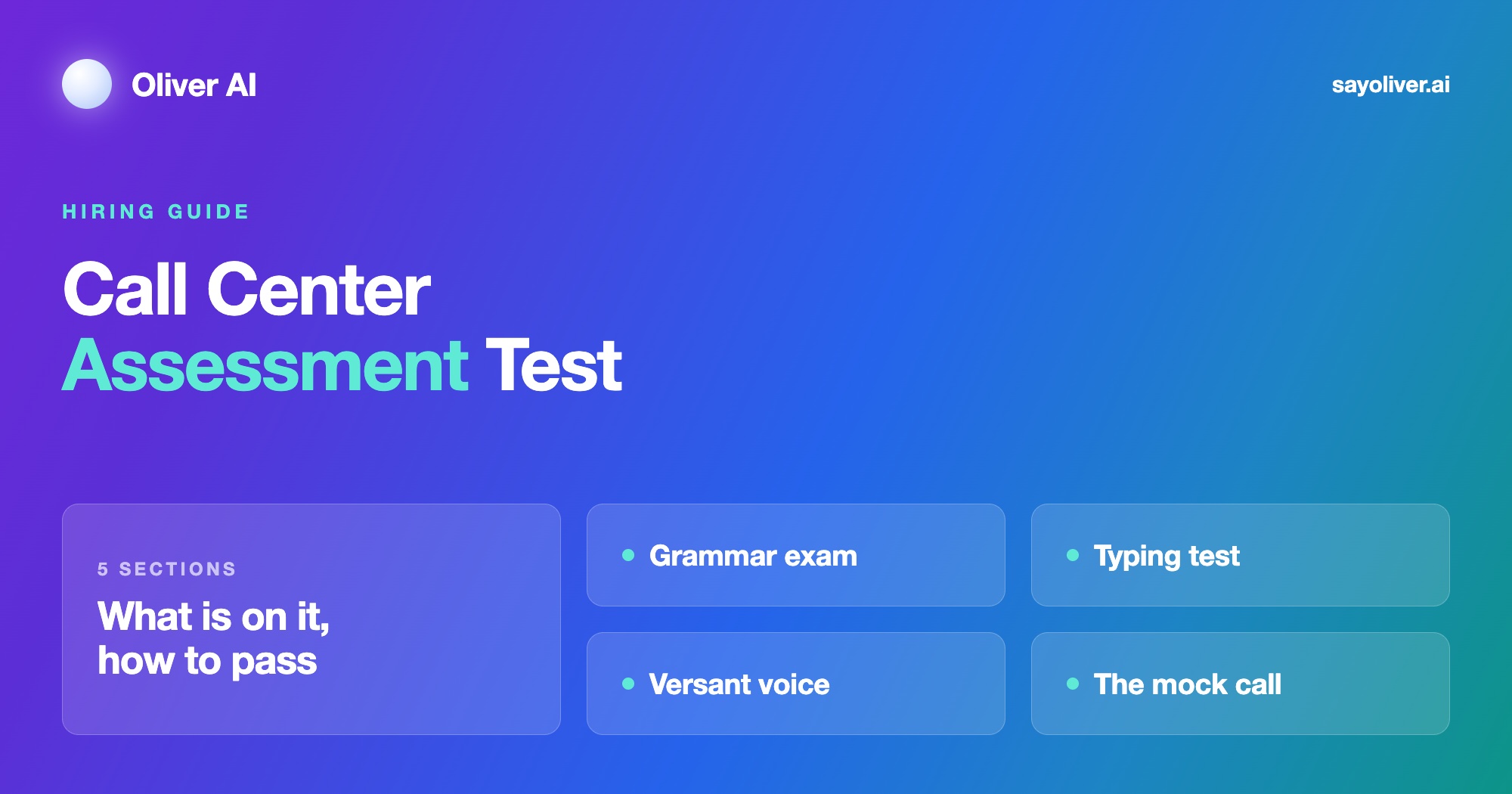
A call center assessment test is the screening stage between your application and the final interview, and it is usually four or five separate tests run back to back in a single sitting: an English grammar and comprehension exam, a typing test, a spoken-English assessment (often Versant), a situational judgment section, and a mock call. Most guides you will find about it are written for the employer buying the assessment software, not the person about to sit it. This one is written for the person sitting it, section by section, with what each part is actually scoring.
What a call center assessment test measures
The whole battery exists to answer one question the recruiter cannot answer from a resume: can this person hold a conversation with a stranger, in English, under time pressure, while typing. Each section isolates one piece of that, and the pieces fall into five broad categories.
Communication and language
Written grammar and comprehension, plus spoken fluency and pronunciation on the Versant or equivalent voice test. This is the biggest single category and the one most applicants expect.
Multitasking
Rarely its own labeled section, but tested throughout: typing while a scenario plays out, following a situational prompt while a clock runs, listening and responding on the mock call at the same time. Applicants who practice each skill in isolation are often surprised by how much harder it is combined.
Typing and data entry
Words per minute and, more heavily weighted, accuracy, since a wrong digit in an account number costs more than a slow one. See the full typing test breakdown for the exact format and a one-week practice plan.
Situational judgment
Short customer scenarios where you pick the best response from several options. The correct answer is almost always the one that acknowledges the customer's feeling first and then follows policy.
Cognitive aptitude
Some platforms add basic logic, numerical reasoning, or pattern-recognition items alongside the language sections, aimed at general problem-solving rather than English ability specifically. Not every account includes this, and it is rarely the deciding section, but treat any unfamiliar question type as a reasoning puzzle rather than a knowledge test and move on quickly if you are unsure.
| Section | What it scores | Typical passing bar |
|---|---|---|
| English grammar and comprehension | Written accuracy, reading speed | 70 to 80% correct |
| Typing test | Words per minute and accuracy | 35 to 45 WPM at 95%+ accuracy |
| Versant or voice assessment | Pronunciation, fluency, sentence mastery, vocabulary | 55 to 65 out of 80, account-dependent |
| Situational judgment | Whether you pick the empathetic, policy-safe option | No fixed score, ranked against other applicants |
| Mock call | Call flow, empathy, dead air, resolution | Scored on a rubric, usually out of 100 |
Section 1: the English grammar and comprehension exam
Usually 30 to 60 multiple-choice items on a timer, covering subject-verb agreement, tenses, prepositions, and a couple of reading-comprehension passages. It is not difficult grammar, it is fast grammar. Applicants fail this by running out of time, not by not knowing the answer.
Prepare by doing timed sets rather than untimed practice. If you can get 40 questions right in 20 minutes you are in the range; if you can get 40 right in 40 minutes you will fail on the clock. The comprehension passages reward skimming for the specific fact the question asks about, not reading the whole passage carefully first.
Rehearse the mock call before assessment day, free, with no account or card needed.
Rehearse the mock call before assessment daySection 2: the typing test
Most voice accounts want 35 to 40 WPM, chat and non-voice accounts want 45 to 50, and nearly all of them weight accuracy above speed. A 60 WPM score at 88% accuracy usually fails where 38 WPM at 98% passes, because a wrong account number costs more than a slow one.
This is the single most improvable section, and the only one where a week of practice reliably moves the number. Ten minutes a day on any free typing site for a week is typically worth five to eight WPM. Practise on a keyboard as close as possible to the one you will sit the test on. See the call center typing test for the full breakdown: the exact format, what the passage looks like, and a one-week practice plan.
Section 3: the Versant or spoken English test
Versant is an automated phone or computer test scored by software, not a person. It gives you a score out of 80 across four sub-scores: sentence mastery, vocabulary, fluency, and pronunciation. Different accounts set different bars, commonly somewhere between 55 and 65 overall. For a sample question from each of the six parts and what specifically each one is scoring, see the full Versant test breakdown.
The three things that cost applicants the most points are all mechanical rather than linguistic. Speak immediately when prompted, because hesitation is scored as low fluency even if the sentence you eventually produce is perfect. Speak at a normal conversational pace, since slowing down to be clearer reads as disfluency to the scoring model. And finish sentences completely rather than trailing off, because incomplete responses score as incomplete regardless of how good the first half was.
- Repeat section: say the sentence back exactly, at natural speed, without pausing to think.
- Short answer questions: answer in one or two words, do not elaborate. Elaboration wastes the clock and adds error surface.
- Sentence builds: say the reassembled sentence once, cleanly. Self-correcting mid-sentence costs more than a slightly awkward word order.
- Story retell: cover the facts in order and keep talking for the full window. Silence scores zero, an imperfect summary does not.
- Open questions: the content barely matters, the fluency does. Keep going until they cut you off.
Rehearse the mock call before assessment day, free, with no account or card needed.
Rehearse the mock call before assessment daySection 4: situational judgment
A set of short customer scenarios with four possible responses, where you pick the best (and sometimes also the worst). There is no trick to these once you know what they are testing: the correct answer is almost always the one that acknowledges the customer's feeling first and then follows policy, rather than the one that is fastest, most generous, or most confrontational.
The two answers designed to catch you out are the one that solves the problem by breaking a rule (giving a refund you are not authorised to give) and the one that follows the rule with no acknowledgement at all ("That is our policy"). Both score badly. The winning pattern is acknowledge, explain what you can do, then do it.
Section 5: the mock call
The mock call is the section that actually decides the hire, and the one applicants prepare for least. A recruiter or trainer plays a customer with a problem, you take the call, and you are scored on a rubric covering the opening spiel, verification, probing, empathy, dead air, resolution, and closing.
Reading about mock calls does not prepare you for one, for the same reason reading about swimming does not. The failure mode is never not knowing what to say, it is knowing what to say and not producing it fast enough while someone is talking at you. Applicants who have said the lines out loud ten times before the assessment sound completely different from applicants who have only read them.
What the rubric usually scores
Opening spiel delivered completely (brand, name, offer). Verification before touching the account. At least one open probing question before jumping to a fix. A specific empathy statement rather than "I understand how you feel". Dead air filled with narration. A stated resolution with a timeframe. A clean closing spiel. Most rubrics allocate roughly a third of the total to the opening and closing alone, because those are the parts that are entirely within your control.
The three fastest ways to fail it
Going silent while you think or type, which reads as not knowing what to do. Skipping verification and going straight to the problem, which is an automatic deduction on most rubrics regardless of how well the rest went. And promising something you cannot deliver to get off the call, which fails the compliance line even on an otherwise strong call.
How to rehearse for it
Say the whole call out loud, end to end, at least five times before the assessment, ideally against someone who interrupts and changes the story mid-call. If nobody is available, free mock call practice runs the same thing in a browser against an AI customer who goes off-script, and returns a transcript plus a score per rubric category so you can see which stage you actually lost.
Rehearse the mock call before assessment day, free, with no account or card needed.
Rehearse the mock call before assessment dayHow to prepare in one week
If your assessment is in seven days, this is the order that returns the most score per hour spent. Typing first because it is the most improvable, mock call second because it carries the most weight, grammar third, and Versant familiarisation last since it is technique rather than knowledge.
- Days 1 to 7: ten minutes of typing practice daily, accuracy over speed. This alone is usually worth five to eight WPM.
- Days 1 to 5: one full mock call out loud per day, different scenario each time. Record yourself on your phone and listen back once.
- Days 2, 4, 6: one timed 30-question grammar set. Time yourself strictly, review only what you got wrong.
- Day 5: read through a set of situational judgment examples and check your answers against the acknowledge-then-policy pattern.
- Day 6: watch one Versant walkthrough so no section format surprises you on the day. Practise answering the instant the prompt ends.
- Day 7: rest, sleep properly, and test your headset and internet if the assessment is remote. Technical failures on the day are counted as your problem, not theirs.
What happens if you fail
Most BPOs let you reapply after a cooling-off period, commonly three to six months, and many will redirect you within the same sitting rather than reject you outright. A Versant score that misses the bar for a US voice account is often enough for a chat or back-office role at the same company, and recruiters routinely make that offer on the spot.
A failed assessment is also unusually specific feedback, which most job rejections are not. If you failed on typing you know exactly what to fix; if you failed on the mock call you know which rubric line went red. Ask which section you missed, since many recruiters will tell you, and it converts a rejection into a training plan for the next application.
Rehearse the mock call before assessment day, free, with no account or card needed.
Rehearse the mock call before assessment dayFrequently asked questions
How do you pass a call center assessment test?
Prepare per section rather than in general. Typing is the most improvable in a week and is scored on accuracy over raw speed. The Versant is technique rather than English ability, so answer immediately, speak at normal pace, and always finish the sentence. The mock call carries the most weight and is the section most applicants skip preparing for, so rehearse a full call out loud at least five times before the day.
What is the BPO assessment test?
BPO assessment test is the same thing as a call center assessment test, the term used more commonly in the Philippines and India. It is the screening battery run between the initial interview and the final interview, typically covering English grammar, typing speed, a spoken-English test such as Versant, situational judgment, and a mock call.
What kind of assessment is used in call centers?
Employers usually buy a bundled assessment platform (Versant, Mercer Mettl, TestDome, and eSkill are common) that runs grammar, typing, and situational judgment as one automated sitting, then add a human-run mock call separately. The automated parts screen out volume; the mock call is what the hiring decision actually turns on.
What is a good Versant score for a call center?
Most voice accounts set the bar somewhere between 55 and 65 out of 80, with premium or healthcare accounts often asking for higher. Chat and back-office roles typically accept lower spoken scores. The four sub-scores (sentence mastery, vocabulary, fluency, pronunciation) are weighted differently by account, but fluency is the one most applicants lose points on through hesitation rather than accent.
Can you still get hired if you fail an assessment test?
Often yes, but for a different role. A spoken-English score that misses the bar for a US voice account is frequently enough for chat support or a back-office account at the same company, and recruiters commonly make that redirect during the same sitting. If you are rejected outright, most BPOs allow a reapplication after three to six months.
How long does a call center assessment test take?
Usually two to four hours end to end when the sections are run back to back on site, or split across two days if the initial interview and assessment are separated. The automated sections take 60 to 90 minutes; the mock call and interviews account for the rest of the time, most of which is waiting.
The assessment battery looks intimidating because it is five tests at once, but four of the five are mechanical and respond to a week of specific practice. The fifth, the mock call, is the one that decides it, and it is the only section where reading about it does nothing. Say a full call out loud a few times before the day and you will walk into the part everyone else improvises already having done it.
See it in Oliver
Ready when you are
Practise before the next real conversation.
No sign-up required. Pick the scenario, add your name, and speak with a realistic AI partner. Get a scorecard and transcript after every call.