AHT Meaning in a Call Center: Average Handle Time Explained for Agents
By Dave Wilson · 8 min read · 7 November 2026
AHT means average handle time. In a call center it is the average length of one customer interaction from start to finish, counted as talk time plus hold time plus after-call work, divided by the number of calls you handled. If you took 40 calls in a shift and spent 280 minutes on them in total, your AHT is 7 minutes. Most guides on AHT are written by software companies for contact center managers. This one is for the agent whose AHT shows up on the scorecard: what counts toward it, what a normal target looks like, and how to bring it down without cutting corners that QA will mark you down for.
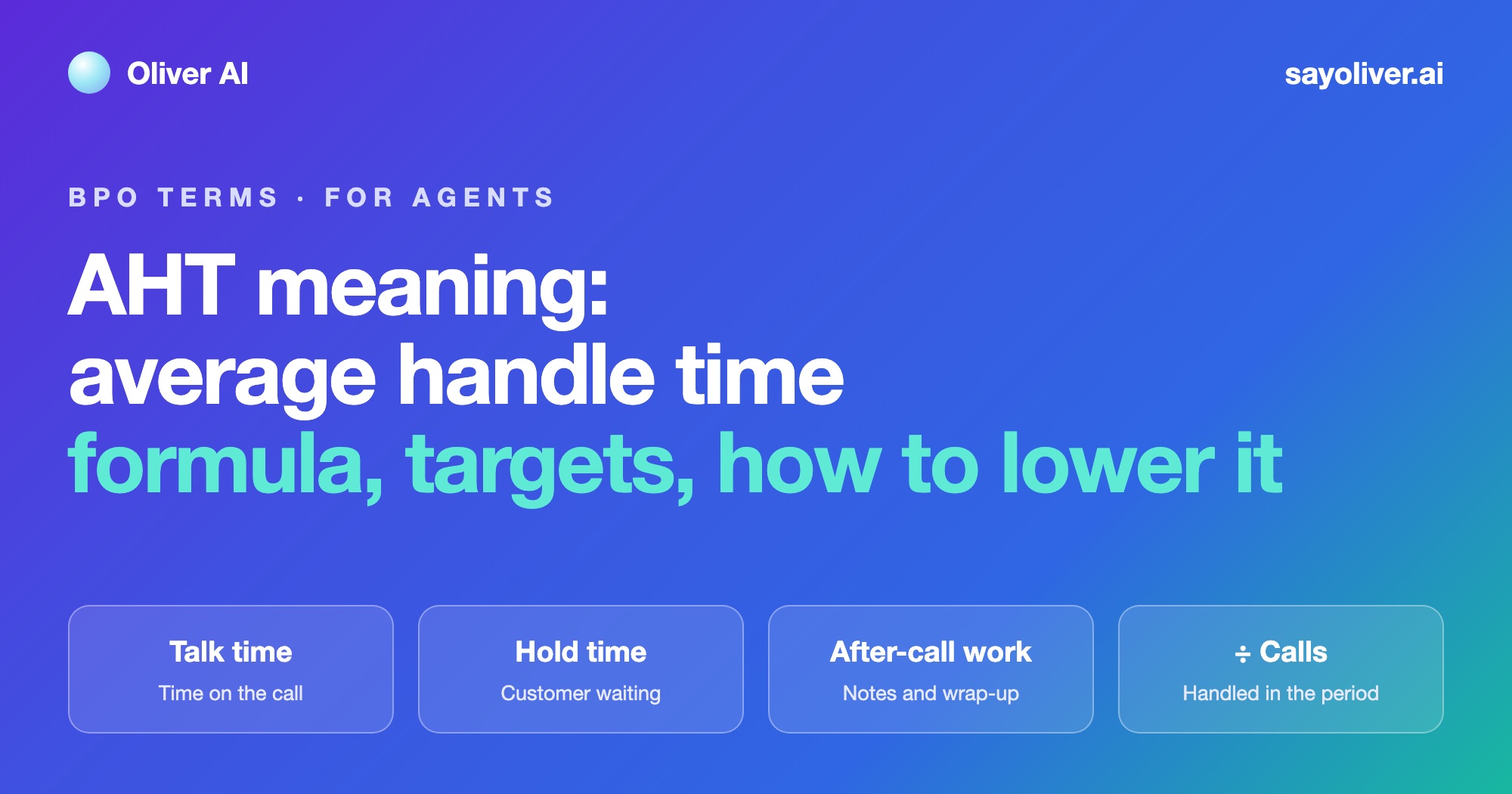
AHT meaning in a call center
AHT stands for average handle time, sometimes written average handling time. It measures how long, on average, it takes you to fully handle one customer: the conversation, any time the customer spends on hold, and the notes and system updates you do after the call ends.
You will hear it in training, see it on your daily stats, and hear your team leader talk about it in coaching. It sits next to the other BPO terms you learn in the first week, such as QA, CSAT, aux and adherence.
AHT has other meanings outside call centers. On task-based AI training platforms it means the expected time per task, so "AHT 3 hours" means the task should take about three hours. As internet slang, "aht aht" means "stop" or "no". In medicine it can mean abusive head trauma. On a call center floor, including a health care account, it always means average handle time.
The AHT formula, with a worked example
AHT = (total talk time + total hold time + total after-call work) ÷ number of calls handled.
Here is one agent's shift on a telco account:
| Part of the call | Total for the shift | What counts |
|---|---|---|
| Talk time | 210 minutes | From when you answer until the call ends, including verification |
| Hold time | 30 minutes | Every second the customer is on hold while you check something |
| After-call work (ACW) | 40 minutes | Notes, tickets and system updates after you hang up, before you take the next call |
| Calls handled | 40 | Completed calls, including transferred ones on most accounts |
Run a billing call and see where the time goes, free, with no account or card needed.
Run a billing call and see where the time goesReading the result
The total is 210 + 30 + 40 = 280 minutes. Divided by 40 calls, AHT is 7 minutes, usually shown as 7:00 or 420 seconds. If the account target is 6:30, this agent is 30 seconds over, and the breakdown shows where: 40 minutes of after-call work averages a full minute per call, which is the easiest part to cut.
Time in aux (break, lunch, coaching) does not count toward AHT. Time waiting for the next call does not count either.
What is a good AHT?
There is no single good number. Each account sets its own target based on how complex its calls are, and your team leader will tell you yours in training. As a rough guide:
| Type of account | Typical AHT range | Why |
|---|---|---|
| Retail and order status | 4 to 6 minutes | Short, repeatable calls about orders, returns and deliveries |
| Telco and billing | 6 to 8 minutes | Verification, bill explanations and plan changes take longer |
| Financial and banking | 6 to 9 minutes | Stricter verification and disclosures on every call |
| Health care | 7 to 10 minutes | Benefits, claims and prior authorizations need careful explanation |
| Technical support | 8 to 12 minutes or more | Troubleshooting steps take time, and some calls need several |
Run a billing call and see where the time goes, free, with no account or card needed.
Run a billing call and see where the time goesWhy AHT matters to you as an agent
AHT is one of the main KPIs (key performance indicators) on an agent scorecard, along with QA score, CSAT, first call resolution and schedule adherence. It affects things you care about directly.
- Regularisation. During probation and nesting, many accounts require you to bring AHT within target before you are regularised.
- Incentives. Monthly performance incentives on many accounts are tied to a scorecard that includes AHT.
- Coaching. An AHT well above target is the most common reason for a coaching session in your first months.
- Workforce planning. The account uses AHT to decide how many agents to schedule, so a team running long can mean tighter breaks and more overtime for everyone.
How to lower your AHT without failing QA
The goal is to remove wasted time, not to rush the customer. QA still scores every call, and a short call that misses verification or the right resolution fails.
Do the after-call work during the call
Type your notes while the customer is talking and while the system loads. Agents who wait until after the call to write notes often spend a minute or more per call in ACW that could have been close to zero.
Ask before you put them on hold, and hold less
Hold time counts in full. Learn where the common answers are in your knowledge base so you can find them while still talking. When you do need a hold, ask first, say how long, and come back on time.
Control the call with probing questions
Long calls usually come from not finding the real problem early. Ask two or three specific questions at the start, such as "Which bill are you looking at?" or "When did it stop working?", instead of letting the customer explain everything from the beginning.
Learn the top five call types
Most accounts get the same few call types all day. Learn the resolution for each one well enough that you do not need to search for it. That is where experienced agents save most of their time.
Keep the close short but complete
Recap, check for anything else, and close with the required spiel. Do not skip it to save time, because a missing closing is a QA markdown, but do not add small talk either.
Run a billing call and see where the time goes, free, with no account or card needed.
Run a billing call and see where the time goesWhat not to do to cut AHT
Some shortcuts lower the number and can cost you the job. QA and team leaders look for them specifically.
- Releasing or disconnecting calls. Hanging up on a customer, or letting a call drop on purpose, is call avoidance and is usually grounds for termination.
- Transferring calls you could handle. Unnecessary transfers lower your AHT and raise the next agent's, and they show up in reports.
- Skipping verification or required disclosures. This fails the call on QA no matter how short it was.
- Promising a callback you will not make. The customer calls back angrier, which hurts first call resolution and someone else's AHT.
- Staying in after-call work to avoid the next call. Long ACW with no notes to show for it is easy to spot.
AHT and the related terms you will hear
These come up in the same conversations as AHT.
| Term | Meaning |
|---|---|
| ATT (average talk time) | Only the talking part of the call, without hold or after-call work |
| ACW (after-call work) | Wrap-up time after the call: notes, tickets, dispositions |
| Hold time | Time the customer spends on hold during the call |
| FCR (first call resolution) | Share of issues solved on the first call, without the customer calling back |
| CSAT | Customer satisfaction score from the post-call survey |
| ASA (average speed of answer) | How long customers wait in the queue before an agent answers |
| Adherence | How closely you follow your schedule: logging in, breaks and lunch on time |
Run a billing call and see where the time goes, free, with no account or card needed.
Run a billing call and see where the time goesIf you are asked "What is AHT?" in an interview
This comes up in interviews for experienced agents and sometimes in the final interview for new ones. A good answer: "AHT means average handle time. It is talk time plus hold time plus after-call work, divided by the number of calls. I keep it within target by typing notes during the call, holding only when I need to, and learning the common call types, but I never cut verification or the closing to save time, because QA matters more than a few seconds." The call center interview questions guide covers the rest of that interview.
Practise faster, cleaner calls
AHT drops fastest when the call flow is automatic: greeting, verification, probing, resolution, close. Free mock call practice lets you run full calls against an AI customer and read the transcript afterwards, so you can see exactly where the time went: a long hold, a repeated question, a close that dragged. The mock call script examples show the full flow for common call types.
Run a billing call and see where the time goes, free, with no account or card needed.
Run a billing call and see where the time goesFrequently asked questions
What does AHT mean in a call center?
AHT means average handle time: the average time it takes to fully handle one customer interaction, counted as talk time plus hold time plus after-call work, divided by the number of calls handled.
How do you calculate AHT?
Add total talk time, total hold time and total after-call work for the period, then divide by the number of calls handled. For example, 280 minutes across 40 calls is an AHT of 7 minutes.
What is KPI and AHT?
A KPI is a key performance indicator, one of the numbers on your scorecard. AHT is one of the main call center KPIs, measured alongside QA score, CSAT, first call resolution and schedule adherence.
What does "AHT 3 hours" mean?
On task-based platforms such as AI training work, AHT is the expected time to complete one task, so "AHT 3 hours" means the task should take about three hours. In a call center, AHT is usually measured in minutes per call.
What is AHT in health care?
On a health care call center account, AHT means average handle time, the same as on any other account, and targets are usually longer because benefits and claims calls need careful explanation. In clinical medicine, AHT can also stand for abusive head trauma, which is unrelated.
Is a high AHT always bad?
No. A long call that resolves the problem the first time is better than a short call that brings the customer back. Team leaders look at AHT together with QA and first call resolution, not on its own.
AHT is average handle time: talk time plus hold time plus after-call work, divided by calls handled. Your account sets the target, and it matters for regularisation, incentives and coaching. Bring it down by writing notes during the call, holding less, probing early and learning the common call types, and never by skipping verification, transferring calls you could handle or releasing calls. A call that is short and wrong costs more than one that is a minute long and right.
See it in Oliver
Ready when you are
Practise before the next real conversation.
No sign-up required. Pick the scenario, add your name, and speak with a realistic AI partner. Get a scorecard and transcript after every call.