Sales Negotiation Training: The Techniques, Tactics, and How to Practice Them
By Dave Wilson · 7 min read · 11 July 2026
Sales negotiation training gets sold as a two-day workshop: a facilitator, a slide deck of frameworks, a role-play exercise with a colleague from finance playing the buyer, and a certificate at the end. Six weeks later, reps are back to discounting the moment a buyer pushes back, because a framework you heard once does not survive contact with a real budget conversation. The reps who actually hold their numbers are not the ones who remember the slide about anchoring — they are the ones who have run the pushback enough times that the response is automatic.
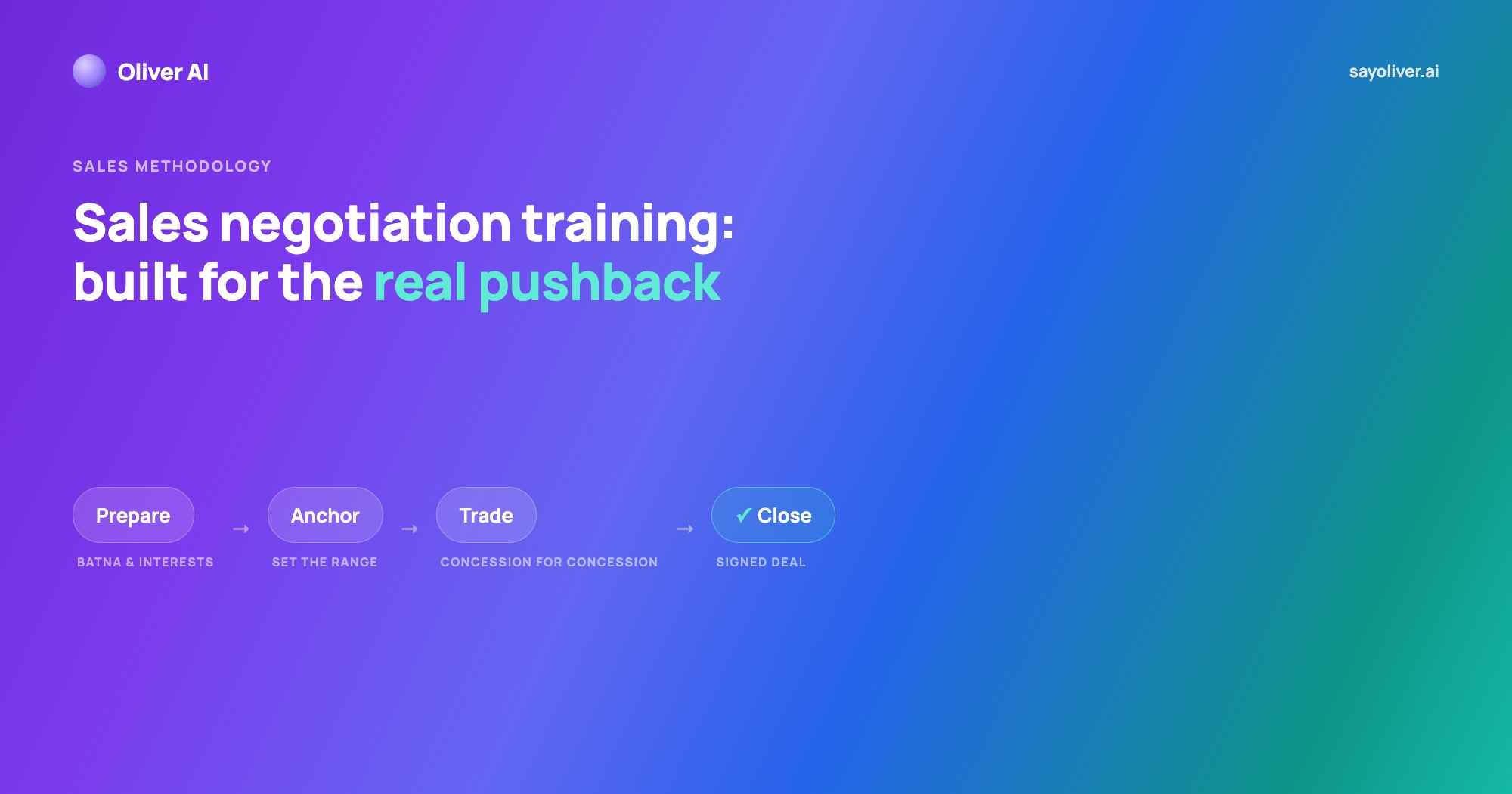
What sales negotiation training actually covers
Sales negotiation training is the set of skills reps use once a deal has cleared the objection stage and moved into what it will actually take to sign. It sits downstream of handling sales objections: an objection is the buyer telling you what is standing in the way, and negotiation is the back-and-forth over price, terms, and scope once that concern is already on the table.
A price objection is usually the opening move of a negotiation, not the whole thing. "It's too expensive" said once, cold, is an objection. The same sentence repeated after you have already explained value, with a specific discount attached, is a negotiation, and it needs a different response.
The core principles behind every good program
Strip away the branding and every credible sales negotiation program, from Sandler to RAIN Group to the Harvard-style principled-negotiation model, teaches some version of the same four ideas.
Separate the person from the problem
Treat the buyer as a partner solving a shared problem, not an opponent to beat. The moment a negotiation feels adversarial, both sides start protecting position instead of looking for terms that work for everyone.
Negotiate interests, not positions
A stated position, "we need 20% off," usually hides a real interest, "I need something to show my CFO I pushed back." Argue the position and you are stuck. Uncover the interest and there is often a cheaper way to satisfy it entirely.
Know your BATNA before you sit down
Your Best Alternative to a Negotiated Agreement is what happens if this specific deal falls through. A rep who has not thought that through gives away margin out of fear of losing the deal. A rep who knows their walk-away point negotiates from strength instead of anxiety.
Trade concessions, never give them away
Every concession should cost the buyer something in return, even something small: "If I can get that price approved, can we sign by Friday?" A concession handed over for free teaches the buyer that pushing works, and they will push again.
Practise a negotiation scenario, free, with no account or card needed.
Practise a negotiation scenarioNegotiation tactics reps are taught, and what they actually do
Beyond the four principles, most programs teach a handful of specific moves. Used well, they are barely noticeable. Used clumsily, they read as a script, and an experienced buyer clocks a script within the first sentence.
| Tactic | What it does | Example line |
|---|---|---|
| Anchoring | Sets the reference point the rest of the conversation gets measured against | "Most teams your size land around [X], depending on rollout scope." |
| Bracketing | Frames your ask inside a wider range so the real number looks reasonable | "We've seen this land anywhere from [low] to [high], depending on term length." |
| Silence | Lets a number or request sit instead of filling the gap with a concession | State the number, then stop talking. |
| Trading, not giving | Turns every concession into an exchange instead of a gift | "I can move on price if we lock in a 12-month term instead of month to month." |
| Walking away well | Keeps a stalled deal open instead of burning it | "Let's park this for now — reach out when the budget picture changes." |
Why classroom training rarely changes what happens on the call
The failure mode is consistent across almost every team that runs a one-off negotiation workshop: reps leave able to recite the four principles and name the tactics, then discount 15% the first time a real buyer sighs and asks for a better number. Knowing that you are supposed to trade concessions is not the same as doing it in the moment, with quota behind you and a buyer who sounds like they are about to walk.
This is the part most sales negotiation training guides skip. They will list the frameworks and the tactics, but not how a rep is actually supposed to acquire the skill, which is a behaviour you rehearse under real pressure, not a fact you memorise from a slide. Reading about BATNA does not make a rep hold the line when a VP says the deal is dead without one more concession. Running that exact conversation enough times, somewhere getting it wrong costs nothing, is what does.
Practise a negotiation scenario, free, with no account or card needed.
Practise a negotiation scenarioA negotiation that goes wrong, and one that does not
Buyer: "Look, we like the product, but we need 20% off to make this work on our end."
Weak response: "Let me see what I can do... I think I can get you 15%." The rep gave away margin in the first ten seconds, with nothing asked for in return, and taught the buyer that the number moves simply by asking.
Stronger response: "I want to understand what makes 20% necessary. Is that a hard budget ceiling, or is there a specific number you need to justify internally?" This surfaces the real interest before any number moves. If the answer is a genuine budget ceiling, the rep can trade scope or timeline instead of price. If it is an internal justification, a smaller, well-framed concession tied to something in return usually resolves it without touching the margin that mattered.
How to structure a sales negotiation training program
A program that actually changes behaviour has four stages, not one.
- Teach the principles once — cover BATNA, interests versus positions, and the core tactics in a single session. This is information transfer, not skill building yet.
- Review real negotiations — have reps read or listen to transcripts of deals that were negotiated well and badly, and name exactly what happened at each turn.
- Run practice reps against real pushback — rehearse the specific moments that come up most, like the 20% ask, the competitor quote, or the "let me check with my boss" stall, until the response is automatic.
- Debrief every live negotiation — after a real deal closes or stalls, review exactly what was traded and what was given away for free, then feed that back into the next round of practice.
Practise a negotiation scenario, free, with no account or card needed.
Practise a negotiation scenarioPractising negotiation before the real deal
Most sales teams do the first two stages and skip the last two, because getting reps live practice takes a manager's calendar and someone willing to play a stubborn buyer convincingly, over and over, for every rep on the team. That gap is exactly what AI roleplay for sales fills: a buyer persona that pushes for the discount, brings up a competitor's lower quote, and does not fold the first time a rep holds their ground, with a transcript and scorecard after every run.
A rep can run the same 20%-off scenario ten times on a Tuesday afternoon before ever hearing it from a real buyer. See how to practise sales calls for the wider case for rehearsal, or compare the leading AI sales roleplay software if you are choosing a platform for the whole team.
Frequently asked questions
What are the 5 P's of negotiation?
Prepare, probe, possibilities, propose, and partner. Prepare means researching both sides' real interests before you sit down; probe is asking questions and listening more than you talk; possibilities means expanding the deal beyond a single price line; propose is putting forward a specific offer once you understand what actually matters; partner is using the process to build a relationship that survives past this one deal.
What is the 70/30 rule in negotiation?
It says a negotiator should spend roughly 70% of the conversation listening and 30% talking. The idea is that most of the leverage in a negotiation comes from understanding the other side's real constraints, which only surfaces when you ask open questions and let them answer in full, rather than filling the silence with your own case.
What are the 4 golden rules of negotiation?
The version most often cited comes from the Harvard "principled negotiation" model: separate the people from the problem, focus on interests rather than stated positions, invent options that create value for both sides before dividing it, and insist the outcome be judged against objective criteria rather than whoever pushes hardest.
What are the 7 pillars of negotiation?
A framework from negotiation trainer Steven P. Cohen: relationship, interests, BATNA, creativity, fairness, commitment, and communication. Together they cover treating the deal as part of an ongoing relationship, understanding what both sides actually want, knowing your walk-away alternative, finding options beyond the obvious one, keeping the process visibly fair, making sure both sides can actually deliver on what's agreed, and keeping information moving cleanly between the parties.
What is the best way to train sales negotiation skills?
Teach the principles once, then spend most of the program on repetition: rehearsing the specific pushback reps actually hear, like a 20% discount request or a competitor quote, until the response holds up under pressure. A single workshop builds vocabulary. Only practice against realistic pushback builds the skill.
Sales negotiation training is not short on frameworks. Anchoring, bracketing, BATNA, and the principled-negotiation rules are all a five-minute search away, and every corporate training vendor sells a version of the same list. What separates a rep who actually holds margin from one who folds at the first "can you do better" is not which framework they memorised. It is how many times they have already had that exact conversation before a real buyer asked.
See it in Oliver
Ready when you are
Practise before the next real conversation.
No sign-up required. Pick the scenario, add your name, and speak with a realistic AI partner. Get a scorecard and transcript after every call.