A Sales Call Script for Cold Calls
By Dave Wilson · 7 min read · 12 June 2026
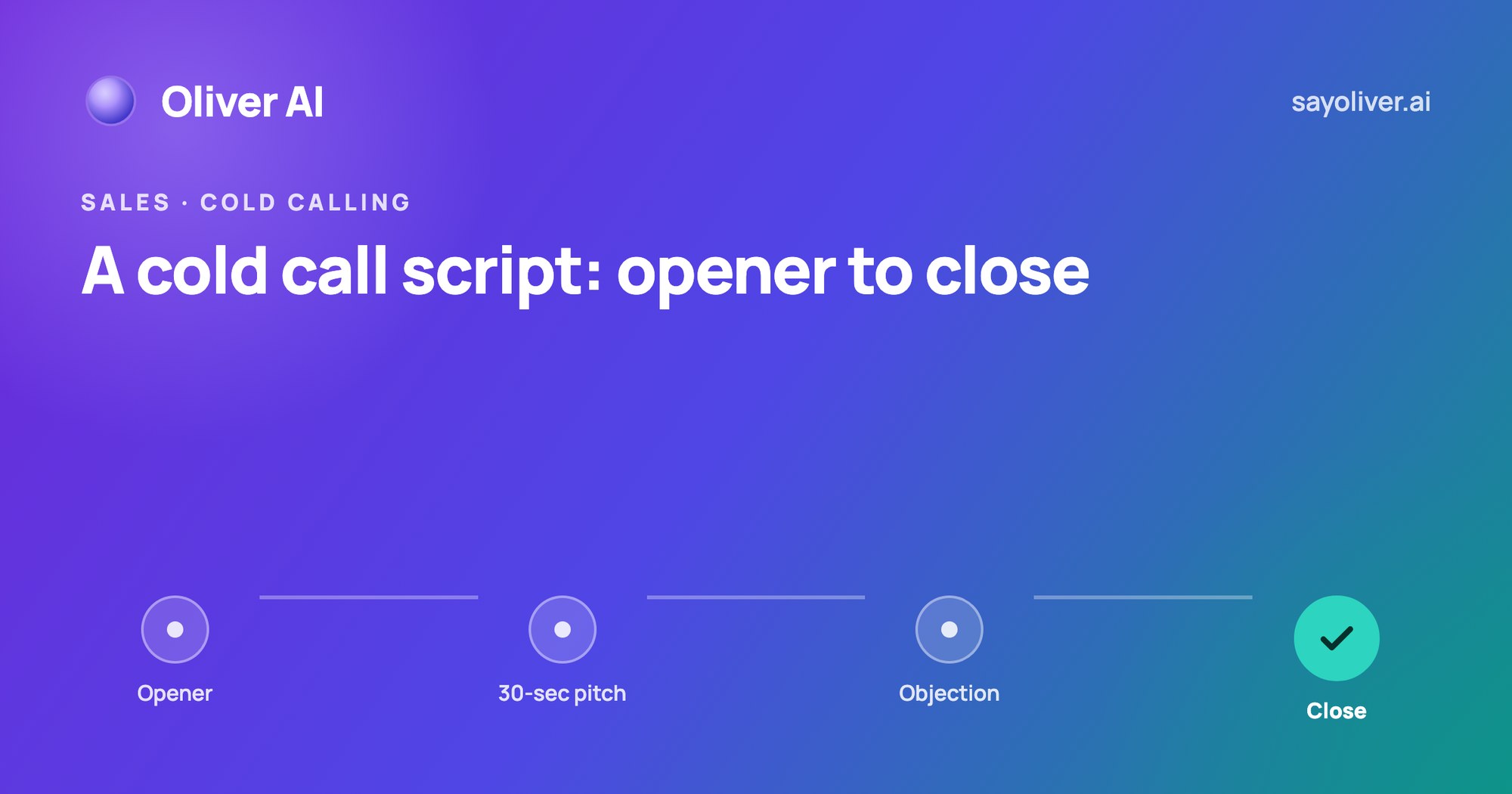
Every cold call has the same four moments: the opener that earns thirty seconds, the pitch that earns a question, the objection that decides everything, and the close that converts attention into a meeting. This script covers all four, with the reasoning behind each line — because a script you understand survives contact with a real prospect, and a script you memorised does not.
The opener: earn thirty seconds
You have about ten seconds before the prospect decides whether this call is an interruption or a conversation. The biggest opener mistake is pretending it is not a cold call — people hear the pretence and trust drops to zero.
Try the opposite: "Hi [name], it's [you] from [company]. I'll be honest — this is a cold call. Do you want to hang up, or can I have thirty seconds and then you decide?" Naming the situation disarms it. Most people, given an explicit exit, do not take it.
The thirty-second pitch
You earned thirty seconds, not thirty minutes. The pitch is one problem, one outcome, one question — no feature list, no company history.
"The reason I'm calling: we work with [role] at companies like [peer], and the thing we keep hearing is [specific problem]. We help them [specific outcome]. Is that something your team runs into, or have you got it handled?"
That final either/or matters. It gives the prospect a genuine out, which paradoxically makes honest engagement more likely — "have you got it handled" is much harder to brush off than "would you like to learn more".
Practise your cold call opener, try it now, no sign-up needed.
Practise your cold call openerHandling the three reflex objections
Cold call objections in the first minute are rarely real objections — they are reflexes to being interrupted. Respond to the reflex, not the words. (For the deeper, deal-stage versions of these, see how to handle sales objections.)
- "I'm busy right now." — "Completely fair, and I'll be quick. If the next twenty seconds aren't relevant, hang up on me guilt-free." (Acknowledge, shrink the ask.)
- "Send me some info." — "Happy to. So I send something useful instead of a brochure: what's the part of [problem] that's most annoying right now?" (Agree, then trade for one discovery question.)
- "We already have a solution." — "That makes sense, most people we talk to do. Out of curiosity, if you could change one thing about how it works today, what would it be?" (Never argue with the incumbent; ask about the gap.)
The close: one specific next step
Do not end a good cold call with "I'll send over some times." Close on the call: "It sounds like [problem] is at least worth a look. I'd suggest twenty minutes with [specialist/demo] — I have Thursday morning or Friday early afternoon. Which is less bad for you?"
Specific beats open-ended, and a light touch of humour ("less bad") keeps it human. If they will not commit to a meeting, close for something smaller: permission to call back next quarter, or one name of the right person to talk to.
Practise your cold call opener, try it now, no sign-up needed.
Practise your cold call openerHow to use a script without sounding scripted
Prospects do not hate scripts; they hate hearing one being read. The difference is internalisation. A rep who has run the opener fifty times can deliver it while genuinely listening; a rep reading it cannot do both.
That is the real role of practice: run the script against a realistic buyer — AI roleplay for sales makes this cheap — until the words stop taking up attention. Then the script becomes structure underneath a real conversation, which is what it was always meant to be.
A cold call script is not magic words; it is a decision tree you have rehearsed so thoroughly that no answer can knock you off balance. Steal the structure here, rewrite the lines in your own voice, and then practise it against resistance until the delivery is yours — our broader cold calling tips cover what happens around the script. The script gets you in the door — the practice is what makes it sound like you.
See it in Oliver
Ready when you are
Practise before the next real conversation.
No sign-up required. Pick the scenario, add your name, and speak with a realistic AI partner. Get a scorecard and transcript after every call.