Discovery Call Best Practices for Sales Reps
By Dave Wilson · 5 min read · 30 May 2026
Following discovery call best practices is not about following a script. It is about having enough structure to stay curious when the conversation pulls you in every direction. The reps who consistently run great discovery calls are the ones who have internalised a few principles, not memorised a hundred questions.
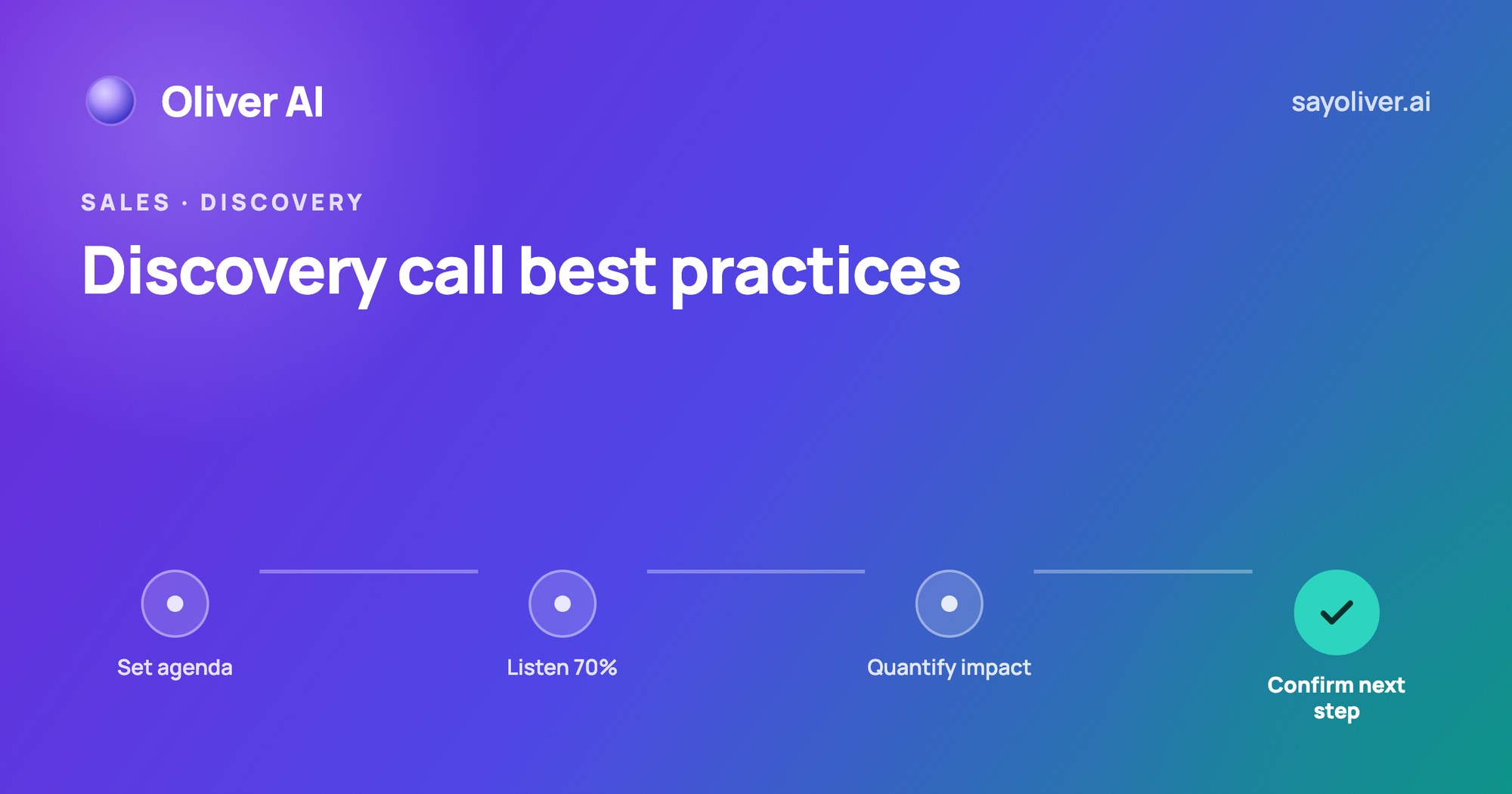
Prepare before the call
Spend ten minutes before every discovery call. Look at the company, understand the industry, know who you are talking to. This is not about showing off. It is about asking better questions. A rep who knows the prospect's business can ask about the specific problem; one who does not is stuck asking about the general one.
Have three or four opening questions ready, and one hypothesis about what their problem might be. You will be wrong half the time. But having a starting point stops you from improvising badly under pressure. Our list of discovery call questions is a good place to build that opening set.
Open with curiosity not pitch
The single most common discovery call mistake is starting to sell before you have listened. Set an agenda, ask permission to ask questions, and then ask them. Resist the urge to share anything about the product until you have a clear sense of what the prospect is trying to solve. If the format itself is new, our guide to how to run a discovery call walks through the full structure.
A useful opening: "I have some thoughts on how we might help, but I'd rather make sure I understand your situation first. Is that okay if I ask a few questions before we get into that?"
Practise a discovery call, try it now, no sign-up needed.
Practise a discovery callListen for problems not features
When a prospect describes what they are looking for, the instinct is to immediately map it to a feature. Resist this. Keep asking about the problem underneath the request.
"You've mentioned you want better reporting. What's going wrong with the reporting you have today?" This question will often reveal something more valuable than any feature mapping could.
Handle the demo request
At some point in discovery, prospects often ask to see the product. Jumping straight to a demo is usually a mistake: you have not yet earned the right to show them something relevant.
Try: "I want to show you the right things, not everything. Can I ask two more questions so I can make sure the demo is actually useful for your situation?" Almost every prospect says yes. The quality of the demo improves significantly as a result.
Practise a discovery call, try it now, no sign-up needed.
Practise a discovery callClose with a clear next step
Discovery calls should end with a specific, agreed next step, not a vague "let's talk again". Summarise what you heard, confirm your understanding is right, and propose the most logical next move tied to their problem.
Be specific about timing: "I'd like to bring in our solutions team to walk through your specific workflow. Are you free Thursday or Friday next week for 30 minutes?"
Discovery call best practices are simple in theory and hard in practice. The gap closes through repetition: running enough calls that the structure becomes instinct. If you are early in your career or working on a new market, practising the conversation before it matters is the fastest shortcut available, and the best AI sales roleplay software lets you do exactly that on demand.
Ready when you are
Practise before the next real conversation.
No sign-up required. Pick the scenario, add your name, and speak with a realistic AI partner. Get a scorecard and transcript after every call.