How to Practice Sales Calls
By Dave Wilson · 6 min read · 12 June 2026
Most reps get their practice on live prospects, which is the most expensive training programme ever invented: every fumbled objection is a real deal lost. Athletes and surgeons rehearse before the moment that counts; sales has mostly skipped that step. This guide covers the practice methods that actually transfer to live calls, and how to fit them into a week that already has a quota in it.
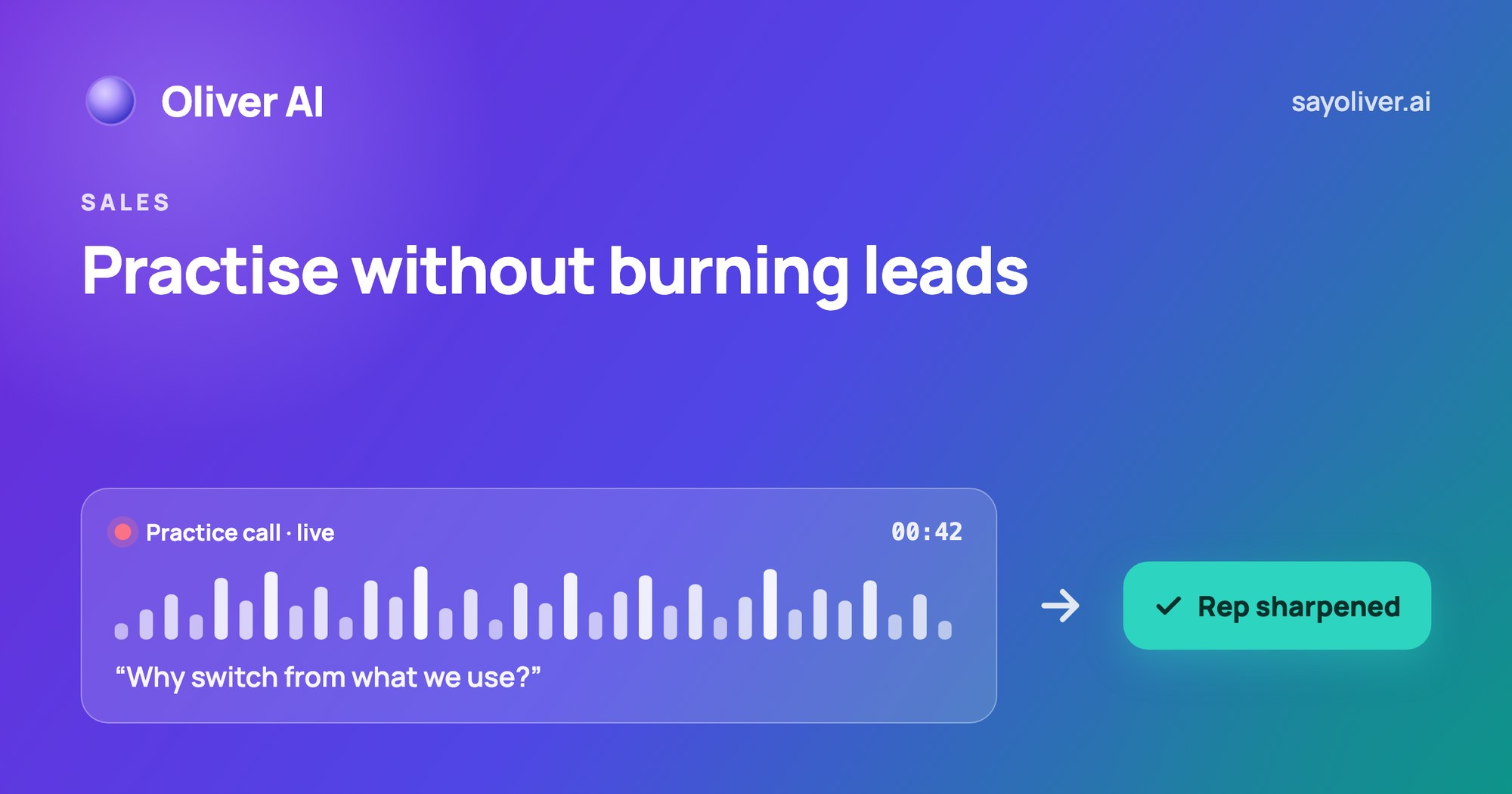
Why practising on prospects fails
When the only reps you get are real calls, two things go wrong. First, the feedback loop is broken: a prospect who goes cold never tells you which sentence lost them. Second, the stakes push you toward safety — you stick to the script you know rather than trying the harder skill you need, because experimenting on a live deal feels reckless.
Deliberate practice needs the opposite conditions: low stakes, high repetition, and immediate feedback. The methods below are ranked by how well they deliver those three things.
Method 1: solo drills
The cheapest practice is saying the words out loud, alone. Record yourself delivering your opener, your pricing explanation, and your response to the three objections you hear most. Listen back. Most reps are shocked the first time — filler words, rushed pacing, buried questions.
Solo drills build fluency, but they cannot build responsiveness, because nothing pushes back. Treat them as warm-up, not the workout.
Run a practice sales call now, try it now, no sign-up needed.
Run a practice sales call nowMethod 2: peer roleplay
Pairing up with a colleague adds the missing ingredient: an unpredictable other side. The classic failure mode is politeness — your teammate plays a softer buyer than any real one, the roleplay gets laughs instead of reps, and everyone learns nothing.
Make it work with three rules: the buyer plays one specific persona with one specific objection — a library of sales role-play scenarios helps here — the scene runs at least four minutes before any feedback, and feedback names one thing to keep and one thing to change. Nothing else.
Method 3: call review
Reviewing recordings of real calls — yours and the team's best — teaches pattern recognition: what a buying signal sounds like, where a discovery call started dying. It is study, though, not practice. Watching film never made anyone fit. Pair every review with a rep: re-run the moment that went wrong and say the better response out loud.
Run a practice sales call now, try it now, no sign-up needed.
Run a practice sales call nowMethod 4: AI roleplay
AI roleplay fixes the scheduling problem that kills the other methods: no partner needed, no manager time, no waiting for Friday training. A rep can face a sceptical CFO raising the price objection at 8am, get scored on the response, and run it again immediately.
It also fixes the politeness problem — an AI buyer does not soften because it likes you — and the repetition problem, because the eleventh attempt costs nothing but ten minutes. You can practise solo, on your own schedule, without booking anyone.
A weekly practice routine that sticks
Practice plans fail when they need an hour. This one needs about twenty minutes a week, attached to things you already do.
- Monday, 5 minutes: solo drill the one skill this week is about — opener, pricing, or a single objection.
- Midweek, 10 minutes: one AI roleplay on that same skill, twice. First attempt cold, second attempt applying the feedback.
- Friday, 5 minutes: re-listen to one real call moment from the week and say the better version out loud.
- Monthly: one live peer roleplay in the team meeting, same three rules as above.
Run a practice sales call now, try it now, no sign-up needed.
Run a practice sales call nowThe reps who improve fastest are not the ones with the most natural talent; they are the ones who get the most reps at the skills that matter, with feedback, before the call that counts. Pick one skill, practise it three times this week in low-stakes settings, and the next live call stops being the practice.
Ready when you are
Practise before the next real conversation.
No sign-up required. Pick the scenario, add your name, and speak with a realistic AI partner. Get a scorecard and transcript after every call.