How to Onboard New Sales Reps
By Dave Wilson · 7 min read · 31 May 2026
How to onboard new sales reps is one of the highest-leverage questions in sales leadership. A great onboarding programme produces reps who hit quota in 8 weeks. A mediocre one produces reps who limp toward quota in 16 — and quietly disengage somewhere in the middle. The cost of the gap is enormous, and most of it is recoverable.
What good onboarding actually produces
Onboarding is not a checklist of things a new rep needs to know. It is a process that produces a specific outcome: a rep who can run a quality conversation with a real buyer, without supervision, by a defined date. Everything else — product certifications, CRM training, methodology workshops — is support for that outcome, not a substitute for it.
The clearest signal that onboarding is working: a rep on day 45 runs a discovery call a senior manager would be proud of. The clearest signal it is broken: a rep on day 90 still needs a manager on every call.
The mistake of training everything at once
The dominant onboarding pattern in most organisations is the firehose. Two weeks of product training, a week of methodology, a week of CRM and tooling, then "go sell." By week four the new rep has been told everything and remembers almost nothing — and is expected to be running live calls.
The problem is that product knowledge and sales skills require completely different kinds of learning. Product knowledge benefits from front-loading and repetition. Sales skills only develop through practice with feedback. Mixing them dilutes both.
Onboard your team with Oliver, try it now, no sign-up needed.
Onboard your team with OliverA 30/60/90 structure that works
The most effective onboarding programmes separate knowledge acquisition from skill development, and stagger them across a 90-day window.
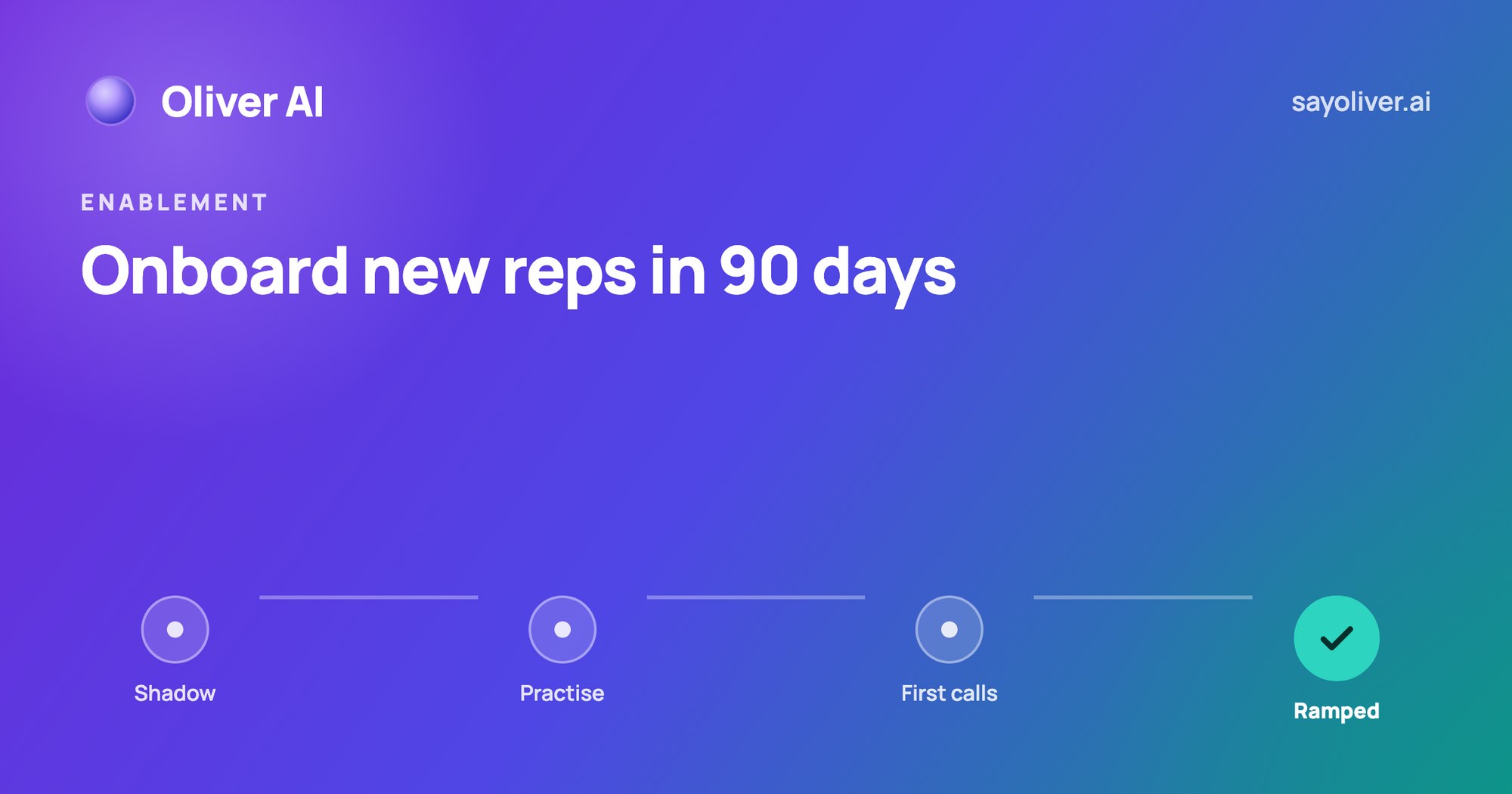
- Days 1–30 — product and market mastery. The rep can explain the top three customer problems and how the product solves each, without notes. Knowledge is assessed through written and verbal explanation, not just slide consumption.
- Days 30–60 — sales skills development through practice. The rep runs 15+ simulated calls covering discovery, objection handling, and demo openings, with structured feedback after each. No live deals yet. This is the phase most programmes skip.
- Days 60–90 — live pipeline under supervision. The rep takes on real deals, with a manager reviewing recordings within 24 hours and coaching on specific moments. Independence increases as quality improves.
Practice is the missing layer
The single biggest accelerator of new-rep ramp is deliberate practice — running simulated calls before live ones. Not role-play with a colleague who goes easy, but practice that mirrors the difficulty of a real conversation, with someone or something that pushes back.
The science on this is settled. Skills that require real-time judgement under pressure develop through repetition with feedback. Watching a senior rep handle a tough call teaches you what good looks like. It does not teach you to do it yourself.
This is where AI role-play has changed onboarding. A new rep can run 15 discovery calls in their first month — with a realistic AI buyer who raises real objections, plus a transcript and scorecard after each — for a fraction of the time and effort of arranging the equivalent with colleagues.
Onboard your team with Oliver, try it now, no sign-up needed.
Onboard your team with OliverHow to measure whether onboarding worked
Onboarding metrics often track activity (calls completed, modules finished, certifications passed) rather than capability. Activity tells you the rep showed up. Capability tells you whether they can do the job.
The metrics that matter: time to first quality solo discovery call, time to first independently sourced deal, and time to consistent quota attainment over two or three months. These are slower to read than activity metrics, but they are the ones that predict whether the hire was a good one.
How to onboard new sales reps is, in the end, a question of how seriously you take practice. The organisations that build practice into the structure of onboarding — not as an optional extra but as the central activity of days 30–60 — consistently produce faster-ramping reps. The ones that do not, recycle the same expensive lesson with every new hire: you cannot train sales skills the way you train product knowledge.
Ready when you are
Practise before the next real conversation.
No sign-up required. Pick the scenario, add your name, and speak with a realistic AI partner. Get a scorecard and transcript after every call.