Customer Service Training: The Complete Guide
By Dave Wilson · 10 min read · 8 July 2026
Customer service training is how support teams turn new hires and experienced agents into people who can handle real customers under real pressure, not just people who have read the policy manual. Most programs get the knowledge half right: product details, systems, scripts, compliance. Where they fall down is the other half — the live conversation, held with a customer who is frustrated, confused, or about to churn. This guide covers what customer service training should include, the methods teams use to deliver it, why so much of it fails to change behaviour on a real call, and how to structure a program that holds up under pressure.
What is customer service training?
Customer service training is the structured process of teaching support agents the product knowledge, systems, and interpersonal skills needed to handle customer interactions well, across phone, chat, email, and in person. It typically spans two categories: hard skills (product knowledge, CRM and helpdesk tools, policy, compliance) and soft skills (empathy, active listening, de-escalation, tone).
Most organisations deliver it in three phases: onboarding training for new hires before their first live call, ongoing training to keep the whole team current as products and policies change, and targeted coaching for individual skill gaps a manager or QA process has flagged. The core skills matter less in isolation than how well an agent can pull them together in real time, mid-conversation, while a customer is talking.
Core customer service training topics
Most customer service training programs, regardless of industry, need to cover the same core ground. The exact mix depends on the product and channel, but these are the building blocks:
- Product and service knowledge — what the company sells and where it typically breaks
- Systems and tools — CRM, helpdesk, knowledge base, order management
- Communication and tone — clear, warm, professional language across every channel
- Active listening — hearing the actual problem, not just the first sentence of it
- Empathy and de-escalation — acknowledging frustration without over-apologising or losing control of the call
- Policy and compliance — refunds, data handling, regulatory requirements
- Time and queue management — resolving efficiently without making the customer feel rushed
Practise a customer service training scenario, free, with no account or card needed.
Practise a customer service training scenarioCustomer service training methods
There is no single right format. Most programs combine several methods, and the right mix depends on team size, budget, and how fast new hires need to be ready for live volume.
Classroom and instructor-led training
Sessions run by a trainer or senior agent, in person or over video, covering product knowledge, policy, and systems. Good for standardising a baseline across a whole cohort at once, but passive: reps sit and absorb rather than do.
Online courses and eLearning
Self-paced modules, quizzes, and video lessons. Scales well and is easy to track completion on, which is why most compliance training runs this way. The tradeoff is the same as classroom training: watching a video about de-escalation does not teach an agent to de-escalate.
On-the-job shadowing
New hires listen to or sit beside experienced agents handling live calls. Genuinely useful for showing what good looks like, but it is observation, not repetition — the new hire still has not done the hard part themselves.
Roleplay and practice-based training
Reps rehearse real conversations — a policy refusal, an angry customer, an ambiguous request — before they face them live. This is the only method here that builds the actual skill being tested: staying composed and finding the right words under pressure, in the moment, with no time to think. Traditionally this meant pairing reps up or scheduling time with a manager, which is exactly why it happens far less often than it should.
Why most customer service training does not stick
The failure mode is consistent across almost every team: agents complete the modules, pass the quiz, and then freeze the first time a real customer interrupts them mid-explanation and demands a manager. The knowledge was there. The experience of handling it under pressure was not, and that gap only closes through repetition, not more content.
This is the part most customer service training guides skip. They will list the topics to cover and the skills to build, but not how a rep is actually supposed to acquire a skill like de-escalation, which is a behaviour you rehearse, not a fact you learn. Reading about the "5 C's of customer service" does not make an agent calmer when a customer is shouting. Running the hard conversation enough times, somewhere getting it wrong costs nothing, is what does.
AI roleplay for customer service can add enabled practice and artifact review to a training programme. Service and contact-centre practice scenarios with transcripts and scorecards; workflow maturity is validated per team. Scenario, repeat, and scorecard workflow are confirmed per team.
Practise a customer service training scenario, free, with no account or card needed.
Practise a customer service training scenarioHow to structure a customer service training program
A well-structured program has three layers, not one:
- New-hire onboarding — product, systems, and policy in week one, then structured practice on the two or three hardest call types before any live volume
- Ongoing and refresher training — short, recurring sessions when policy or product changes, not a once-a-year retraining event
- Targeted coaching — practice runs aimed at a specific gap a QA review or manager has flagged, rather than generic training everyone sits through
Sequencing knowledge and practice correctly
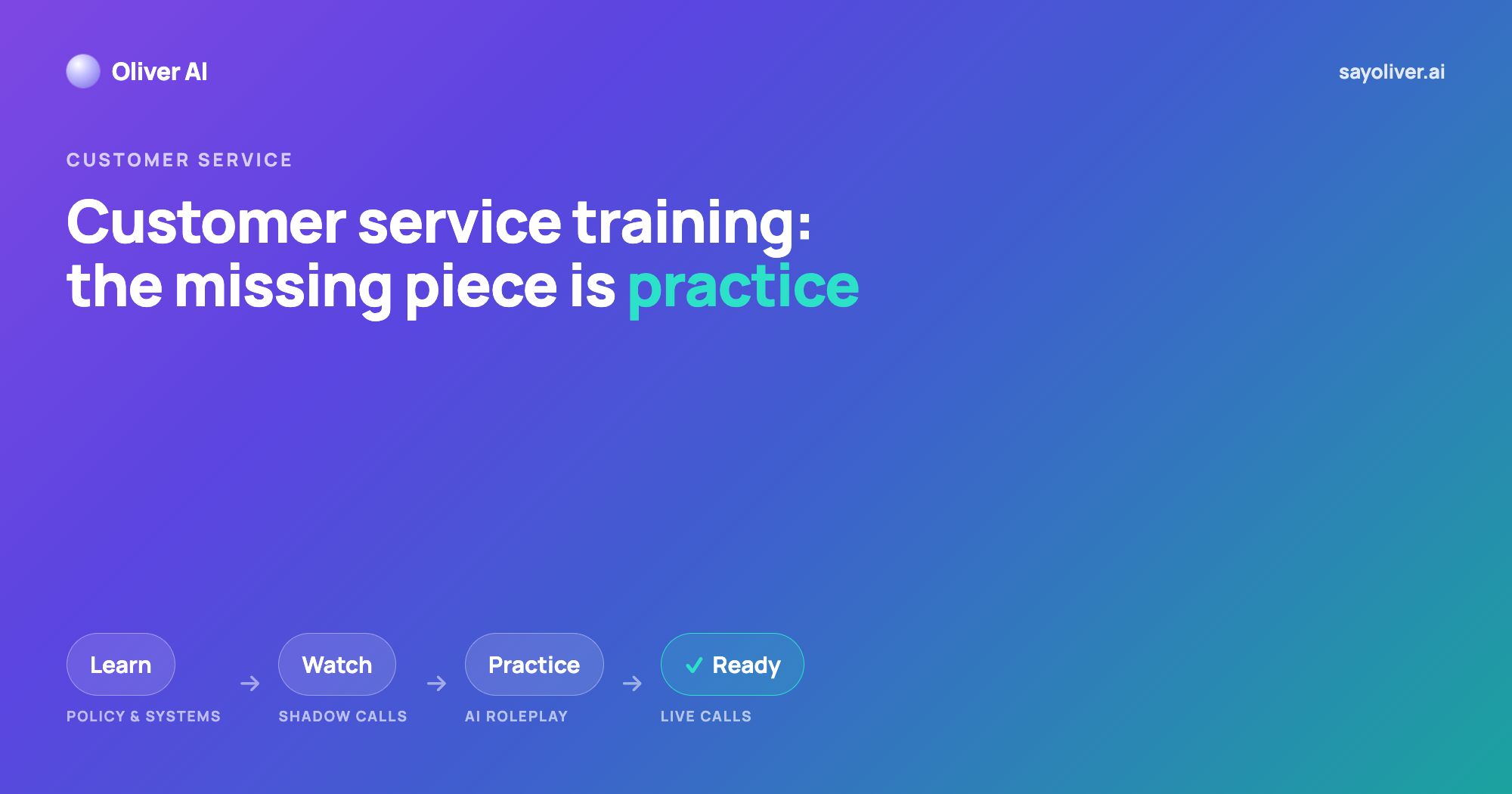
The sequencing matters as much as the content. Knowledge should come first, since there is nothing to practise applying without it. But knowledge should never be the last step before live calls — there needs to be a practice stage in between, or the first time an agent handles a hard conversation is with a real customer on the line. For the specific structure of that first two weeks, see how to onboard new customer service agents.
Practise a customer service training scenario, free, with no account or card needed.
Practise a customer service training scenarioChoosing customer service training software
Most teams eventually look for software to make training scalable and measurable rather than running everything manually. What to look for depends on where the gap actually is: if it is knowledge delivery and tracking, an LMS-style tool with courses, quizzes, and completion reporting covers it. If it is coaching visibility, conversation intelligence software that reviews real call recordings helps managers spot patterns, but only after the call already happened. If it is practice — the layer most programs are missing — look for software built specifically for rehearsal: realistic scenarios, instant feedback, and the ability to run the same conversation repeatedly before it happens live.
Most teams need more than one of these. See the full comparison of customer service training software for how the leading tools stack up, or how AI coaching software fits alongside them.
Frequently asked questions
What are the 5 C's of customer service?
The 5 C's are commonly cited as compensation, culture, communication, compassion, and care — the conditions that let a support team deliver consistently good service. They describe the environment training needs to build, not the training itself; a team can understand all five and still handle a live call badly without practice.
What training is needed for customer service?
At minimum: product and systems knowledge, communication and tone, active listening, empathy and de-escalation, and policy or compliance. Most teams cover the knowledge half well through onboarding and eLearning; the interpersonal and de-escalation skills need repeated practice, not just instruction, to actually change behaviour on a call.
What are the 7 skills of good customer service?
Commonly listed as empathy, clear communication, patience, problem-solving, active listening, adaptability, and time management. These are outcomes of good training, not a syllabus — the real training question is how an agent builds each one, and for most of them the honest answer is repetition under realistic pressure.
What is the 10-5-3 rule in customer service?
Originally an in-person retail guideline (acknowledge a customer at 10 feet, smile at 5 feet, greet them at 3 feet), it is sometimes adapted for contact centres as a response-time framework instead. Either way, it describes a service standard, not a training method for reaching it.
What are the 7 principles of customer service?
A common list includes working as a team, listening to customers, building relationships, practising honesty, showing empathy, knowing the product, and making every interaction count. Training should be built around these principles, but stating them is the easy part — the hard part is giving agents enough repetition that the principles hold up in a difficult, live conversation.
What are the 4 types of training methods?
The four most commonly cited are on-the-job training, classroom or instructor-led training, eLearning, and blended learning that combines the above. Practice-based roleplay is not always listed separately, but it is the piece most programs are missing: the difference between an agent who has heard about de-escalation and one who has actually done it, repeatedly, before a real customer tested them.
Customer service training is not short on frameworks, checklists, and "principles of good service" — every guide on the first page of Google has one. What separates a team that talks about empathy and de-escalation from a team that actually delivers it under pressure is repetition: agents who have handled the hard conversation enough times in practice that the real one feels familiar. Build the knowledge layer first, then make practice a genuine stage in the program, not an afterthought.
See it in Oliver
Ready when you are
Practise before the next real conversation.
No sign-up required. Pick the scenario, add your name, and speak with a realistic AI partner. Get a scorecard and transcript after every call.