Discovery Call Questions That Actually Work
By Dave Wilson · 5 min read · 29 May 2026
The right discovery call questions do not just gather information. They change how a prospect thinks about their problem. A great question surfaces something the buyer had not articulated before, and that moment of recognition is what creates urgency.
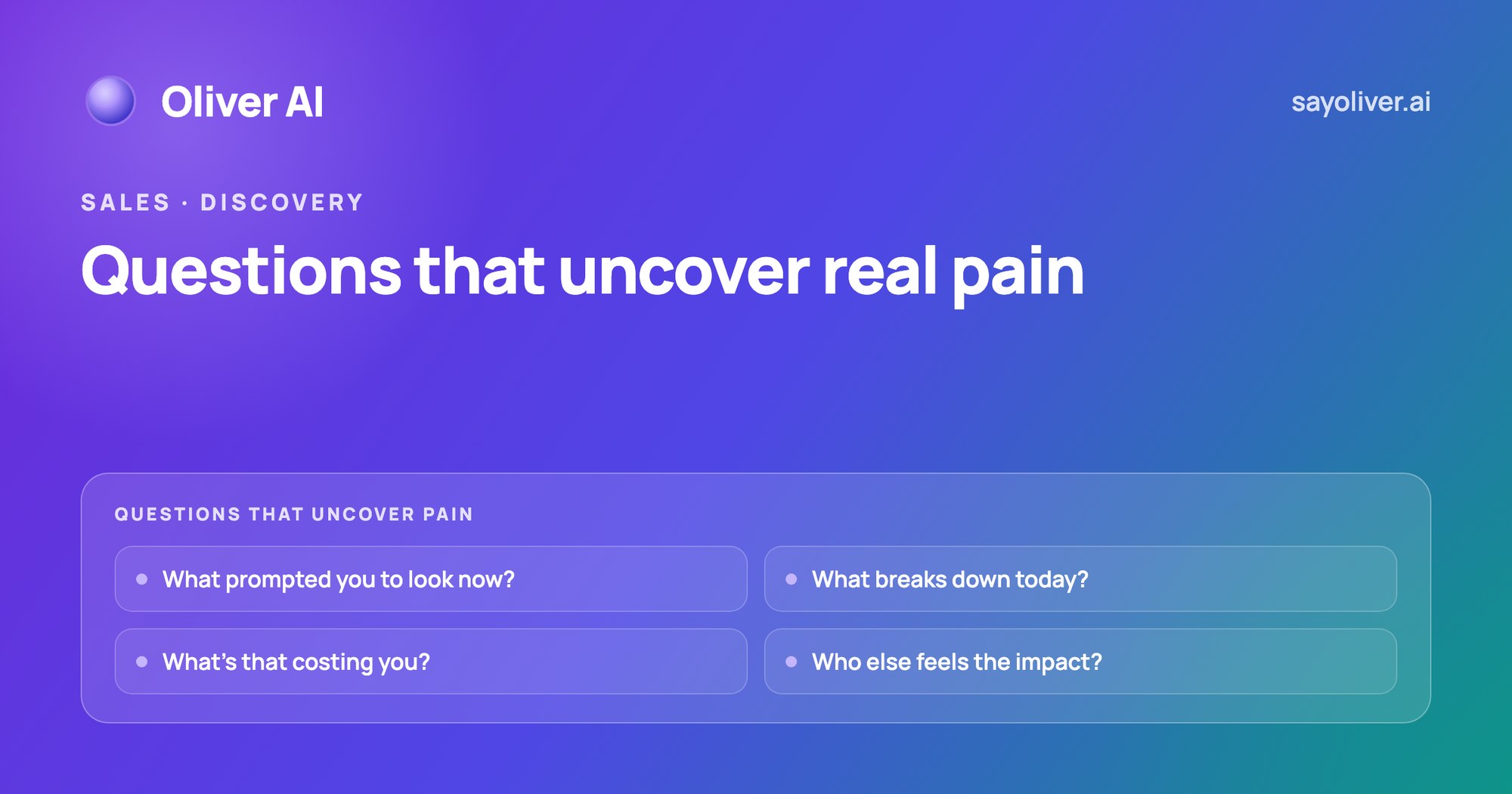
What makes a great discovery question
Great discovery questions are open, specific, and focused on the prospect rather than the product. They invite reflection rather than a yes or no. And they build on each other: each answer opens the door to the next question. If you are new to the format, start with how to run a discovery call end to end.
The questions that do the most damage are the ones that telegraph the answer: "Would it be helpful if you could save time on reporting?" Nobody says no. You learn nothing.
Problem questions
Problem questions surface what is not working in the prospect's current situation. Use these after you have established enough context about how they operate today.
- "What's the biggest frustration with how you handle [process] right now?"
- "Where do things most often go wrong?"
- "What does the team complain about most?"
- "What's taking longer than it should?"
- "If you could change one thing about [current approach], what would it be?"
Practise your discovery questions, try it now, no sign-up needed.
Practise your discovery questionsImpact questions
Impact questions connect the problem to the business. They are the most important questions in discovery and the most commonly skipped. Without them, you cannot quantify value, and neither can the buyer.
- "What does that cost you, in time, revenue, or relationships?"
- "When this goes wrong, who feels it most?"
- "How often does this happen?"
- "What have you tried before, and why didn't it stick?"
- "If you solved this, what would that unlock for the business?"
Questions to avoid
Some questions are worse than silence.
- Leading questions: "Don't you think it would be better if...?"
- Feature-forward questions: "Would you find it useful if our platform could...?"
- Double-barrelled questions: "What's the problem and who owns it and what's the budget?"
- Questions you could have answered with basic research.
Practise your discovery questions, try it now, no sign-up needed.
Practise your discovery questionsHow to sequence them
Start with situation questions to establish context (their role, their team, how they work today). Move to problem questions once you know enough to ask sensibly. Then shift to impact: what does it cost, who cares, what does good look like.
The sequence matters because it mirrors how the prospect thinks. They are unlikely to tell you the impact of a problem before they have even named it. Follow their logic, not your script. The same instinct underpins the broader discovery call best practices that strong reps internalise.
Discovery call questions are a craft, not a checklist. The reps who ask the best questions have usually asked a lot of bad ones first, and had the chance to see what worked. Practising the conversation before it is live is the fastest way to get there, which is what our AI roleplay for sales gives you.
Ready when you are
Practise before the next real conversation.
No sign-up required. Pick the scenario, add your name, and speak with a realistic AI partner. Get a scorecard and transcript after every call.