How to Handle the "We Have No Budget" Objection
By Dave Wilson · 6 min read · 11 June 2026
Of every objection a rep hears, "we have no budget" is the one most likely to end a deal prematurely — not because it is unbeatable, but because reps take it literally and walk away. In reality it is one of the least literal things a buyer says. It can mean a dozen different things, and your job is to find out which one before you accept it as a no.
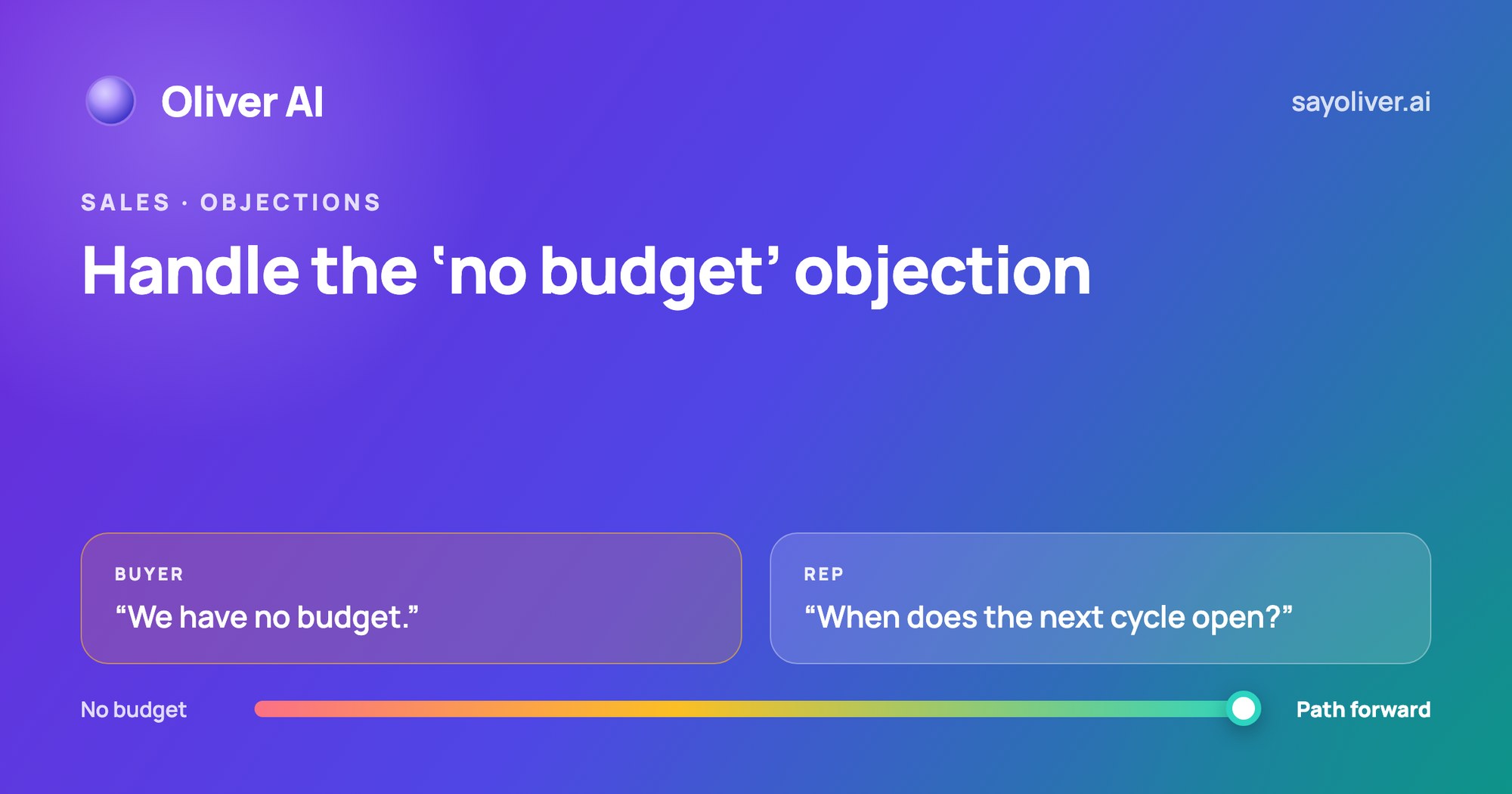
What "no budget" actually means
Buyers reach for "no budget" because it is socially frictionless. It sounds final, it does not require them to critique your product, and it ends the pressure. That is exactly why you should not take it at face value.
Underneath, it is usually one of a few very different situations: there is genuinely no money this year; there is money but it is allocated elsewhere; the buyer has no authority to move budget; or — most commonly — they are not yet convinced the outcome is worth funding. Each of those needs a completely different response, so the first move is always to diagnose, not to discount — the same diagnostic instinct that underpins handling sales objections generally.
The mistake reps make
The reflex is either to immediately offer a discount, or to thank them and close the file. Both are premature. Discounting in response to "no budget" trains the buyer to believe your price is soft and does nothing if the real issue is value or authority. Walking away abandons deals that were one good question from progressing.
The deeper mistake is treating budget as a fixed constraint rather than a decision. Budgets get reallocated all the time when the cost of inaction becomes clear. Your discovery call should have surfaced that cost; if it did not, "no budget" is the signal you skipped it.
Practise the budget objection, try it now, no sign-up needed.
Practise the budget objectionA framework for the budget objection
Slow down and separate "no money" from "not a priority". These steps do that without applying pressure.
- Acknowledge, then open: "That makes sense — most teams we work with did not have a line item for this at first. Can I ask how budget decisions like this usually get made here?"
- Diagnose the type: is it timing (next fiscal year), allocation (money exists elsewhere), authority (not their call), or value (not yet convinced)?
- Quantify the cost of inaction: reconnect to the pain and its price from discovery — "Earlier you said this was costing roughly X a month. What happens if it stays unsolved through next quarter?"
- Find the real path: "If we agreed this was worth solving, who would need to be involved to free up budget, and what would they need to see?"
Phrases that keep the deal alive
The aim is to stay collaborative — you are helping them build the internal case, not pushing past a no.
- "I am not asking you to find money today. I am trying to understand whether this is worth building a case for."
- "If budget were not the constraint, is this something you would want to move forward with?" — this isolates whether budget is the real objection or a polite proxy.
- "What would need to be true for this to earn a slot in next quarter's budget?"
- "Who else feels this problem? Sometimes the budget lives in a different team than the one experiencing the pain."
Practise the budget objection, try it now, no sign-up needed.
Practise the budget objectionPractise it before the deal is on the line
The budget objection is high-pressure precisely because it sounds terminal. Reps who handle it well have heard it many times in low-stakes practice, so the diagnostic questions come out naturally instead of as a panicked discount.
AI roleplay for sales lets you face a buyer who says "we have no budget" and pushes back on every follow-up, so you can rehearse the diagnosis until it is instinct — then get coached on whether you isolated the real constraint.
"We have no budget" is not a wall, it is a door with the label scratched off. The reps who get through it are not the ones with the biggest discount — they are the ones who ask one more question to find out what is really behind it. That skill is built by repetition, not by reading a script once.
Ready when you are
Practise before the next real conversation.
No sign-up required. Pick the scenario, add your name, and speak with a realistic AI partner. Get a scorecard and transcript after every call.