Sales Pitch Examples: 9 Formats That Actually Land
By Dave Wilson · 7 min read · Updated 13 August 2026
A good sales pitch example teaches you a structure you can adapt, not a script you can recite word for word. Below are nine formats that consistently work, each with a script you can steal and the reasoning behind why it lands. The reason most reps read examples like these and still stumble in a live call has nothing to do with the words. It is the gap between reading a pitch on a page and delivering one while a real buyer interrupts, pushes back, or goes quiet halfway through.
What actually makes a sales pitch example worth copying
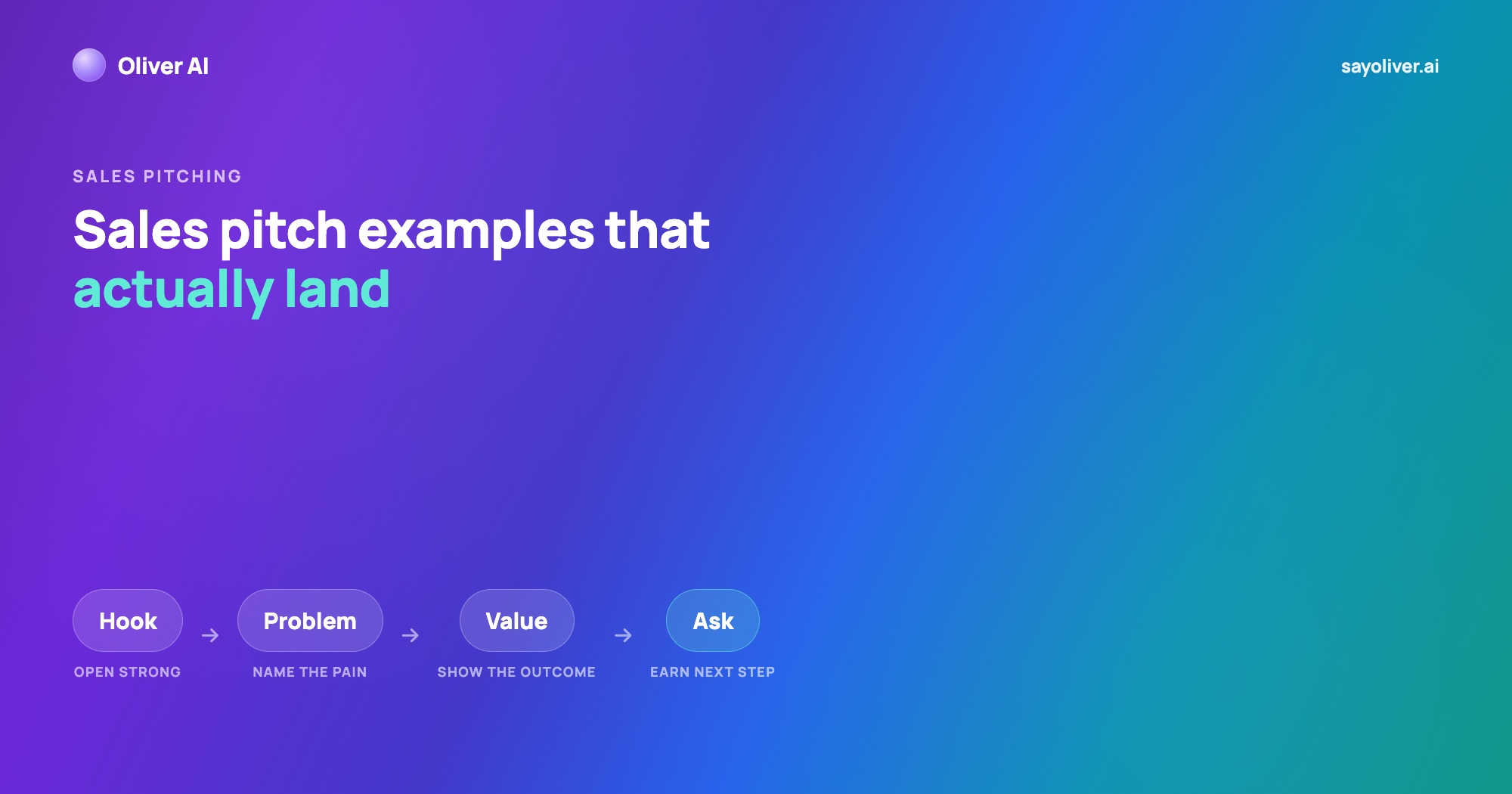
The internet has thousands of sales pitch examples, and most of them are interchangeable: a hook, a value statement, a call to action, dressed up in whatever font that week's blog post uses. What is worth copying is never the exact sentence. It is the underlying structure, the order in which a pitch surfaces the problem, states the value, and earns the next step.
Use the nine formats below as templates. Pick the one that matches the situation you are actually in, a cold call, a warm follow-up, a booth conversation at a conference, then swap in your own product, your own numbers, and the prospect's own words for the problem.
| Format | Use it when |
|---|---|
| Elevator pitch | A hallway conversation or cold intro, thirty seconds or less |
| Problem-solution pitch | The prospect knows they have a problem but has not framed it clearly |
| Before-after-bridge | The contrast between current and possible state is dramatic |
| One-line pitch | A subject line or the first sentence of a cold email |
| Question-based pitch | You want the prospect talking before you mention the product |
| Storytelling pitch | You have a specific customer result and time to tell it properly |
| Social-proof pitch | The prospect is skeptical of a newer or less familiar vendor |
| Comparison pitch | The prospect already has a status quo or competitor in place |
| Follow-up pitch | Re-engaging a prospect who has gone quiet since the first conversation |
9 sales pitch examples, and when to use each one
Every pitch below is built for a different moment in the sales process. Match the format to the situation, not the other way around.
The elevator pitch
Used when: a hallway conversation, a conference, a cold intro, thirty seconds or less. Script: "We help [audience] do [outcome] without [pain]. Most teams see [specific result] within [timeframe]." It works because it forces you to compress the value down to one sentence a stranger can repeat to someone else later.
The problem-solution pitch
Used when: the prospect already knows they have a problem, they just have not framed it clearly. Script: "Most [role] we talk to are dealing with [specific problem]. That usually means [consequence]. What we built fixes that by [mechanism], so [outcome]." It works because naming the problem more precisely than the prospect has builds instant credibility.
The before-after-bridge pitch
Used when: the contrast between the current state and the possible state is dramatic. Script: "Right now, [current painful state]. Imagine instead [desired state]. The bridge between those two is [your product/mechanism]." It works because it makes the prospect picture the outcome before you have asked them to buy anything.
The one-line pitch
Used when: you have one sentence and no more, a subject line, an intro at an event, the first line of a cold email. Script: "[Product] helps [audience] [achieve outcome] in [timeframe]." It works because brevity signals confidence. A pitch that needs three sentences to say what you do usually means you have not decided what you do.
The question-based pitch
Used when: you want the prospect talking before you have said anything about your product. Script: "How are you currently handling [process]?" followed by, once they answer, "Most teams doing it that way run into [specific issue], is that something you've seen?" It works because a prospect who states the problem in their own words is more convinced by it than one who heard you state it.
The storytelling pitch
Used when: you have a specific customer result and enough time to tell it properly. Script: "[Customer type] came to us dealing with [problem]. Within [timeframe] of [action], they saw [specific result]. What changed was [mechanism]." It works because a concrete story is easier to trust and remember than a claim about your product in the abstract.
The social-proof pitch
Used when: the prospect is skeptical of a newer or less familiar vendor. Script: "[Number] teams like yours use [product] to [outcome]. [Named customer, if you can use it] saw [specific result] in [timeframe]." It works because it transfers the risk of being wrong from the prospect onto a group of people like them who already made the same call.
The comparison pitch
Used when: the prospect already has a status quo or a competitor in place. Script: "Most teams using [status quo / competitor] tell us the gap is [specific limitation]. Where we're different is [specific mechanism], which is why teams like [type] switch for [specific reason]." It works when it stays specific about the one real gap, rather than a generic list of features the prospect has to verify themselves.
The follow-up pitch
Used when: re-engaging a prospect who has gone quiet since your first conversation. Script: "Following up on [specific thing they said mattered]. Since we spoke, [new, relevant reason to revisit], wanted to check whether [problem] is still a priority." It works because it references something specific from the last conversation instead of a generic check-in that reads as a template.
Practise delivering your pitch, free, with no account or card needed.
Practise delivering your pitchWhy a pitch that reads well still falls apart live
A pitch example is a monologue. A live sales conversation is not. The moment a real prospect interrupts with "we already use something for that" or goes quiet for four seconds after your one-liner, the script in your head does not know what to do next, because it was written assuming no one would talk back.
This is the part most sales pitch roundups skip entirely. They give you the words and stop, as if memorising the elevator pitch is the hard part. The hard part is delivering it with the same confidence on the fortieth cold call as the first, and adjusting mid-sentence when the buyer's reaction is not the one you rehearsed for. Getting sales objections right the moment they interrupt your pitch matters more than the pitch itself.
How to adapt any pitch example to your product
Turning a generic template into something that actually fits your product takes four steps.
- Name the specific outcome, not the category. "Save time on scheduling" is a category. "Cut rota planning from four hours to twenty minutes a week" is an outcome someone can picture.
- Borrow the buyer's own language. Swap your internal feature names for the words the prospect used to describe their problem on the call before this one.
- Cut every sentence that describes what the product does instead of what changes for the buyer.
- Read it out loud, not silently. Pitches that look tight on a slide often reveal a clunky sentence the moment you have to say it in one breath.
Practise delivering your pitch, free, with no account or card needed.
Practise delivering your pitchHow to practice a pitch before it is live
Reading nine examples gets you the shape of a good pitch. It does not get you the reps. The gap between "I know what a good pitch sounds like" and "I can deliver it smoothly while someone interrupts me" only closes with repetition against realistic pushback, ideally somewhere getting it wrong costs nothing.
That is what AI roleplay for sales is built for: run the same pitch against a buyer persona that interrupts, asks a hard question, or goes cold, as many times as it takes before a real prospect hears it. Pair it with how to run a discovery call if the pitch lands but the conversation after it does not, or cold calling tips if you are opening cold.
Frequently asked questions
What is a sales pitch?
A sales pitch is a short, structured message, delivered in person, by phone, or in writing, designed to convince a prospect that your product solves a specific problem they have. It differs from a full sales presentation by being compressed to the essentials: the problem, the value, and a clear next step.
What are the 5 steps in a sales pitch?
Most sales pitch frameworks converge on the same five moves: identify the specific problem, present your solution to that problem, back it up with proof (a result, a number, a customer story), handle the objection that surfaces, and close with a clear next step. Skipping the objection-handling step is the most common reason a pitch that sounded convincing does not convert.
What are the 5 P's of a sales pitch?
The version most often cited for building a pitch is Purpose, Problem, Proposal, Proof, and People: why you're talking to this prospect, the problem you're addressing, what you're proposing to do about it, evidence that it works, and who is actually involved in the buying decision.
How do you write a sales pitch for your product?
Start from the buyer's problem, not your product's features. Name the problem in language the buyer would use, state the specific outcome your product creates, back it with one concrete proof point, and end with a single clear next step. Then cut it down until every sentence earns its place.
What's the difference between an elevator pitch and a full sales pitch?
An elevator pitch is a single, compressed sentence built for a stranger with no context and thirty seconds, meant to earn a follow-up conversation. A full sales pitch has room to name the problem in detail, walk through proof, and handle the first objection, and is used once you already have the prospect's attention for a real conversation.
Every sales pitch example on this page will work, right up until a real prospect responds in a way you did not rehearse for. The words are the easy part; anyone can read nine formats and pick the closest fit. What separates a pitch that lands from one that gets recited is whether you have already said it out loud enough times, against enough pushback, that adjusting mid-sentence feels natural instead of rattling.
See it in Oliver
Ready when you are
Practise before the next real conversation.
No sign-up required. Pick the scenario, add your name, and speak with a realistic AI partner. Get a scorecard and transcript after every call.