How to Qualify a Lead: BANT, MEDDIC, and What Actually Works
By Dave Wilson · 7 min read · 11 June 2026
Qualifying a lead is deciding, as early and honestly as possible, whether a deal is real. Get it right and you spend your time on opportunities that close; get it wrong and your pipeline fills with deals that feel busy but never convert. Frameworks like BANT and MEDDIC exist to make that judgement repeatable — but only if you understand what they actually measure and stop treating them as checklists.
What qualification is really for
Qualification is not about disqualifying people to be efficient. It is about matching your effort to the deals most likely to close, and giving every prospect an honest read on whether you can help them. A good qualification conversation is useful to the buyer too — it forces clarity about their own problem, priority, and process. In practice it lives inside the discovery call, not in a separate stage.
The trap is treating it as an interrogation. Buyers can feel a checklist being run on them, and it kills trust. The frameworks are scaffolding for your thinking, not a script to read aloud.
BANT: the simple baseline
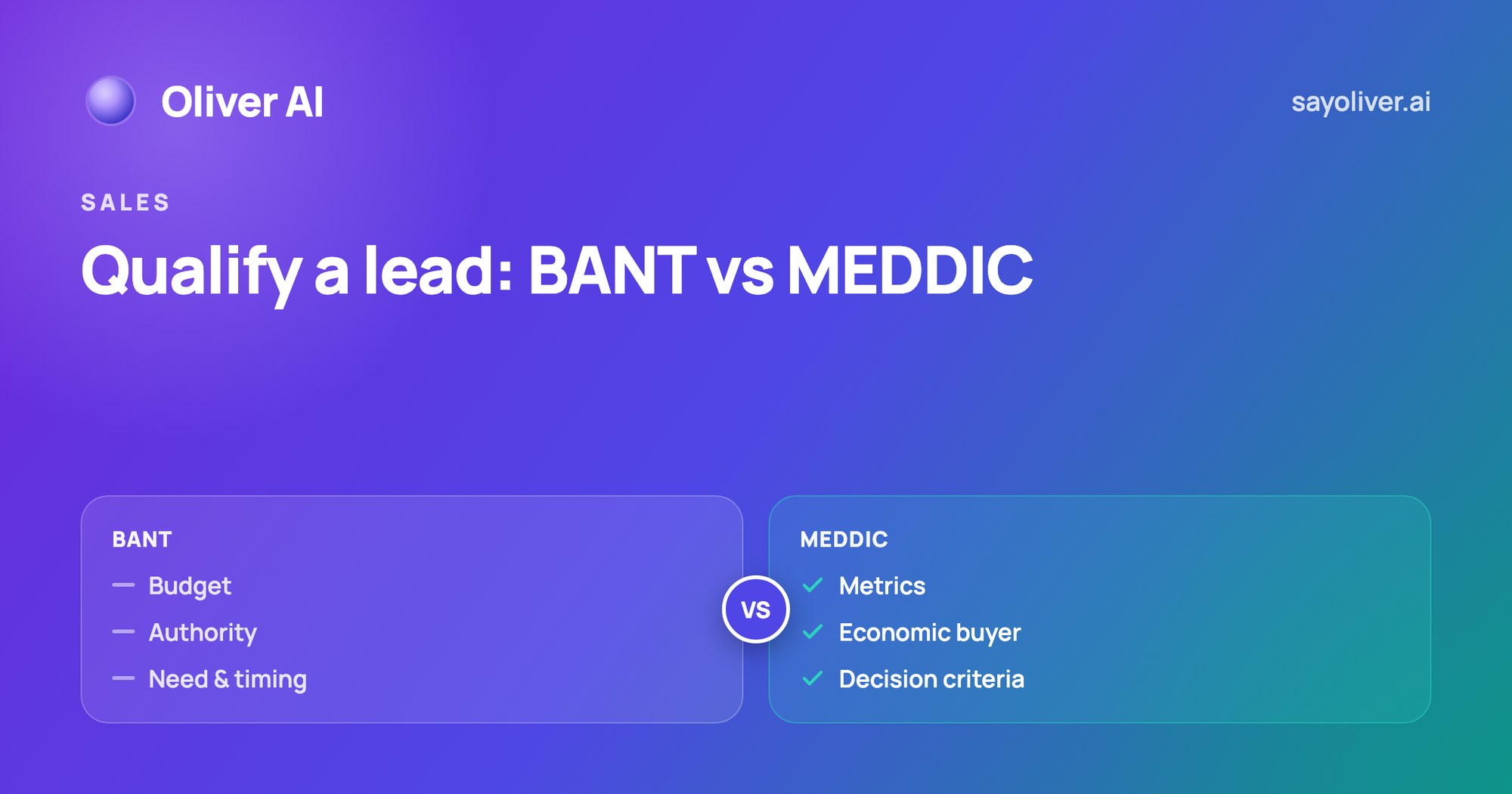
BANT — Budget, Authority, Need, Timing — is the oldest and simplest qualification framework. It asks four things: can they pay, can the person you are talking to decide, do they have a real need, and is there a timeline to act.
BANT works well for transactional and mid-market deals where the buying process is short and the decision sits with one or two people. Its weakness is that it is seller-centric and binary — it tells you whether a box is ticked, not how strong the opportunity is or what could derail it.
- Budget: "How do purchases like this usually get funded for you?"
- Authority: "Besides yourself, who would be involved in a decision like this?"
- Need: "What prompted you to look into this now?"
- Timing: "Is there a date or event driving when this needs to be solved?"
Practise qualifying a lead, try it now, no sign-up needed.
Practise qualifying a leadMEDDIC: for complex, high-value deals
MEDDIC — Metrics, Economic buyer, Decision criteria, Decision process, Identify pain, Champion — is built for enterprise deals with long cycles and many stakeholders. It goes deeper than BANT on how the decision gets made and who drives it internally.
The two pieces reps most often skip are the economic buyer (the person who can actually release funds, who is rarely your first contact) and the champion (an internal advocate who sells on your behalf when you are not in the room). Deals stall most often because neither was identified.
- Metrics: the quantified outcome the buyer is trying to achieve.
- Economic buyer: who controls the money, and whether you have access to them.
- Decision criteria and process: how they will choose, and the actual steps to a signature.
- Identify pain and Champion: the compelling problem, and the person inside who wants you to win.
BANT vs MEDDIC: which to use
Use BANT when the deal is small-to-mid, the cycle is short, and the buying group is one or two people — it is fast and good enough. Use MEDDIC when the deal is large, the cycle is long, and many stakeholders are involved — its extra depth on the economic buyer and decision process is exactly what prevents late-stage surprises.
In practice, strong reps blend them: BANT-level questions to triage early, MEDDIC-level depth once a deal looks real. The framework is a lens, not a religion.
Practise qualifying a lead, try it now, no sign-up needed.
Practise qualifying a leadWhere qualification actually breaks down
The failure is almost never not knowing the framework. It is asking qualification questions so mechanically that the buyer disengages, or accepting vague answers ("yeah, we have budget") instead of pushing one level deeper. The right discovery call questions do the qualifying without sounding like a checklist. Qualification lives or dies on the follow-up question.
That is a conversational skill, and conversational skills are built by practice. Rehearsing qualification calls with AI roleplay for sales — where the prospect gives evasive or surface answers and you have to dig without sounding like an interrogator — is the fastest way to get good at it before it costs you a real deal.
BANT and MEDDIC are not competing religions; they are different-resolution lenses on the same question: is this deal real, and what would make it close? Pick the lens that fits the deal, ask one more question than feels comfortable, and treat qualification as a conversation you practise — not a form you fill in.
Ready when you are
Practise before the next real conversation.
No sign-up required. Pick the scenario, add your name, and speak with a realistic AI partner. Get a scorecard and transcript after every call.