What Is Conversation Intelligence? (And Where Practice Fits In)
By Dave Wilson · 7 min read · 17 June 2026
Conversation intelligence is software that records, transcribes, and analyses the conversations your team has with customers — sales calls, support tickets, demos, renewals — and turns them into searchable data and coaching signals. Instead of relying on what a rep remembers, you get the actual words, the talk-to-listen ratio, the topics discussed, and the moments that mattered. It has quietly become one of the most-adopted categories in revenue technology, and it is often confused with practice tools like Oliver, which solve a related but different problem.
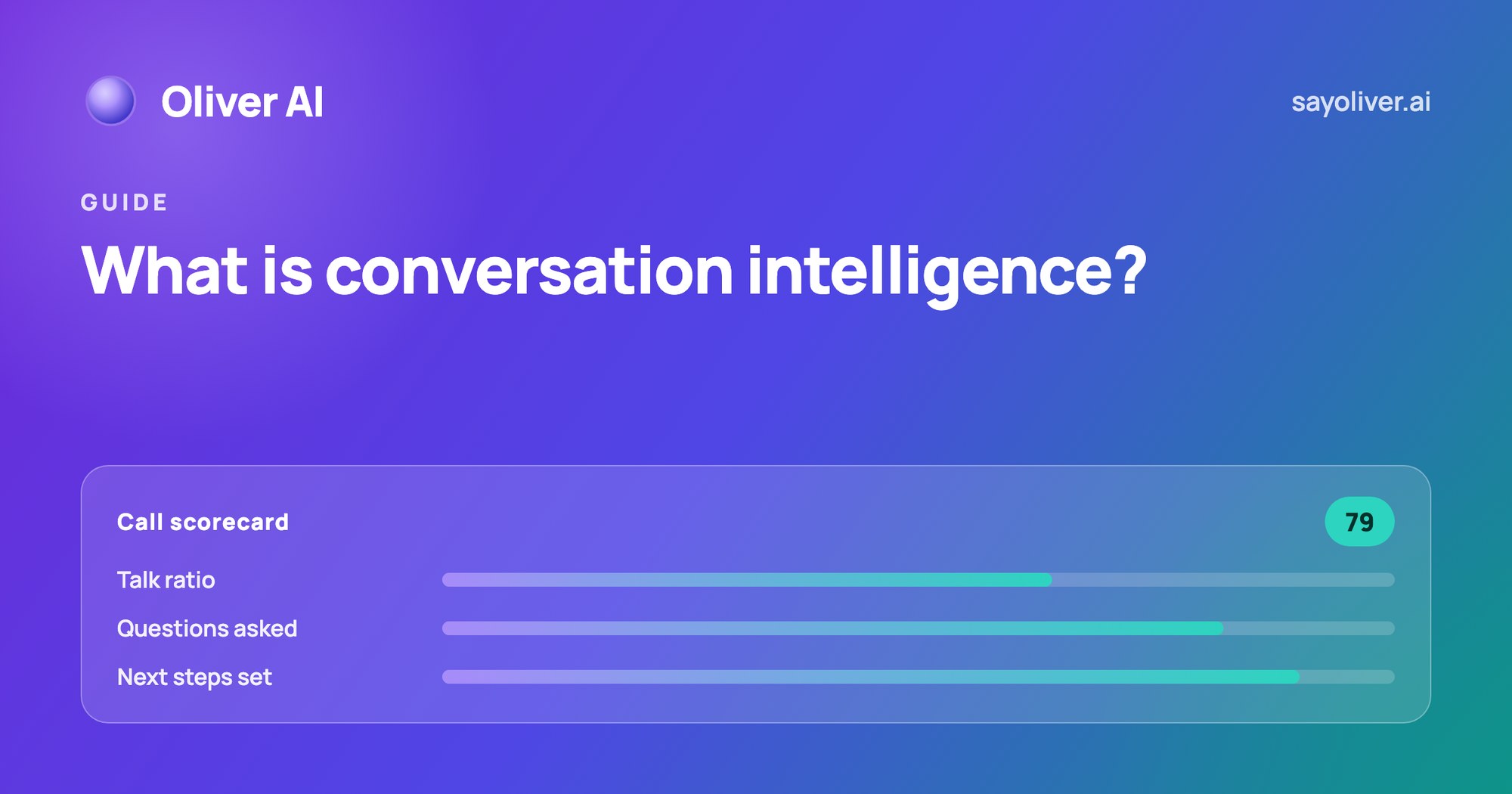
What conversation intelligence actually is
At its core, conversation intelligence (sometimes called revenue intelligence or call intelligence) is a layer that sits on top of your real customer conversations. It captures the audio or transcript of a live call, processes it with speech-to-text and language models, and extracts structured insight: who spoke, for how long, what topics came up, which competitors were mentioned, and where the conversation succeeded or stalled.
The category was popularised by tools like Gong, Chorus (now part of ZoomInfo), and Salesloft. Their promise is simple: most of what happens in a sales or service organisation happens in conversations, and until recently almost none of it was captured as data. Conversation intelligence makes those conversations visible, searchable, and analysable at scale.
How conversation intelligence works
The mechanics are consistent across most platforms, even if the polish varies. The software connects to your calling and meeting tools, captures the conversation, and runs it through a pipeline that produces insight you can act on.
- Capture: the tool records calls and meetings via integrations with your dialer, video conferencing, or telephony system.
- Transcription: speech is converted to text, with speaker separation so you know who said what.
- Analysis: language models tag topics, detect questions, measure talk-to-listen ratio, flag competitor mentions, and identify risk signals like a long silence or a pricing objection.
- Surfacing: insights roll up into dashboards, deal-risk scores, and call libraries that managers and reps can search and review.
- Coaching: managers use flagged moments to give feedback tied to the exact line in the transcript, rather than a second-hand summary.
Practise before your next real call, try it now, no sign-up needed.
Practise before your next real callWhat teams use it for
The value of conversation intelligence shows up in three places. For reps, it removes the burden of note-taking and gives them a record they can revisit. For managers, it makes coaching evidence-based: you can point to the exact moment a rep rushed past a buying signal instead of relying on memory. For leaders, it surfaces patterns across hundreds of calls — which objections recur, which messaging lands, which deals are quietly slipping.
In customer service and contact-centre settings, the same technology is used for quality assurance: scoring interactions against a rubric, catching compliance issues, and spotting the agents who need support before a small problem becomes a churned customer — a natural companion to the kind of customer service training software that builds the skill in the first place.
What to look for when choosing a tool
Conversation intelligence platforms differ more than their marketing suggests. A few criteria separate the genuinely useful from the merely impressive.
- Transcription accuracy, especially for accents, technical vocabulary, and multi-speaker calls — poor transcription poisons everything downstream.
- Integration depth with your CRM, dialer, and meeting tools, so insight flows to where reps already work.
- Coaching workflow: can a manager easily clip a moment, comment on it, and assign it, or is the insight stranded in a dashboard nobody opens?
- Privacy and consent handling, including call-recording disclosure that meets the rules in every region you operate in.
- Signal-to-noise: the best tools surface the few moments that matter, rather than burying managers in metrics they will never action.
Practise before your next real call, try it now, no sign-up needed.
Practise before your next real callThe gap conversation intelligence leaves
Here is the limitation that matters most. Conversation intelligence analyses conversations after they happen. It is, by design, a rear-view mirror. It can tell a rep that they fumbled an objection on Tuesday — but the deal where they fumbled it is already affected, and the rep cannot rehearse the better response without making another live call and risking another real opportunity.
That is the gap. Conversation intelligence is excellent at telling you what to improve, and it sits alongside the wider sales enablement software stack. But it does nothing to give reps a safe place to actually practise the improvement before the next real conversation. The feedback loop is real, but it is slow and expensive: every repetition costs a live deal.
Where practice fits in
This is the layer Oliver occupies, and it is deliberately a different category from conversation intelligence. Oliver is a voice-first AI practice platform: reps speak with a realistic AI buyer or customer, handle the objection or the angry caller or the discovery call, and get a transcript and scorecard afterwards. The conversation is simulated, so reps can fail, retry, and build the muscle memory before any real money is on the line.
The two categories are complementary, not competitive. Conversation intelligence tells you, from real calls, that your team consistently struggles with budget objections or rushes discovery. Oliver is where reps then go to drill that exact weakness — as many times as they need — before the next live call. Insight from real conversations, practice before real conversations. Many teams run both: one to diagnose patterns in live deals, the other to close the skill gaps those patterns reveal.
If you are evaluating where to invest first, a useful rule of thumb: if your reps already know what they should be doing but freeze under pressure, you have a practice problem, not a visibility problem. Tools like Oliver, and the broader category of AI roleplay for sales, are built for exactly that. You can see how the practice loop works, or run a scenario yourself from the try-demo page without creating an account.
Practise before your next real call, try it now, no sign-up needed.
Practise before your next real callConversation intelligence turned customer conversations into data, and that was a genuine step forward — managers coach from evidence now instead of memory. But analysing real calls is only half the loop. The other half is practice: giving reps a safe place to rehearse the harder conversations before they happen. Conversation intelligence shows you the gap. A practice layer is how you close it. Used together, they make every real conversation count for more.
See it in Oliver
Ready when you are
Practise before the next real conversation.
No sign-up required. Pick the scenario, add your name, and speak with a realistic AI partner. Get a scorecard and transcript after every call.