Case Management Skills Training: How to Prepare for High-Stakes Decisions
By Dave Wilson · 6 min read · 3 June 2026
Case management skills training is not like most professional development. The conversations case managers need to handle — disclosing difficult decisions to clients, navigating emotionally volatile interactions, managing situations where there is no clean right answer — do not improve through reading frameworks or watching someone else handle them. They improve through practice. The challenge is that practice has always meant live cases, which means learning at the client's expense.
What makes case management conversations different
Most professional conversations have a defined success state. A sales call closes or it does not. A customer service call resolves or it escalates — and even there, de-escalating an angry customer has a recognisable end point. Case management conversations often have no clean endpoint: a worker may need to hold a client's distress without resolving it, deliver a decision the client will reject, or navigate a situation where any path forward involves harm.
This ambiguity is what makes case management training hard. Generic communication frameworks — listen actively, show empathy, summarise back — are necessary but not sufficient. Workers also need the composure to stay present under emotional pressure, the judgement to know when to hold a boundary and when to yield, and the language to explain a difficult decision in a way that does not destroy the working relationship.
Where traditional training falls short
Most case management training programmes invest heavily in the knowledge layer: legislation, policy, risk frameworks, documentation procedures. All of this is necessary. None of it produces the skill to handle a client who is in crisis, or a family member who is challenging a care decision, or a colleague who disagrees with your assessment.
The skills layer — how to have the conversation — is usually addressed through role-play workshops in group training. These are better than nothing but have significant limitations. The colleague playing the distressed client pulls their punches. The group setting creates performance anxiety that does not mirror the reality of a one-to-one case meeting. And the feedback is often general: "that was really good" or "maybe try a bit more empathy" rather than tied to specific moments in the conversation.
Practise a difficult case conversation, try it now, no sign-up needed.
Practise a difficult case conversationThe scenarios that matter most
The highest-value case management practice scenarios are the ones workers avoid in real life: the conversation they have been putting off, the client they find most difficult, the decision they are not confident explaining. These are the conversations where preparation makes the biggest difference.
- Delivering a difficult decision — telling a client they will not receive the support they applied for, or that a previous arrangement is changing. The skill: leading with clarity, not hedging, while maintaining the relationship.
- Managing a client in emotional crisis — holding the conversation without trying to fix the unfixable. The skill: staying present under pressure, regulating your own response while the client is dysregulated.
- Handling a challenge to professional judgement — a family member who disputes an assessment, or a client who argues the process was unfair. The skill: explaining reasoning clearly without becoming defensive.
- Navigating competing priorities — a case where two legitimate needs are in conflict and there is no clean resolution. The skill: transparency about the constraints, not evasion.
What simulation adds to case management training
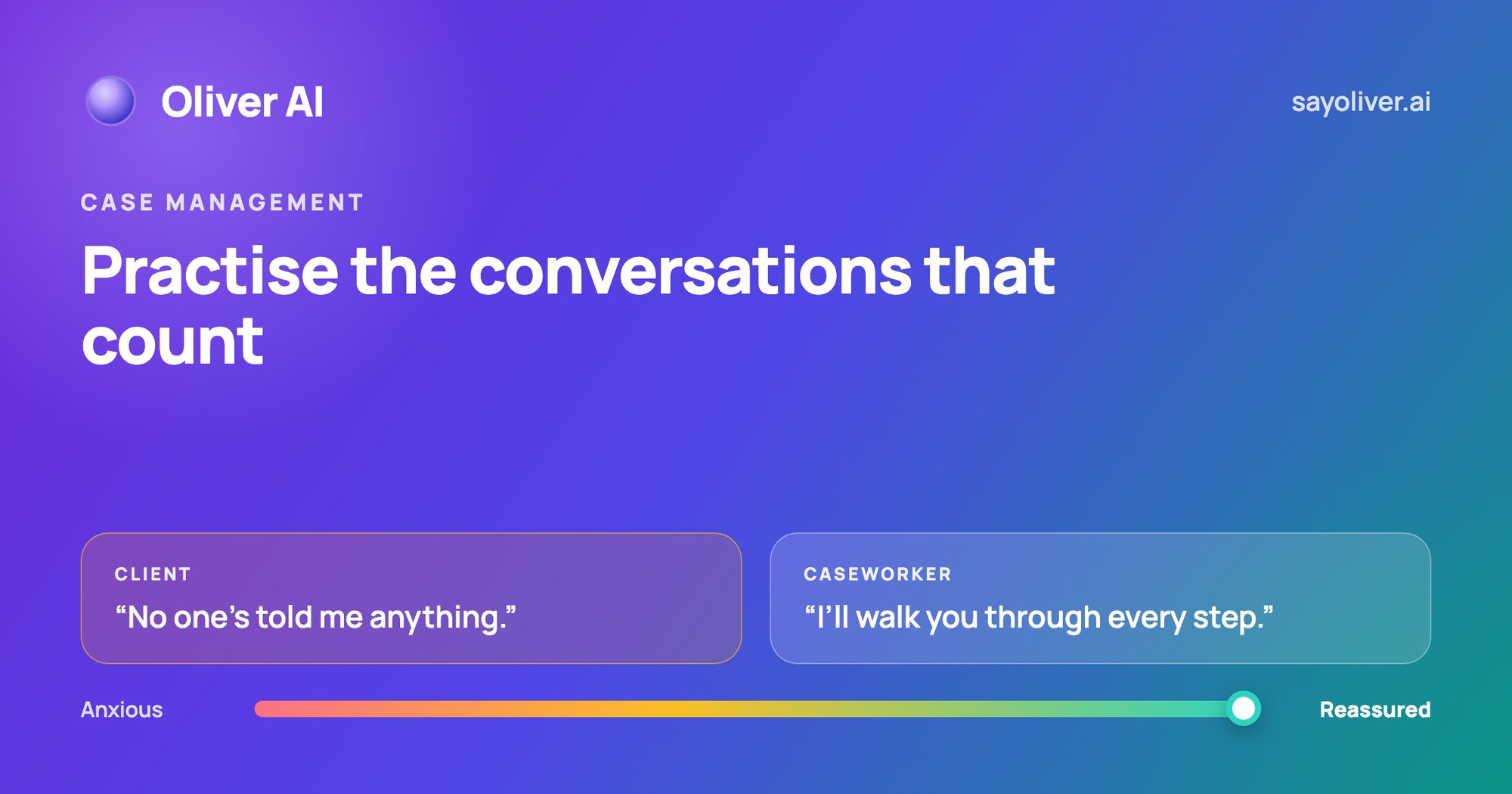
AI-powered simulation — the same approach behind modern customer service training software — lets case workers practise these conversations without a real client being on the other end. The AI plays a realistic client — emotionally present, not scripted, able to respond dynamically to what the worker says. The worker practises holding the conversation. Afterwards, they receive a transcript and feedback: what language de-escalated, what responses inadvertently increased tension, where clarity could have been sharper.
The advantage over group role-play is privacy and repetition. A worker practising alone, without colleagues watching, is more willing to try things that feel risky. They can run the same conversation three times with different approaches, compare the results, and build the confidence to use a different technique in the next live case.
Practise a difficult case conversation, try it now, no sign-up needed.
Practise a difficult case conversationBuilding a practice habit into supervision
The most effective way to use simulation training in case management is as a preparation tool tied to real cases. When a worker is anticipating a difficult conversation — a review meeting with a challenging client, a disclosure they are anxious about — the practice call is the warm-up. They run the scenario, review the transcript, discuss it with their supervisor, and go into the live meeting having already heard the hard questions once.
This model turns supervision from a retrospective review into a prospective preparation. The worker is not reflecting on what went wrong last week. They are building the readiness to handle what is coming next.
Case management skills training is most valuable when it is specific, frequent, and tied to the real conversations workers are actually facing. The practice that makes the biggest difference is not a half-day workshop twice a year — it is ten minutes of focused preparation before the conversation that matters. Building that habit is what separates workers who develop confidence over time from those who simply accumulate difficult experiences.
Ready when you are
Practise before the next real conversation.
No sign-up required. Pick the scenario, add your name, and speak with a realistic AI partner. Get a scorecard and transcript after every call.